

OIL & GAS EQUIPMENT | Updated May 2026 | 7 min read
What You’ll Learn in This Guide
- What a vapor combustor unit (VCU) is and how it differs from an elevated flare
- Why tank battery vent gas is a good fit for enclosed combustor treatment
- Working losses, breathing losses, and flash gas, what VCUs handle
- Sizing a VCU for the tank battery vent gas profile
- OOOOb Quad O certification for enclosed combustor devices
- VCU vs flare vs vapor recovery unit, which one wins on tank battery
- Common tank battery VCU specification mistakes and how to avoid them
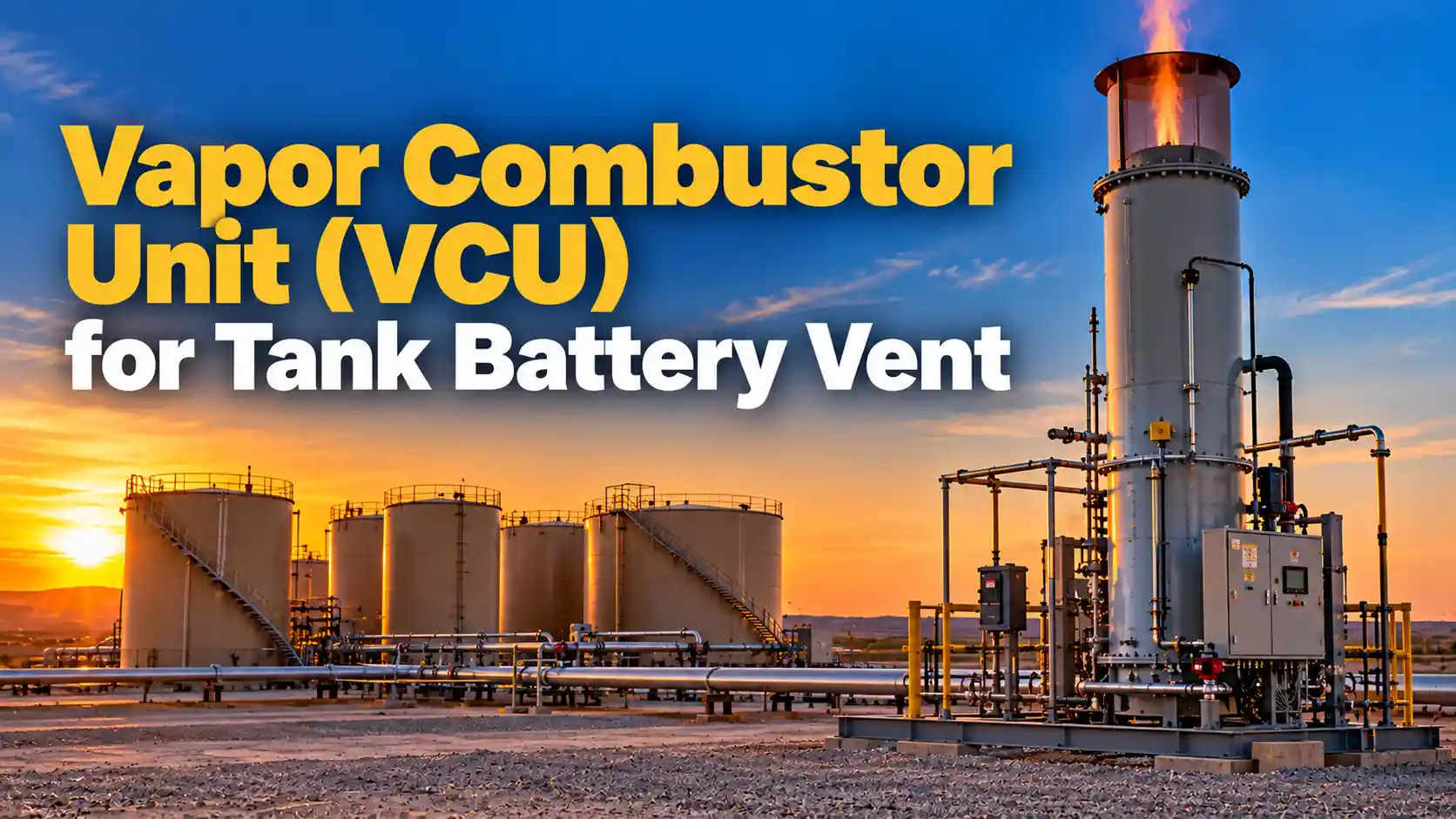
Tank battery vent gas, the working, breathing, and flash losses from oil storage tanks at upstream production facilities, is one of the most common vent streams in oil and gas. Every producing site with storage tanks has vent gas that must be either recovered or destroyed. Vapor combustor units (VCUs), enclosed combustors that destroy vent gas at 98% or higher DRE, are the standard EPA-approved control device for tank battery vent gas when recovery is not economic.
Hero Process Solutions, founded in 2011 and headquartered in Kellyville, Oklahoma with operations in Midland, Texas, manufactures enclosed combustor units and vapor recovery systems for tank battery vent gas control across North American upstream operations.
DIRECT ANSWER: A vapor combustor unit (VCU) is an enclosed combustion device that destroys tank battery vent gas at 98% or higher Destruction and Removal Efficiency (DRE). Unlike elevated flares, VCUs contain the flame within a refractory-lined chamber, giving cleaner combustion, no visible flame, and lower radiation. Tank battery vent gas is a good fit for VCU treatment because the flow rate is relatively steady, the volume is low-to-medium, and the composition is well-defined. EPA OOOOb and OOOO Quad O certification apply to VCUs used as tank battery vent gas controls.
1. What a Vapor Combustor Unit Does
A vapor combustor unit combusts hydrocarbon vent gas within an enclosed refractory-lined chamber. Vent gas enters the combustor through a burner, mixes with combustion air, and burns at controlled temperature and residence time. The combustion products, primarily CO₂ and water vapor, exit through a stack at the top of the combustor.
Unlike an elevated flare, the flame is contained within the combustor chamber. This has several operational advantages: no visible flame from the outside, much lower thermal radiation to surrounding equipment, better control of combustion temperature and residence time, and cleaner combustion with higher DRE.
2. Tank Battery Vent Gas Sources
Tank battery vent gas comes from three sources.
Working losses are the vapor displaced when liquid enters the tank. As oil fills the tank, the vapor space compresses and vents through the tank hatches or pressure-vacuum valve. Working losses are proportional to filling rate.
Breathing losses are the vapor displaced when temperature or barometric pressure changes cause the vapor space to expand. Diurnal temperature cycling and weather-front pressure changes both drive breathing losses.
Flash gas is the vapor released when high-pressure liquid (from a separator or heater-treater) enters the low-pressure tank. Flash gas is typically the largest of the three sources and depends on upstream pressure and gas composition.
Total tank battery vent gas is the sum of all three. For a typical 6-tank battery with moderate production, total vent gas might be 20, 100 MSCFD.
3. Why VCU Fits Tank Battery Service
Tank battery vent gas has three characteristics that make VCU the right technology choice.
Flow rate is steady with some cyclical variation. VCUs handle steady flow well because combustion parameters can be tuned to a target flow. Highly variable flow makes combustion control harder.
Volume is low-to-medium. Tank battery vent gas is typically small enough that an elevated flare would be oversized for the duty. A properly sized VCU fits the flow envelope efficiently.
Composition is well-defined. Tank battery vent gas composition can be estimated from oil composition and operating temperature/pressure. This lets combustion parameters be sized precisely for the expected fuel.
KEY INSIGHT: Where tank battery vent gas volume is high enough to justify recovery (typically 50+ MSCFD), a vapor recovery unit may be more economic than a VCU because the recovered gas has sale value. VCU vs VRU is a rent-vs-buy-style decision based on recovery volume.
4. VCU Sizing
Vapor combustor unit sizing depends on three parameters.
Peak vent gas flow drives burner sizing. Peak flow typically includes flash gas plus maximum working losses during simultaneous tank filling. A 20% safety margin above peak is typical.
Vent gas heat content drives combustion temperature and residence time. High-BTU vent gas (rich in C3+ hydrocarbons) combusts hot with short residence time. Low-BTU vent gas may require pilot fuel or dilution to reach ignition temperature.
Turndown ratio drives ability to handle low-flow periods. A 10:1 turndown ratio is common. Higher turndown allows the VCU to operate at both peak and low flow without adjustment.
5. OOOOb Quad O Certification
EPA 40 CFR 60 Subpart OOOOb and OOOOa (Quad O) require enclosed combustor devices used as tank battery vent controls to meet specific performance standards. Certification requires performance testing at the manufacturer that verifies 98% DRE across the operating envelope, continuous parametric monitoring, and documentation of tested combustion parameters.
Once certified, the VCU can be deployed as a compliance control device without site-specific performance testing beyond initial installation verification. This is a significant procurement advantage for high-volume upstream operators who deploy many VCUs. See our companion resource on EPA OOOOb compliance for the certification framework.
6. VCU vs Flare vs Vapor Recovery Unit
For tank battery vent gas control, three technology options are typically compared.
| Option | Best When | Advantages | Trade-offs |
|---|---|---|---|
| Vapor Combustor Unit (VCU) | Low-medium volume, no visible flame required | 98%+ DRE, no visible flame, low radiation, Quad O certified | Higher CAPEX than flare, no gas recovery value |
| Enclosed / Elevated Flare | Higher volume, remote/rural sites | Lower CAPEX, familiar technology | Visible flame, higher radiation, may require setback |
| Vapor Recovery Unit (VRU) | High volume with pipeline access | Recovers saleable gas, no combustion | Higher OPEX, compressor maintenance, pipeline required |
7. Common Tank Battery VCU Mistakes
| Mistake | Why It Hurts | Fix |
|---|---|---|
| Underestimating flash gas contribution | VCU undersized during peak upstream pressure events | Size for peak flash gas plus working losses combined |
| Skipping Quad O certification | Site-specific performance testing needed post-install | Specify Quad O certified VCU from certified manufacturer |
| Missing turndown ratio spec | Cannot operate at low breathing-loss flow | Specify 10:1 turndown ratio minimum |
| Ignoring vapor recovery economic case | Miss revenue from recoverable gas at high volume | Run VRU-vs-VCU economic comparison at 50+ MSCFD |
| Undersized pilot fuel for low-BTU vent | Combustion fails at low breathing losses | Verify vent gas heat content before pilot fuel sizing |
| Wrong instrumentation for OOOOb monitoring | Compliance gaps in parametric monitoring | Specify OOOOb-compliant thermocouples and flame verification |
Article Summary
- Vapor combustor units (VCUs) combust tank battery vent gas at 98%+ DRE within an enclosed refractory chamber.
- Tank battery vent gas has three sources: working losses, breathing losses, and flash gas.
- VCUs fit tank battery service because vent flow is steady, volume is manageable, and composition is well-defined.
- Sizing depends on peak flow, gas heat content, and required turndown ratio.
- EPA OOOOb Quad O certification allows deployment without site-specific performance testing.
- VCUs vs flares vs VRUs, selection depends on volume, sale-gas availability, and visible-flame constraints.
- Flash gas is typically the largest of the three vent gas sources.
- Hero Process Solutions manufactures Quad O-certified VCUs and full tank battery vent control packages.
Related resources: See our articles on enclosed combustor Quad O, low flow flare vs vapor recovery, flare vs thermal oxidizer, and enclosed vs open flare selection. Explore our combustor systems.
Frequently Asked Questions
What is a vapor combustor unit?
A vapor combustor unit (VCU) is an enclosed combustion device that destroys hydrocarbon vent gas at 98% or higher DRE. Vent gas enters a refractory-lined chamber through a burner, combusts at controlled temperature and residence time, and exits through a stack. Unlike an elevated flare, the flame is contained within the chamber, no visible flame outside, much lower radiation, and cleaner combustion.
How is tank battery vent gas produced?
Three sources. Working losses are vapor displaced during liquid filling. Breathing losses are vapor displaced by temperature or pressure changes in the tank vapor space. Flash gas is vapor released when high-pressure liquid from a separator or heater-treater enters the low-pressure tank. Flash gas is typically the largest of the three.
What is Quad O certification?
Quad O certification is an EPA-approved performance-testing program under 40 CFR 60 Subpart OOOOa/OOOOb. A certified enclosed combustor has been performance-tested at the manufacturer to verify 98% DRE across its operating envelope, allowing deployment as a compliance control device without site-specific performance testing beyond initial installation verification.
VCU or vapor recovery for tank vent gas?
VCU is preferred where vent volume is low-to-medium (<50 MSCFD) or where pipeline access is limited. Vapor recovery unit (VRU) is preferred at higher volumes with pipeline access because the recovered gas has sale value that offsets the higher OPEX and compressor maintenance. Run an economic comparison at your specific volume before choosing.
How is a VCU sized?
Three parameters: peak vent gas flow (drives burner sizing, typically flash gas + working losses combined, plus 20% margin); vent gas heat content (drives combustion temperature and residence time; low-BTU vent may need pilot fuel); required turndown ratio (typically 10:1 to handle breathing-loss low-flow periods).
Can a VCU replace an existing tank battery flare?
Yes. VCUs are commonly deployed as replacements for existing tank battery flares when operators need higher DRE, lower visible-flame impact, or Quad O certification. The retrofit typically includes removing the old flare, installing the VCU on a similar footprint, and updating tie-ins from tank vent piping to the new combustor inlet.