
OIL & GAS EQUIPMENT | Updated May 2026 | 8 min read
What You’ll Learn in This Guide
- The mechanical and thermodynamic difference between a flare and a thermal oxidizer
- Why thermal oxidizers reach higher DRE on dilute streams than flares can
- How to compare CAPEX, OPEX, and footprint between the two technologies
- What VOC stream characteristics determine which technology wins
- How EPA OOOOb and EPA RACT/MACT rules affect thermal oxidizer vs flare selection
- When a regenerative thermal oxidizer (RTO) outperforms both options
- Common selection mistakes operators make when choosing between flare and thermal oxidizer
Choosing between a flare and a thermal oxidizer for VOC destruction is one of the most consequential equipment decisions on any oil and gas, petrochemical, or refining facility that needs to control hydrocarbon emissions. The two technologies overlap on what they accomplish they both burn VOCs to destroy them but they differ on how they do it, what destruction efficiency they reach, what they cost to install and operate, and which regulatory requirements they best satisfy. This guide walks through the selection framework so you can make the call confidently rather than defaulting to whichever technology your last project used.
Hero Process Solutions, founded in 2011 and headquartered in Kellyville, Oklahoma with operations in Midland, Texas, manufactures both industrial flare systems and thermal oxidizers for oil and gas, refining, and petrochemical customers. This guide draws on the selection patterns we see most often in real projects.
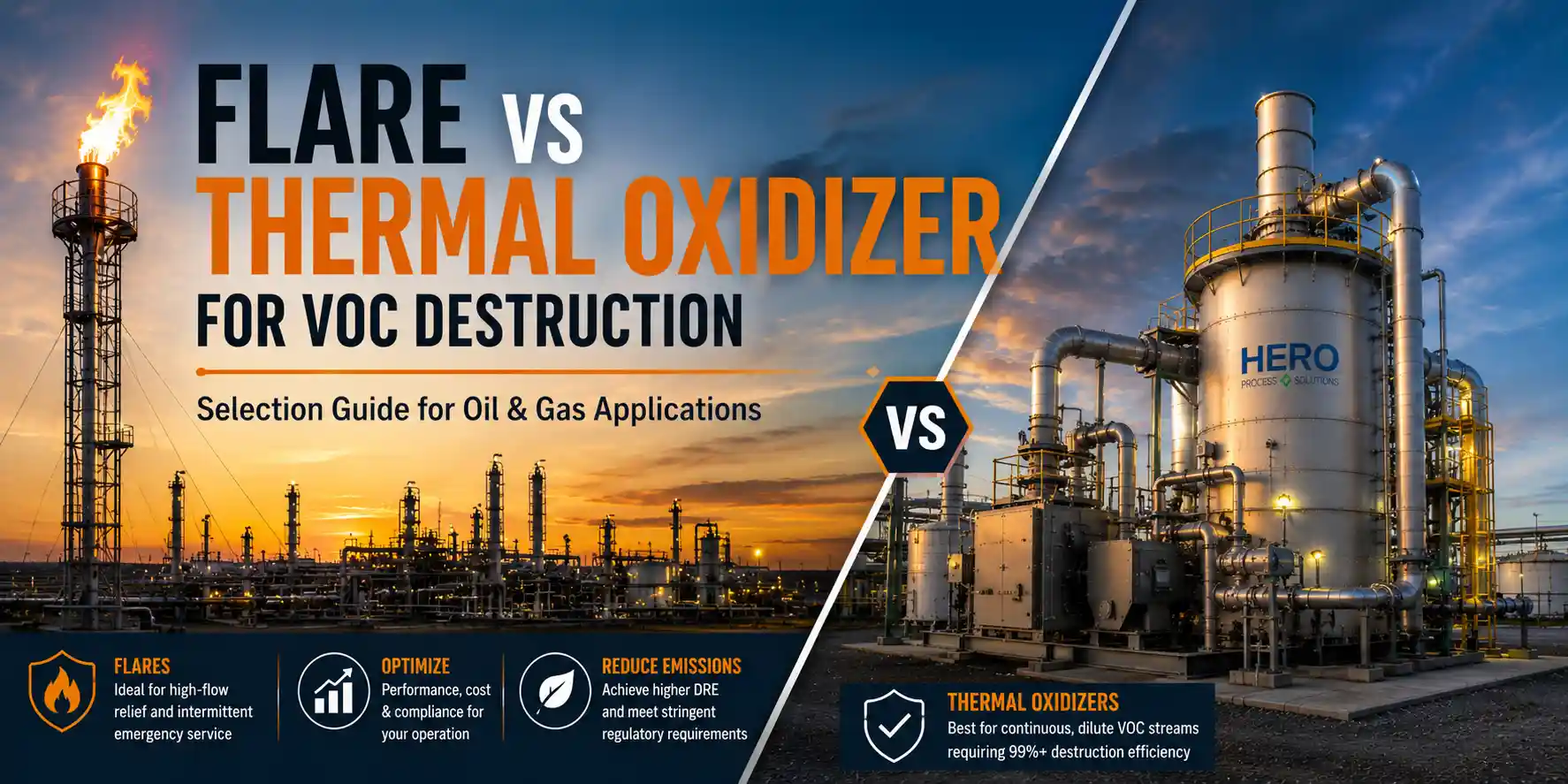
DIRECT ANSWER: Choose a flare for intermittent, high-flow, energy-rich relief streams from oil and gas relief headers and emergency contingencies. Choose a thermal oxidizer for continuous, lower-flow, dilute VOC streams with extended operating hours and tight destruction efficiency requirements above 99%. Flares are open-flame combustion devices typically reaching 98% Destruction and Removal Efficiency under OOOOb on routine streams and 95% on emergency relief. Thermal oxidizers are refractory-lined chambers operating at 1,500 to 2,000°F with controlled residence time, regularly reaching 99% or higher DRE on dilute VOC streams that flares cannot burn cleanly without supplemental fuel.
1. The Mechanical and Thermodynamic Difference
A flare burns waste gas at an open flame on top of a stack, typically using high exit velocity, auxiliary air, steam, or fuel gas to achieve sufficient mixing and combustion completion. Combustion happens in the atmosphere around the flare tip, with temperature, residence time, and air-fuel mixing determined by tip geometry and operating conditions at the moment of release.
A thermal oxidizer burns waste gas inside a refractory-lined chamber at a tightly controlled temperature (typically 1,500 to 2,000°F) with engineered residence time (typically 0.5 to 1.5 seconds). Combustion air is supplied by a controlled blower, and the combustion zone is monitored continuously by thermocouple. If the inlet stream is too dilute to support combustion on its own, supplemental natural gas or LPG is added at the burner to maintain chamber temperature.
The difference is control. A flare combusts in the atmosphere with whatever mixing and temperature the moment provides. A thermal oxidizer combusts in a controlled chamber with measured temperature and residence time. That control is why thermal oxidizers can routinely deliver 99%+ DRE on streams where flares struggle to reach 95%.
2. Why Thermal Oxidizers Win on Dilute VOC Streams
The single largest performance gap between flares and thermal oxidizers is on dilute VOC streams process vents, tank exhaust, soil vapor extraction, and similar streams with VOC concentrations below 1% by volume and net heating value below 100 Btu per scf.
Flares struggle with dilute streams because the gas cannot self-sustain a stable flame at the tip. Operators add fuel gas to raise the heating value above the flammability threshold, but that adds OPEX and creates flame stability issues across changing inlet composition. Even with supplementation, flares on dilute streams often plateau at 90% to 95% destruction efficiency.
Thermal oxidizers handle dilute streams natively. The chamber is held at combustion temperature by supplemental natural gas, and the dilute VOC stream is destroyed as it passes through the maintained combustion zone. 99%+ DRE is routine. The supplemental gas cost is real, but predictable and quantifiable, and the regulatory certainty is much higher than with a flare.
KEY INSIGHT: The dilution threshold for choosing thermal oxidizer over flare is approximately 100 Btu per scf of inlet stream net heating value. Above that, flares perform well at 98% DRE. Below that, thermal oxidizers reliably reach 99%+ while flares require expensive supplementation and still rarely beat 95%. The inlet heating value, not the flow rate, is the determining variable.
3. CAPEX and OPEX Comparison
Flare CAPEX is generally lower for equivalent flow capacity, because the stack and tip are simpler than a refractory chamber with controls. Flare CAPEX scales roughly linearly with capacity, with minimal step changes between sizes.
Thermal oxidizer CAPEX is higher, especially for smaller units, because the refractory chamber, burner, blower, and control system represent significant fixed costs regardless of capacity. CAPEX per scfm of capacity drops as units get larger.
Flare OPEX depends on supplemental fuel gas for dilute streams (significant on continuous service) plus periodic tip maintenance and pilot fuel. Air-assisted flares add blower electric OPEX. Sonic flares avoid auxiliary OPEX but require high inlet pressure.
Thermal oxidizer OPEX is dominated by supplemental fuel gas for dilute streams (significant and unavoidable) plus blower electric and refractory maintenance. For inlet streams with sufficient heating value to self-sustain combustion, supplemental fuel drops to pilot only and OPEX becomes much lower.
4. Where Footprint, Noise, and Visibility Matter
| Factor | Flare | Thermal Oxidizer |
|---|---|---|
| Vertical height | 30 to 200+ feet (radiation height-driven) | 20 to 40 feet (chamber + stack) |
| Horizontal footprint | Smaller (just stack base + radiation zone) | Larger (chamber + burner + blower skid) |
| Visible flame | Yes (visible from neighbors) | None (enclosed combustion) |
| Noise | Higher (especially air-assisted) | Lower (enclosed chamber dampens) |
| Plume visibility | Sometimes visible (heat shimmer, occasional smoke) | Steam plume in cold weather, otherwise none |
| Best application | Open industrial sites, remote locations | Sites near neighbors, urban or near-residential |
For sites with neighboring residential or commercial property within visual range of the stack, the absence of visible flame on a thermal oxidizer is often the deciding factor regardless of cost economics. For remote upstream and midstream sites, the open flame is acceptable and the flare’s lower CAPEX wins.
5. EPA OOOOb, RACT, and MACT Rule Implications
EPA 40 CFR 60 Subpart OOOOb governs oil and gas affected facilities and requires 98% DRE on flares used as control devices for storage tank vent gas and similar continuous streams. Both flares (with appropriate air-assist or steam-assist) and thermal oxidizers can satisfy OOOOb when properly sized and operated. See our EPA OOOOb compliance resource for the full requirements.
EPA RACT (Reasonably Available Control Technology) and MACT (Maximum Achievable Control Technology) rules apply to specific source categories and often require 99% DRE on hazardous air pollutants. At the 99% threshold, thermal oxidizers are nearly always the right answer because flares cannot reliably deliver that level on dilute or variable composition HAP streams.
For oil and gas facilities subject to both OOOOb and broader RACT/MACT obligations, the thermal oxidizer is often the simpler compliance answer because a single device satisfies both rule families.
6. Regenerative Thermal Oxidizer (RTO) Considerations
A regenerative thermal oxidizer (RTO) is a specialized thermal oxidizer that uses ceramic heat exchange beds to recover combustion heat from the exhaust and preheat the incoming waste gas. This recovery drops supplemental fuel gas consumption dramatically on dilute streams often 90% or more compared to a conventional thermal oxidizer.
RTOs make sense on continuous, dilute VOC streams that would otherwise require massive supplemental gas to maintain chamber temperature. The CAPEX is higher than a conventional thermal oxidizer because of the ceramic bed system, but OPEX savings often recover the difference in 1 to 3 years on large continuous flows.
For intermittent, low-utilization service, RTOs are not the right answer because the ceramic bed startup energy negates the savings. Conventional thermal oxidizers or flares win on those duty cycles.
7. Selection Decision Matrix
| Operating Profile | Best Choice | Why |
|---|---|---|
| Continuous tank vent or process vent, low Btu stream | Thermal oxidizer or enclosed combustor | Reliable 98%+ DRE with controlled combustion |
| Continuous high-Btu stream, midstream or refinery scale | Air-assist or sonic flare | Lower CAPEX, OOOOb-compliant with proper auxiliary |
| Emergency relief, infrequent large flow | Utility flare | Sized for worst-case API 521 contingency |
| Continuous dilute VOC requiring 99%+ DRE (RACT/MACT) | Thermal oxidizer (or RTO for high-volume) | Flares cannot reliably deliver 99% on dilute streams |
| Site near neighbors or residential | Thermal oxidizer or enclosed combustor | No visible flame, lower noise |
| Remote upstream well site, low flow | Low flow flare or vapor combustor | Lower CAPEX, simple maintenance |
The selection is application-specific. For most upstream and midstream sites with neighbor sensitivity or 99% DRE requirements, thermal oxidizers are the right choice. For routine relief duty with high-Btu gas in remote locations, flares win on cost.
8. Integration with Existing Site Infrastructure
Either technology requires upstream knockout drum to remove liquid carryover from the vent stream. Hero’s liquid knockout systems are standard upstream of both flares and thermal oxidizers on tank battery applications.
Thermal oxidizers require supplemental fuel gas supply at burner pressure (typically 5 to 50 psig depending on burner design). Flares typically require pilot fuel only (5 to 30 psig). Site infrastructure must support whichever supply is needed at the design pressure.
For OOOOb-affected facilities, both technologies require continuous parametric monitoring instrumentation tied to the existing PLC or DCS. The specific monitors differ thermal oxidizers track combustion zone temperature, flares track pilot and combustion zone separately but both feed the same compliance reporting system through CEDRI.
9. Common Selection Mistakes
| Mistake | Why It Hurts | Fix |
|---|---|---|
| Specifying flare for dilute VOC stream requiring 99% DRE | Flare cannot reliably reach 99% on low-Btu streams | Specify thermal oxidizer with appropriate burner design |
| Specifying thermal oxidizer for intermittent emergency relief | RTO ceramic bed startup energy and conventional TO supplemental gas wasted on low utilization | Specify utility flare sized to API 521 contingency |
| Comparing CAPEX without including supplemental gas OPEX | Underestimates thermal oxidizer cost on dilute streams or flare cost on low-Btu service | Run complete lifecycle cost analysis including supplemental fuel |
| Ignoring neighbor visibility and noise concerns | Permit objections or community pushback during commissioning | Choose thermal oxidizer or enclosed combustor near sensitive sites |
| Skipping RACT/MACT applicability check | OOOOb-only specification may not satisfy parallel HAP rules | Verify all applicable rules before final technology decision |
| Not designing knockout drum upstream of either device | Liquid carryover damages refractory or tip and creates safety risk | Specify properly sized knockout drum for the inlet stream |
Article Summary
- Flares burn waste gas at an open flame; thermal oxidizers burn it in a controlled refractory chamber at 1,500 to 2,000°F with engineered residence time.
- Thermal oxidizers reach 99%+ DRE on dilute VOC streams (below 100 Btu/scf) where flares struggle to exceed 95%.
- Flares have lower CAPEX for equivalent capacity; thermal oxidizers have higher CAPEX with lower neighbor-visibility impact.
- The dilution threshold for choosing thermal oxidizer over flare is approximately 100 Btu/scf inlet net heating value.
- Both technologies satisfy EPA OOOOb 98% DRE when properly sized; thermal oxidizers are required for many RACT/MACT 99% DRE applications.
- Regenerative thermal oxidizers (RTOs) drop OPEX dramatically on continuous, dilute streams via ceramic-bed heat recovery.
- Selection depends on stream Btu, duty cycle, neighbor proximity, and regulatory rule set, not just capacity or capital cost.
- Hero Process Solutions manufactures both flare systems and thermal oxidizers as integrated turnkey packages from Kellyville, Oklahoma.
Frequently Asked Questions
When should I choose a thermal oxidizer over a flare?
Choose a thermal oxidizer when the inlet stream is dilute (below 100 Btu per scf net heating value), continuous, requires 99%+ Destruction and Removal Efficiency, or when the site is close enough to neighbors that visible flame or flare noise creates a permitting or community concern. Choose a flare for intermittent, high-flow, energy-rich emergency relief and routine OOOOb 98% DRE duty on high-Btu streams.
What DRE can a thermal oxidizer achieve?
Well-designed thermal oxidizers routinely deliver 99% or greater Destruction and Removal Efficiency on dilute VOC streams. The controlled combustion temperature (1,500 to 2,000°F), engineered residence time (0.5 to 1.5 seconds), and turbulent mixing achieved by burner design are sufficient to destroy hydrocarbons, alcohols, ketones, and many hazardous air pollutants to below detectable outlet concentrations.
How much does a thermal oxidizer cost compared to a flare?
Thermal oxidizer CAPEX is typically 2 to 4 times higher than an equivalent capacity flare due to the refractory chamber, controlled-air burner, blower, and instrumentation. OPEX differs based on stream characteristics thermal oxidizers consume more supplemental fuel gas on dilute streams, while flares require auxiliary air (electric) or steam for smokeless operation on heavier streams. The right economic comparison runs full lifecycle cost on the specific inlet stream.
What is a regenerative thermal oxidizer (RTO)?
A regenerative thermal oxidizer uses ceramic heat exchange beds to recover combustion heat from the exhaust and preheat incoming waste gas. The heat recovery drops supplemental fuel gas consumption by 90% or more on dilute streams compared to conventional thermal oxidizers. RTOs are economic on continuous, dilute VOC streams; they are not the right choice for intermittent or low-utilization service.
Does EPA OOOOb require a thermal oxidizer instead of a flare?
No. EPA 40 CFR 60 Subpart OOOOb requires 98% Destruction and Removal Efficiency on flares used as control devices for storage tank vent gas and similar continuous streams. Both flares (with appropriate air-assist or steam-assist) and thermal oxidizers can satisfy OOOOb when properly sized and operated. The choice between them depends on stream characteristics and site constraints, not the OOOOb rule itself.
Can Hero Process Solutions supply both flare and thermal oxidizer systems?
Yes. Hero manufactures the full range of flare types (air-assisted, sonic, gas-assisted, utility, low flow) and thermal oxidizers as integrated turnkey packages from Kellyville, Oklahoma. The selection between the two technologies is supported by Hero’s engineering team during the project assessment phase, with sizing, integration, and OOOOb compliance documentation included.