
OIL & GAS EQUIPMENT | Updated May 2026 | 8 min read
What You’ll Learn in This Guide
- What the burn-vs-capture decision actually is and why it shapes upstream tank battery economics
- How to calculate gas value lost to flaring vs gas value captured by a VRU
- How to estimate VRU CAPEX and ongoing electric/maintenance OPEX vs low flow flare CAPEX
- How EPA OOOOb 95% control + IRA methane fee change the math in favor of capture
- What gas volume threshold typically tips the decision from burn to capture
- Why the right answer is sometimes both — a VRU for routine flow plus a low flow flare for backup
- Common burn-vs-capture analysis mistakes and how to avoid them
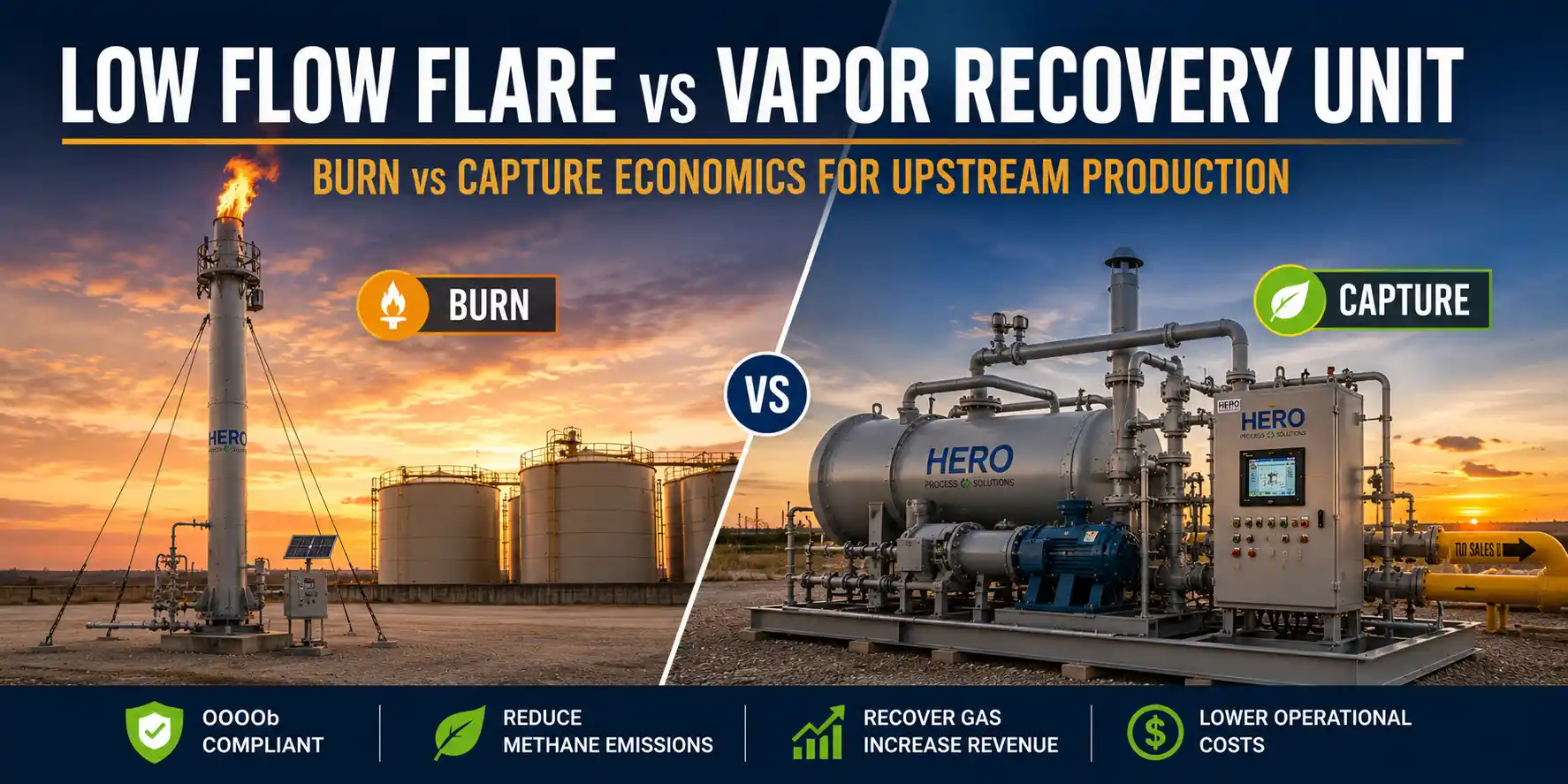
Every upstream tank battery operator faces the same question: install a low flow flare to combust storage tank vent gas, install a vapor recovery unit to capture and route that gas to sales, or some combination of both. The answer used to be set almost entirely by gas volume — too little gas, burn; enough gas, capture. EPA 40 CFR 60 Subpart OOOOb and the Inflation Reduction Act methane emissions fee changed the math by adding a regulatory cost to flaring that did not exist a decade ago. The right decision is now an integrated economic, regulatory, and operational question rather than a pure gas-volume calculation.
Hero Process Solutions, founded in 2011 and headquartered in Kellyville, Oklahoma with operations in Midland, Texas, manufactures both low flow flare systems and vapor recovery systems for upstream production. This guide walks through the burn-vs-capture decision framework, the inputs that drive it, and the typical thresholds at which the answer flips.
DIRECT ANSWER: The burn-vs-capture decision compares the all-in cost of a low flow flare (CAPEX, maintenance, OOOOb compliance, methane fee) against the all-in cost of a vapor recovery unit (CAPEX, electric OPEX, maintenance, residual compliance) net of the sales value of captured gas. Below approximately 50 MSCFD of routine vent gas, the low flow flare typically wins on economics. Above approximately 200 MSCFD, the VRU typically wins. Between those volumes the answer depends on gas value, distance to a sales connection, IRA methane fee exposure, and site-specific reliability requirements. A combined VRU-plus-backup-flare configuration is common at moderate volumes.
1. What the Burn-vs-Capture Decision Actually Is
The decision is whether to combust storage tank vent gas to destroy VOC emissions and meet EPA control requirements, or to compress and capture that gas to a sales connection so it earns revenue instead. Both paths satisfy EPA 40 CFR 60 Subpart OOOOb storage vessel control requirements. They differ on CAPEX, OPEX, operational complexity, methane fee exposure, and revenue.
The economic comparison has three line items per option that must be quantified before any decision: capital cost amortized over service life, ongoing operating cost (electric power, maintenance, compliance reporting), and revenue or avoided cost (gas sales value for capture, avoided methane fee for both options).
2. How to Calculate Gas Value at Stake
The starting point for the analysis is gas volume — how much vent gas the storage tank battery actually produces in a typical year. From the working loss, breathing loss, and flash gas calculations covered in the low flow flare sizing guide, sum the annual flow in MMSCF.
Multiply that annual volume by the gas sales price net of gathering, compression, and treating costs. Natural gas sales prices vary by basin and over time; for routine economic screening, use the current Henry Hub price or local basin index minus a basin-specific differential. For a tank battery producing 100 MSCFD of vent gas (36.5 MMSCF/year) at $2.50 net realized price, the annual gas value at risk is approximately $91,000.
That number is the upper bound of what a VRU could recover. The VRU does not capture 100% — typical capture efficiency is 90% to 98% — and the captured gas must be compressed to sales pressure, which consumes electric power. Net realized revenue from VRU capture is lower than gross gas value, but still substantial for any meaningful gas volume.
3. How to Estimate CAPEX and OPEX for Both Options
Low flow flare CAPEX for a typical upstream tank battery installation is in the low- to mid-five-figure range delivered, depending on tip size, stack height, knockout drum, and battery/solar ignition package. Ongoing maintenance OPEX is low — battery replacement every few years, annual inspection, monthly visual check. OOOOb compliance OPEX adds annual performance testing and CEDRI reporting.
Vapor recovery unit CAPEX for a comparable upstream tank battery service is generally higher — typically several times the cost of a low flow flare — because it includes the compressor, motor, control system, knockout drum, and tie-in to the sales line. Ongoing OPEX is dominated by electric power for the compressor motor, which depends on gas volume and compression ratio. Maintenance OPEX includes compressor service, oil changes, and seal replacements at scheduled intervals.
The actual values are project-specific. For accurate burn-vs-capture analysis, get vendor quotes for both options at the actual battery configuration rather than relying on rules of thumb.
KEY INSIGHT: The VRU economics improve dramatically with gas volume because the major cost components (compressor, controls, sales tie-in) are largely fixed regardless of throughput. Low flow flare economics are nearly flat with volume. That is why volume is the dominant variable in the decision — it scales VRU revenue much faster than VRU cost.
4. How OOOOb and the IRA Methane Fee Change the Math
The Inflation Reduction Act of 2022 established a methane emissions fee on certain large oil and gas facilities exceeding methane emission thresholds. The fee phases in at $900 per metric ton of methane in 2024, rising to $1,500 per metric ton in 2026 and beyond. The fee applies to methane emissions above the facility-specific threshold, and uncombusted methane vented or leaked counts toward the threshold.
A low flow flare achieving 95% control still vents 5% of inlet methane, which is now a regulatory cost. A vapor recovery unit at 95% capture vents 5% to atmosphere through compressor seals and incidental leaks. The math for affected facilities now must include the methane fee on residual emissions from both options, plus the additional benefit that captured gas eliminates uncombusted methane while sales-routed gas eventually combusts at the end consumer.
For facilities below the IRA methane fee threshold, the math reverts to the traditional gas-volume calculation. For facilities at or above the threshold, the capture option gains meaningful additional value from avoided methane fee.
5. Typical Volume Thresholds Where the Decision Flips
| Vent Gas Volume | Typical Recommendation | Why |
|---|---|---|
| Below 50 MSCFD routine | Low flow flare | VRU CAPEX cannot be recovered from gas sales at this volume |
| 50-200 MSCFD routine | Detailed economic analysis required | Decision depends on gas price, distance to sales, methane fee exposure, reliability requirement |
| Above 200 MSCFD routine | Vapor recovery unit (often with backup low flow flare) | Gas value justifies VRU CAPEX; revenue scales with volume |
| Above 500 MSCFD routine | Vapor recovery unit + dedicated backup flare | Reliability and methane fee exposure require redundancy |
These thresholds are screening guidance. Specific projects need project-specific analysis with actual gas composition, local gas price, distance to sales connection, electric power availability for VRU, and OOOOb and IRA methane fee exposure.
6. Why the Right Answer is Often Both
At moderate-to-high vent gas volumes (50 MSCFD and above), the optimal solution is increasingly a combination: a vapor recovery unit handling routine flow as the primary control device, plus a backup low flow flare handling excursions, VRU downtime, and emergency relief.
The combination preserves the revenue benefit of capture, the methane fee benefit, and adds a reliable control device for periods when the VRU is offline for maintenance or upset. Many upstream operators now specify the dual configuration as the default for new tank batteries above the capture-economics threshold.
Hero supplies both equipment types, designs the integration between them, and provides field services for commissioning and ongoing reliability of the combined system.
7. Operational Trade-Offs Beyond the Economics
| Factor | Low Flow Flare | Vapor Recovery Unit |
|---|---|---|
| Unmanned operation | Designed for unmanned with battery/solar ignition | Requires electric power and routine attention |
| Cold/remote climate | Tolerant; pilot and ignition rated for weather | Compressor and electrics need cold-weather provisions |
| Reliability of control function | Very high — ignition every 3 seconds, few moving parts | Compressor uptime depends on maintenance discipline |
| Emissions during downtime | Near-zero — control function essentially always available | Vent flow goes uncontrolled unless backup flare is present |
| Revenue stream | None — gas is combusted | Yes — captured gas sold to pipeline |
| Methane fee exposure | 5% residual emissions counted toward fee threshold | 5% residual emissions counted toward fee threshold |
8. Common Burn-vs-Capture Analysis Mistakes
| Mistake | Why It Hurts | Fix |
|---|---|---|
| Using vent gas volume only at routine averages instead of full-year inventory | VRU economics depend on annual sales; underestimating volume kills capture case | Use annual vent gas inventory including flash gas during all production days |
| Ignoring IRA methane fee exposure | Misses a real economic driver above facility threshold | Verify facility methane fee classification before final decision |
| Skipping distance-to-sales infrastructure cost | Tie-in to sales may need miles of new pipeline | Include pipeline tie-in CAPEX in VRU total project cost |
| Assuming VRU eliminates need for any flare | VRU downtime leaves storage tanks uncontrolled | Pair VRU with backup low flow flare for moderate-to-high volumes |
| Using rules-of-thumb instead of project quotes | Volume thresholds for the decision flip vary by basin and project | Get vendor quotes for both options at project-specific conditions |
| Not running OOOOb classification check | Both options must satisfy OOOOb; misses applicable thresholds | Verify OOOOb applicability and Kb storage tank classification in design phase |
Frequently Asked Questions
What volume of vent gas justifies a vapor recovery unit over a low flow flare?
The typical screening threshold is 50 to 200 MSCFD routine vent gas. Below 50 MSCFD, the VRU CAPEX cannot be recovered from gas sales over the service life, and the low flow flare is the better economic choice. Above 200 MSCFD, the captured gas revenue more than justifies the VRU CAPEX. Between those volumes, the decision is project-specific.
Does EPA OOOOb require a vapor recovery unit instead of a flare?
No. EPA 40 CFR 60 Subpart OOOOb requires 95% VOC reduction on affected storage vessels but does not specify which control technology — a low flow flare and a vapor recovery unit both satisfy the rule provided they achieve the required reduction. The operator can choose based on economics, operations, and methane fee exposure.
How does the IRA methane emissions fee affect the decision?
The Inflation Reduction Act methane fee applies to large oil and gas facilities exceeding methane emission thresholds. Above the threshold, residual emissions from both a low flow flare (5% uncombusted methane) and a vapor recovery unit (5% leaks) count as fee-exposure tons. The fee improves the relative economics of the capture option, especially as the rate climbs from $900 per metric ton in 2024 to $1,500 in 2026 and beyond.
Should I install both a VRU and a backup flare?
For tank batteries above approximately 50 MSCFD routine vent gas, the combined configuration is increasingly the default. The VRU captures routine flow for sales revenue, and the backup low flow flare handles VRU downtime, maintenance windows, excursions, and emergency conditions. The combination preserves capture revenue while ensuring control device availability under all conditions.
What inputs are needed for a burn-vs-capture economic analysis?
The analysis needs annual vent gas inventory (working, breathing, and flash gas combined), gas composition and heating value, net realized gas sales price after gathering and treating, distance to sales tie-in, electric power availability for VRU, OOOOb applicability and Kb classification, IRA methane fee facility classification, and project quotes for both low flow flare and VRU at the actual battery configuration.
Can Hero Process Solutions supply both options?
Yes. Hero manufactures low flow flares with battery/solar spark ignition for unmanned upstream service and vapor recovery units sized for tank battery applications. The integrated dual configuration (VRU plus backup flare) is also available as a single coordinated package, including knockout drum, vent header, and tie-in design from Kellyville, Oklahoma.