OIL & GAS EQUIPMENT | Updated October 2026 | 7 min read
- The specific operational scenarios where a rental flare is lower total cost than purchasing a permanent unit
- Available rental flare configurations, from trailer-mounted low-flow units to high-capacity air-assist systems
- How to size a rental flare correctly for well testing, turnaround and emergency applications
- EPA 40 CFR 60 Subpart OOOOb compliance requirements for rental flare operations
- Total cost comparison between rental and purchase for planned versus unplanned flaring events
- Mobilization and demobilization timelines for Hero Process Solutions rental flare equipment
- Common rental flare mistakes that increase cost and reduce combustion efficiency
A rental flare gives oil and gas operators fast-deploy, temporary combustion control for situations where purchasing a permanent flare system is not economically justified or operationally practical. Producers and midstream operators who use rental combustion equipment for well testing, planned turnarounds and bridge-gap compliance avoid the capital commitment of a purchased unit while meeting EPA 40 CFR 60 Subpart OOOOb combustion efficiency requirements during the rental period.
Hero Process Solutions, founded in 2011 and headquartered in Kellyville, Oklahoma with operations in Midland, Texas, maintains a fleet of portable trailer-mounted flares and combustion equipment available for rental in the Permian Basin, Mid-Continent and throughout North American oil and gas markets. The company’s rental fleet spans low-flow combustors to high-capacity air-assist flares, with rapid mobilization capability for both planned and unplanned combustion events.
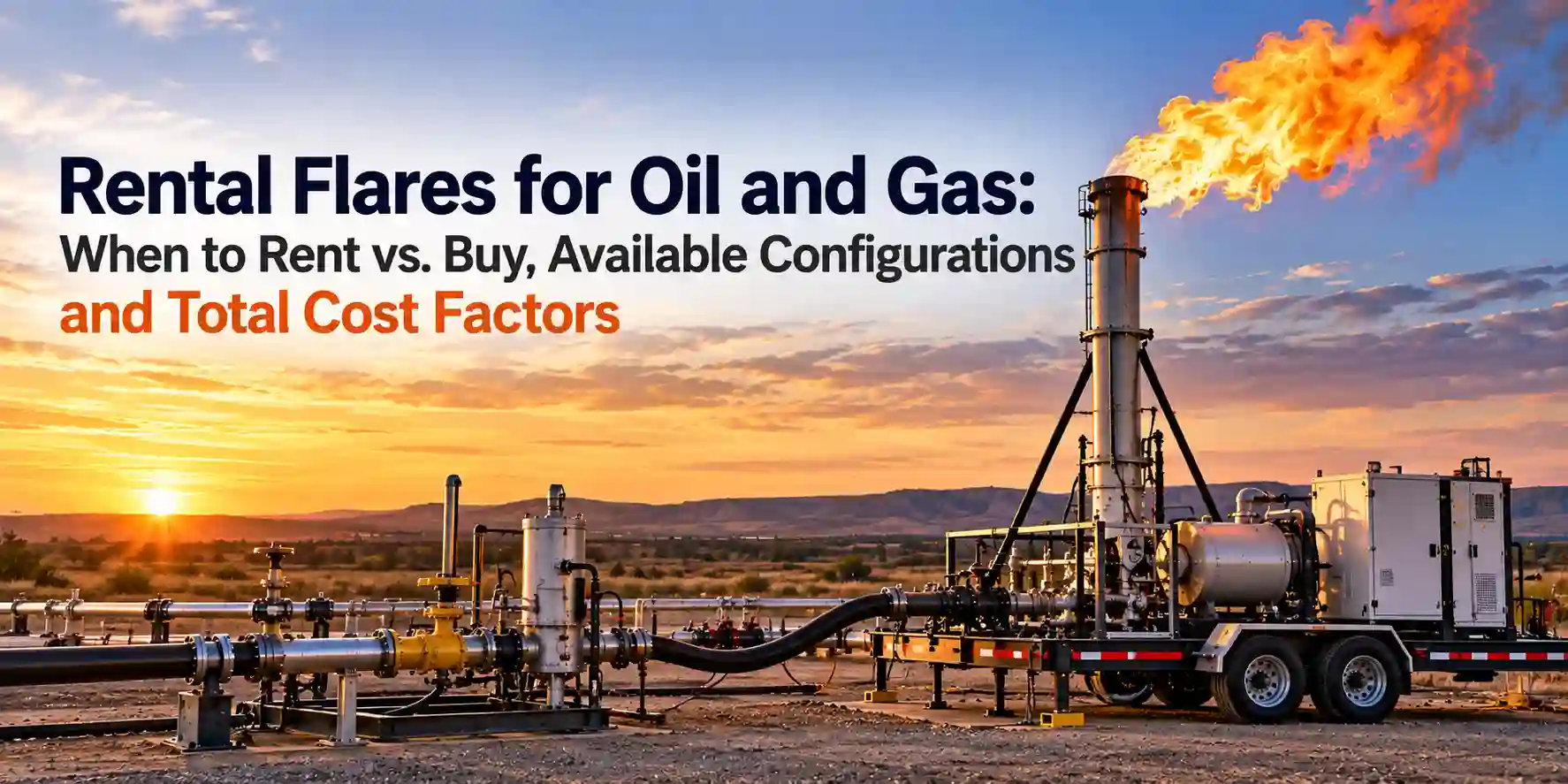
A rental flare is a temporary combustion device, typically trailer-mounted for rapid mobilization, that an operator leases from a flare manufacturer or combustion equipment provider for a defined period rather than purchasing outright. Under EPA 40 CFR 60 Subpart OOOOb, a rental flare used for emissions control on an affected source must meet the same combustion efficiency standards (95 percent or greater destruction efficiency, plus continuous pilot monitoring) as a permanent installed flare. Rental flares are most cost-effective for applications lasting less than 12 to 18 months or for events where the gas volume, location or duration is uncertain, making permanent capital investment difficult to justify.
1. When a Rental Flare Is the Right Choice
Rental flares make economic and operational sense in specific scenarios that share a common characteristic: the combustion need is temporary, uncertain in duration or geographically variable. The most common applications across the oil and gas flare systems rental market include:
- Well testing and flowback: During initial well completion and flowback, a rental flare handles high-volume gas and condensate combustion before the well is tied in to the gathering system. The flare is on-site for days to weeks, making purchase of a permanent unit unjustifiable.
- Planned turnarounds and shutdowns: Refineries, gas plants and midstream facilities that shut down process units for maintenance use rental flares to handle relief and purge gas during the transition periods that exceed normal flare header capacity.
- Emergency backup: A permanent flare taken offline for repairs or inspection requires a temporary backup unit to maintain combustion control on associated emission sources. A rental flare can be mobilized within 24 to 48 hours for most Permian Basin and Mid-Continent locations.
- Bridge-gap compliance: Operators who have triggered vapour control obligations under OOOOb before permanent equipment is installed can use a rental flare as a compliant interim control device while capital equipment is procured and constructed.
- Short-term production tests: Extended production tests on new drilling areas or unconventional formations require combustion control for test volumes that may or may not justify a permanent installation, depending on results.
2. Available Rental Flare Configurations
Rental flares are available in configurations that span the full range of upstream and midstream combustion requirements. Choosing the correct configuration at the start of the rental prevents undersized units from venting during peak gas events, which creates both regulatory exposure and product loss.
| Configuration | Best Application | Typical Capacity | Key Feature |
|---|---|---|---|
| Trailer-mounted low-flow combustor | Tank battery vapour control, stranded gas destruction | Up to 20 MMBtu/hr | Lowest mobilization cost, rapid setup on lease |
| Trailer-mounted open flare | Well testing, flowback, short-duration high-volume events | Up to 100 MMBtu/hr | High gas throughput capability, no air compression required |
| Air-assist rental flare | High-volume well tests, turnarounds requiring smokeless combustion | Up to 500 MMBtu/hr | Smokeless combustion at high flow rates, meets visible emissions limits |
| Enclosed combustor rental unit | Applications requiring 99.9 percent destruction, residential proximity | Up to 30 MMBtu/hr | No visible flame, lowest noise and light impact |
Low-flow rental flares are the most frequently deployed configuration in upstream applications because most well site and tank battery vapour streams fall within the 1 to 20 MMBtu/hr range during normal production. These units arrive pre-plumbed and pre-wired, reducing setup time to less than four hours from truck arrival at most lease locations.
3. Sizing a Rental Flare for Well Testing and Emergency Applications
Rental flare sizing follows the same engineering parameters as permanent flare sizing, with one critical difference: the sizing must account for the worst-case gas rate expected during the rental period, not the average rate. Undersizing a rental flare for a well test creates both safety and compliance risks when early high-pressure gas rates exceed the flare’s hydraulic capacity.
The five inputs required to size a rental flare correctly are: peak gas flow rate in MMscfd, gas molecular weight or specific gravity, inlet pressure and allowable pressure drop to the flare tip, required destruction efficiency (95 percent for OOOOb or 99.9 percent for enclosed combustor applications) and ambient wind speed range at the planned location. For well testing, engineers use the expected maximum wellbore deliverability at the test choke setting as the sizing basis, with a 25 percent safety factor applied to the peak rate.
For planned turnaround applications, sizing is based on the maximum relief and purge rate calculated in the plant’s relief system design document. Emergency utility flares from Hero Process Solutions are engineered to handle these large, short-duration events without tip overheating or structural fatigue that would reduce the flare’s service life.
Well test gas rates in unconventional formations frequently exceed pre-drill estimates by 30 to 50 percent during the first 72 hours of flowback. Specifying a rental flare with a capacity buffer of at least 30 percent above the expected peak rate eliminates the risk of field-improvised modifications that void the unit’s certification and create compliance exposure under EPA Subpart OOOOb.
4. EPA OOOOb Compliance Requirements for Rental Flares
Under EPA 40 CFR 60 Subpart OOOOb, a flare used as a control device for an affected emission source must meet the same performance standards whether it is a permanent installation or a rental unit. The rental flare must achieve a net heating value at the flare tip of at least 300 BTU per standard cubic foot for assisted flares, maintain a continuous pilot flame, and control visible emissions to no more than 5 minutes in any 2-hour period.
Key compliance documentation requirements for rental flare operations include a written operations and maintenance plan for the flare, records of continuous pilot flame monitoring during all periods when the flare is controlling regulated sources, and documentation of the flare’s design combustion efficiency. Operators must retain these records for at least five years and produce them on request during an EPA or state agency inspection. Before renting a flare for any OOOOb-regulated source, confirm with the rental provider that the unit comes with the required design documentation and that its pilot monitoring instrumentation is functional and calibrated.
A rental flare used as an interim control device for an OOOOb-regulated source is subject to the same compliance monitoring and recordkeeping requirements as a permanent flare. The operator of the affected source, not the rental equipment provider, is responsible for ensuring that monitoring records are maintained and that the flare meets performance standards throughout the rental period. Failure to maintain required records can result in the rental period being classified as a compliance deviation.
5. Rent vs. Buy: Total Cost Analysis for Oil and Gas Flaring Decisions
The financial case for renting versus buying a flare system depends on the duration of the combustion need, the capital budget available, the certainty of future combustion requirements and the cost of logistics between job sites. For most oil and gas applications, rental becomes less cost-effective than purchase after 12 to 18 months of continuous operation, assuming similar daily rates across both market conditions and rental fleet availability.
Total cost of a rental flare includes the daily or monthly rental rate, mobilization and demobilization charges, fuel gas consumption during operation, any inspection or service fees during the rental period, and the cost of vapor recovery infrastructure if the rental flare is serving as a bridge-gap while permanent vapor recovery systems are under construction.
Total cost of purchasing a permanent flare includes the capital equipment cost, installation and commissioning, annual inspection and maintenance, regulatory compliance testing and the opportunity cost of capital deployed in a non-productive asset if the production well or facility does not meet expectations. For single-well pads in areas where production volumes are uncertain, rental provides capital flexibility that purchase does not.
6. Mobilization, Setup and Support for Rental Flare Operations
The operational advantage of a rental flare is speed of mobilization. Hero Process Solutions maintains equipment ready for rapid dispatch from its Oklahoma and Texas locations, with trailer-mounted units deployable within 24 to 72 hours for most Permian Basin and Anadarko Basin destinations, depending on distance and road conditions.
Standard mobilization for a trailer-mounted rental flare includes truck transport to the lease location, positioning and leveling the unit on the pad, connection to the gas supply line at the operator’s flange, pilot gas supply connection and ignition system startup and verification. Full setup from truck arrival to first flame typically runs two to four hours for a low-flow combustor and four to eight hours for a larger air-assist unit requiring blower startup and adjustment. Hero Process Solutions field services provide onsite startup support, commissioning documentation and operator training for all rental combustion equipment deployments.
7. Common Rental Flare Mistakes That Increase Cost and Risk
| Mistake | Why It Hurts Operations | Fix |
|---|---|---|
| Sizing to average gas rate instead of peak rate | Flare cannot handle initial high flowback rates, venting unburned gas and creating OOOOb compliance gaps | Size to peak expected rate plus 30 percent margin; confirm sizing with the rental provider before mobilization |
| Selecting an open flare where visible emissions limits apply | Smoking combustion on high-liquid-content gas streams violates OOOOb visible emission limits within hours of startup | Specify an air-assist rental flare for gas streams with high condensate content or for sites near residential or commercial areas |
| Failing to confirm OOOOb documentation with the rental provider before deployment | A rental flare without design efficiency documentation cannot demonstrate compliance for an OOOOb-regulated source | Request written design combustion efficiency certification and pilot monitoring calibration records before accepting the rental unit |
| Underestimating mobilization lead time for large units | A high-capacity air-assist unit may require 5 to 7 days lead time for dispatch, transport and setup permits in some jurisdictions | Contact the rental provider at least 2 weeks before the planned start date for any air-assist or large enclosed combustor rental |
| Renting when a permanent unit is more cost-effective | Rental flare costs exceed purchase amortization after 12 to 18 months, increasing total combustion cost per Mcf destroyed | Run a total cost comparison at 6-month intervals during long-term rentals; transition to purchase when rental cumulative cost approaches capital equipment cost |
Article Summary
- Rental flares provide temporary combustion control for well testing, planned turnarounds, emergency backup and bridge-gap OOOOb compliance
- A rental flare is most cost-effective for combustion needs lasting less than 12 to 18 months, or where gas volume and duration are uncertain
- Available configurations include trailer-mounted low-flow combustors, open flares, air-assist units and enclosed combustors to match the specific application requirements
- Rental flare sizing must be based on peak expected gas rate plus a 30 percent safety margin, not average flow rate
- EPA 40 CFR 60 Subpart OOOOb requires rental flares used for regulated sources to meet the same pilot monitoring and combustion efficiency standards as permanent flares
- The operator of the regulated source, not the rental equipment provider, is responsible for maintaining compliance records throughout the rental period
- Hero Process Solutions provides 24 to 72 hour mobilization for trailer-mounted rental flares in the Permian Basin and Mid-Continent markets
- After 12 to 18 months of continuous use, a rental flare cost comparison against purchase amortization should be performed to determine the most cost-effective long-term path
Frequently Asked Questions
How quickly can a rental flare be mobilized for an emergency well site application?
Trailer-mounted low-flow and medium-capacity rental flares can typically be mobilized within 24 to 48 hours for most Permian Basin and Mid-Continent well site locations, assuming the unit is available in the provider’s fleet. Larger air-assist units or enclosed combustors may require 5 to 7 days for dispatch, transport and any required oversize load permits. Operators planning for planned turnarounds should contact the rental provider at least two weeks in advance to confirm availability and lead time for the required configuration.
Does a rental flare need to meet EPA OOOOb requirements?
Yes. When a rental flare is used as a control device for an EPA 40 CFR 60 Subpart OOOOb regulated source, it must meet the same performance standards as a permanent flare installation. This includes achieving a net heating value at the flare tip of at least 300 BTU per standard cubic foot, maintaining continuous pilot flame monitoring and controlling visible emissions. The operator of the affected source is responsible for ensuring compliance throughout the rental period and must maintain monitoring records for at least five years.
What is the typical daily rate for a rental flare in the Permian Basin?
Rental flare daily rates vary by configuration, capacity and market conditions. Low-flow combustor units typically run in the range of $300 to $800 per day, while larger open flares and air-assist units range from $800 to $3,000 or more per day depending on capacity and whether air compression equipment is included. Mobilization and demobilization charges are typically billed separately and vary by transport distance. Contact Hero Process Solutions directly for current availability and pricing for specific applications and locations.
At what point does it make more sense to buy a flare rather than rent?
The break-even point between renting and purchasing a flare typically falls between 12 and 18 months of continuous operation, depending on the daily rental rate, capital cost of the equivalent purchased unit and whether the purchase includes installation, commissioning and spare parts. Operators should run a present-value analysis at the six-month mark of any long-term rental to determine whether transitioning to a purchased unit will reduce total combustion cost over the expected service life of the installation.
Can a rental flare be used as an interim control device while permanent equipment is being installed?
Yes. A rental flare is a recognized interim control device under EPA policy and is an accepted compliance path for OOOOb-regulated sources during the period between when vapour control obligations begin and when permanent equipment is placed in operation. The operator must ensure the rental flare meets OOOOb performance standards from the first day it is used as a control device, maintain all required monitoring records during the interim period and transition to the permanent unit without any uncontrolled venting gap between the two systems.