
WHAT YOU’LL LEARN IN THIS GUIDE
- How pipeline blowdowns generate peak flow rates that determine flare capacity
- The API 521 depressurization methodology used to calculate required flare tip size
- Why gas composition matters as much as flow rate when selecting a temporary flare
- Utility requirements: pressure, pilots, and ignition for a rental flare on a remote site
- How long typical blowdown operations run and what that means for rental vs. purchase
- Common sizing mistakes that result in incomplete combustion or permit violations
- Hero Process Solutions’ portable flare specifications and how to request a rental
A pipeline blowdown flare must handle the peak depressurization rate from your line segment, not the average throughput — and that distinction is what most operators get wrong when they call for a rental unit. Peak flow during an unassisted blowdown through a fully open ESD valve can reach 3 to 10 times the normal operating flow for the first few minutes, then taper off exponentially as line pressure drops. Undersizing a temporary flare for that peak load produces smoke, incomplete combustion, and potential permit violations under EPA 40 CFR 60.18, which requires a minimum combustion efficiency of 98% for waste gas flares.
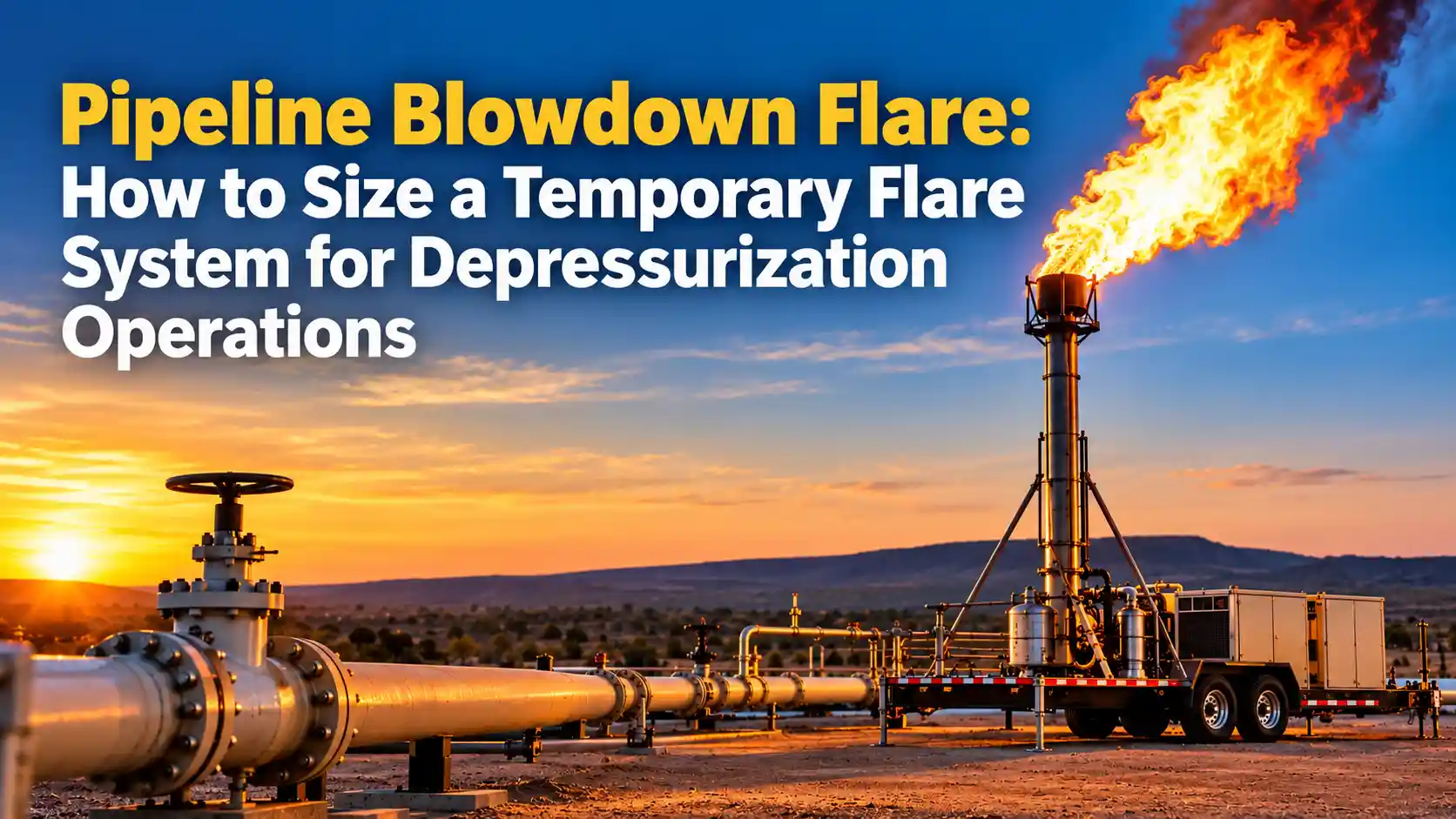
Hero Process Solutions, founded in 2011 and headquartered in Kellyville, OK with field operations in Midland, TX, manufactures and rents portable trailer-mounted flares sized for exactly this application. The rental fleet covers blowdown operations from small gathering lines to large transmission segments, with units deployable on short notice for planned turnarounds, emergency depressurization, or hydro-test gas disposal.
DIRECT ANSWER: Pipeline Blowdown Flare
A pipeline blowdown flare is a temporary combustion device deployed to safely dispose of pressurized natural gas during pipeline depressurization. Sizing requires calculating peak blowdown flow rate using API Standard 521 methodology, then selecting a flare tip with sufficient capacity to maintain smokeless combustion at that rate. EPA 40 CFR 60.18 requires 98% combustion efficiency and a continuously burning pilot flame at all times.
1. How Pipeline Blowdowns Work and Why Peak Flow Rate Is the Design Basis
When you isolate a pipeline segment and open the blowdown valve, gas exits as a function of the upstream pressure differential, the orifice size, and the gas properties. At the moment the valve opens, the flow rate hits its peak. That peak flow rate, not the time-averaged rate, is the design basis for your temporary flare.
Choked vs. subsonic flow: At high line pressures (typically above 2x the atmospheric pressure at the valve exit), flow is choked, meaning it is limited by the speed of sound in the gas at the orifice throat. As pressure drops below the critical ratio, flow transitions to subsonic. This transition point matters because choked-flow rates are higher, and the flare must handle them without smoking.
The exponential decay: After the initial peak, blowdown flow rate decays roughly exponentially as the segment depressurizes. Most pipeline blowdowns are operationally complete (line pressure below 50 psig) within 30 minutes to 4 hours, depending on segment volume and initial pressure. This duration drives the rental vs. buy decision: for a one-time blowdown, a rental flare from Hero Process Solutions is almost always the correct choice.
Liquid carryover: Natural gas pipelines accumulate condensate. During a blowdown, liquid slugs can carry over into the flare header. Your temporary flare system needs a knockout drum upstream of the tip to prevent liquid from reaching the combustion zone.
2. API 521 Methodology: Calculating the Required Flare Capacity
API Standard 521 (Pressure-relieving and Depressuring Systems) provides the accepted method for calculating blowdown flow rates. The core equation for orifice flow through a restriction is:
Q = C × A × P × √(M / (Z × T))
Where: Q = volumetric flow rate (MMSCFD or SCFH); C = orifice discharge coefficient (typically 0.72–0.82); A = orifice cross-sectional area (in²); P = upstream absolute pressure (psia); M = molecular weight of the gas; Z = compressibility factor; T = upstream temperature (°R).
KEY INSIGHT
API 521 requires that the flare system be sized for the maximum credible flow scenario, not just normal operating blowdown rates. For a segment with multiple taps or a large segment volume, that maximum scenario can be 40–60% higher than the rate calculated for a single valve at average operating pressure.
Step-by-step sizing process:
- Identify the blowdown valve orifice size and Cv rating
- Determine initial line pressure and gas composition (molecular weight, H2S content, BTU value)
- Calculate peak choked-flow rate using the API 521 equation or your company’s approved simulation tool
- Apply a 1.1–1.25 safety factor to the calculated peak
- Match to a flare tip rated for that flow at the available header pressure
- Confirm the selected tip produces smokeless combustion at that rate per manufacturer data
3. Gas Composition: Why BTU Value and H2S Content Drive Flare Selection
Heating value (BTU/scf): A standard natural gas stream runs 950–1,100 BTU/scf. Lean gas (post-processing, CO2-diluted, or nitrogen-blanketed) can drop below 300 BTU/scf, which is below the self-sustaining combustion threshold for a standard open flare tip. For lean gas blowdowns, you need an enclosed combustor or an air-assist flare that can sustain combustion at low heating values.
H2S content: Sour gas blowdowns produce sulfur dioxide (SO2) at the flare tip. Above certain H2S concentrations (typically 500 ppm H2S in the waste gas stream), state air quality permits may require SO2 monitoring or a consent-to-operate from the state environmental agency. Texas and Oklahoma both have state-level requirements that run parallel to federal Subpart OOOOb limits.
4. Portable Flare Options for Pipeline Blowdown Applications
Hero Process Solutions’ portable flare and rental fleet covers the range of pipeline blowdown scenarios most operators encounter.
| Flare Type | Capacity Range | Best Blowdown Application | Key Requirement |
|---|---|---|---|
| Low-Flow Portable | Up to 1.0 MMSCFD | Small gathering lines, test separators | Stable pilot, < 50 psig header |
| Standard Trailer-Mounted | 1.0–10 MMSCFD | Mid-size transmission, production manifolds | Knockout drum, instrument air |
| High-Capacity Portable | 10–25 MMSCFD | Large transmission segments, processing plants | Site utility package, aux fuel |
| Air-Assist Portable | 1.0–10 MMSCFD (lean gas) | Nitrogen-purged lines, inert-diluted streams | Blower package, power supply |
All Hero Process Solutions rental flares arrive with a continuously burning pilot system, a structural base rated for trailer deployment, and connection flanges matching standard blowdown manifold specs. Field services are available for commissioning and decommissioning on the same dispatch.
5. Utility Requirements for a Rental Flare on a Remote Pipeline Site
Fuel gas for pilots: The pilot flame must stay lit continuously, per EPA 40 CFR 60.18(f)(1). On a pipeline blowdown, you will not typically have a dedicated fuel gas supply from the line (it will be depressurizing). You need either a portable propane bottle package or a separate natural gas supply at stable pressure to maintain the pilot independently of the blowdown flow.
Ignition system: All Hero Process Solutions flares use electronic ignition with automatic re-ignition. On remote sites without a 120V power supply, the ignition system runs off a 12V battery maintained by a solar trickle charger included in the rental package.
Knockout drum: Liquid carryover from the pipeline must be removed before the gas reaches the flare tip. If your site does not have a separator or knock-out vessel upstream of the blowdown point, request a portable liquid knockout system as part of the rental package.
CRITICAL RULE
EPA 40 CFR 60.18(f)(1) requires a flare to have a pilot flame present at all times. A blowdown that extinguishes the pilot (due to pressure surge or liquid slug) and continues venting gas is an emission violation. Your temporary flare must have automatic re-ignition and a pilot fuel supply independent of the blowdown stream.
6. EPA Compliance for Pipeline Blowdown Flares
Pipeline blowdowns are covered under EPA 40 CFR 60.18 (General Control Device Standards for Flares) and, if the affected facility is subject to it, under 40 CFR 60 Subpart OOOOb. Key compliance parameters for any temporary flare used in a blowdown:
Combustion efficiency: 98% minimum destruction of the waste gas hydrocarbon content. Net heating value: The gas stream must have a net heating value of at least 300 BTU/scf, or the flare must be equipped to maintain combustion below that threshold. Exit velocity: EPA 60.18 sets maximum tip velocity limits depending on the gas heating value. For standard natural gas (above 1,000 BTU/scf), the maximum tip exit velocity is 60 ft/s for non-assisted flares.
Hero Process Solutions’ flares are rated and documented for EPA 60.18 compliance. The OOOOb compliance page covers the regulatory requirements for each equipment category.
7. Rental vs. Purchase: How Long Does a Pipeline Blowdown Take?
Most pipeline blowdown operations run 2 hours to 5 days. For operations under 2 weeks, a rental flare is the correct call. Beyond 2 weeks (extended pig runs, multi-segment depressurization campaigns, or prolonged maintenance outages), purchase or a long-term rental agreement typically offers a lower total cost. Hero Process Solutions offers short-term rentals (1–4 weeks), mid-term rentals (1–3 months), and long-term agreements with rates that include transportation, setup documentation, and EPA compliance data sheets.
8. Common Mistakes When Sizing a Pipeline Blowdown Flare
| Mistake | Why It Hurts | Fix |
|---|---|---|
| Sizing to average flow, not peak | Flare smokes or flames out during initial surge | Use API 521 peak choked-flow calculation with safety factor |
| Ignoring liquid carryover | Liquid slugs extinguish the pilot or damage the tip | Add portable knockout drum upstream of flare header |
| Assuming standard gas composition | Lean gas or sour gas may require different flare type | Get a gas analysis (BTU/scf, MW, H2S ppm) before ordering |
| No independent pilot fuel supply | Pilot extinguishes when blowdown flow stops | Order propane pilot package or confirm site gas supply |
| Wrong header pressure for the rental unit | Flow restriction causes incomplete combustion | Match rental flare to your blowdown header pressure rating |
| Skipping field commissioning | Operator error at startup causes safety and compliance issues | Request Hero Process Solutions field commissioning on delivery |
Article Summary
- A pipeline blowdown flare must be sized for the peak choked-flow rate at the moment the blowdown valve opens, not the time-averaged rate.
- Use API Standard 521 methodology to calculate peak blowdown flow; apply a 1.1–1.25 safety factor before selecting a flare tip.
- Gas composition (BTU value, molecular weight, H2S content) determines whether a standard open-tip flare, air-assist unit, or sour-rated system is required.
- EPA 40 CFR 60.18 requires 98% combustion efficiency and a continuously burning pilot at all times during a blowdown operation.
- The pilot flame must be supplied from an independent fuel source separate from the depressurizing line.
- Liquid knockout upstream of the flare tip is mandatory for pipeline blowdowns where condensate carryover is possible.
- Most pipeline blowdown operations run 2 hours to 5 days; rental flares are the standard solution for operations under 2 weeks.
- Hero Process Solutions’ portable and trailer-mounted rental flares cover capacities from sub-1 MMSCFD to 25+ MMSCFD.
- Remote-site utility requirements (pilot fuel, ignition power, instrument air) must be confirmed before dispatch to avoid setup delays.
Frequently Asked Questions
What size flare do I need for a pipeline blowdown?
Flare size is determined by the peak depressurization flow rate, which depends on the pipeline segment volume, initial operating pressure, and the blowdown valve orifice size. Use API Standard 521 to calculate the peak choked-flow rate, apply a safety factor of 1.1 to 1.25, and match that to a flare tip rated for that flow at your header pressure.
Can I use a rental flare for a pipeline blowdown?
Yes, rental flares are the standard approach for pipeline blowdown operations. Most blowdowns are complete in less than a week, making rental far more cost-effective than purchase. Hero Process Solutions’ rental fleet includes portable trailer-mounted flares in multiple capacity ranges, deployable on short notice.
Does a temporary pipeline blowdown flare require EPA permits?
Federal EPA requirements under 40 CFR 60.18 apply to any flare used for waste gas combustion. Subpart OOOOb may apply if the affected facility is a covered source. State-level permits vary — Texas and Oklahoma both have state-specific requirements for temporary combustion equipment.
How long does a pipeline blowdown take?
Blowdown duration depends on segment volume, initial pressure, and blowdown valve size. A typical 10-mile gathering line at 600 psig can depressurize in 1 to 3 hours. A large transmission segment may take several days. Rental flares are available in short-term (1–4 week) and longer-term agreements.
What happens if the flare pilot goes out during a blowdown?
A pilot outage during an active blowdown means waste gas is venting unburned, which is both a safety hazard and an EPA compliance violation under 40 CFR 60.18(f)(1). All Hero Process Solutions rental flares include automatic electronic re-ignition, and the pilot fuel supply must be independent of the blowdown stream.
What is the difference between a blowdown flare and a regular flare stack?
A permanent flare stack is designed for continuous or high-frequency use, installed on a fixed foundation with permanent utilities. A blowdown flare is a temporary, portable unit deployed specifically for depressurization events. Blowdown flares must still meet the same EPA combustion efficiency and pilot requirements as permanent stacks.