OIL & GAS EQUIPMENT | Updated May 2026 | 7 min read
What You’ll Learn in This Guide
- What cold venting is and why regulators are pushing operators to convert to flare
- How EPA OOOOb, IRA methane fee, and state rules combine to force cold vent conversion
- Engineering steps to convert an existing cold vent to flare or combustor service
- Selection between elevated flare, low flow flare, and enclosed combustor
- Tie-in engineering, safety review, and permit changes
- Economic case: fee avoidance, compliance risk, and gas recovery upside
- Common cold vent conversion mistakes and how to avoid them
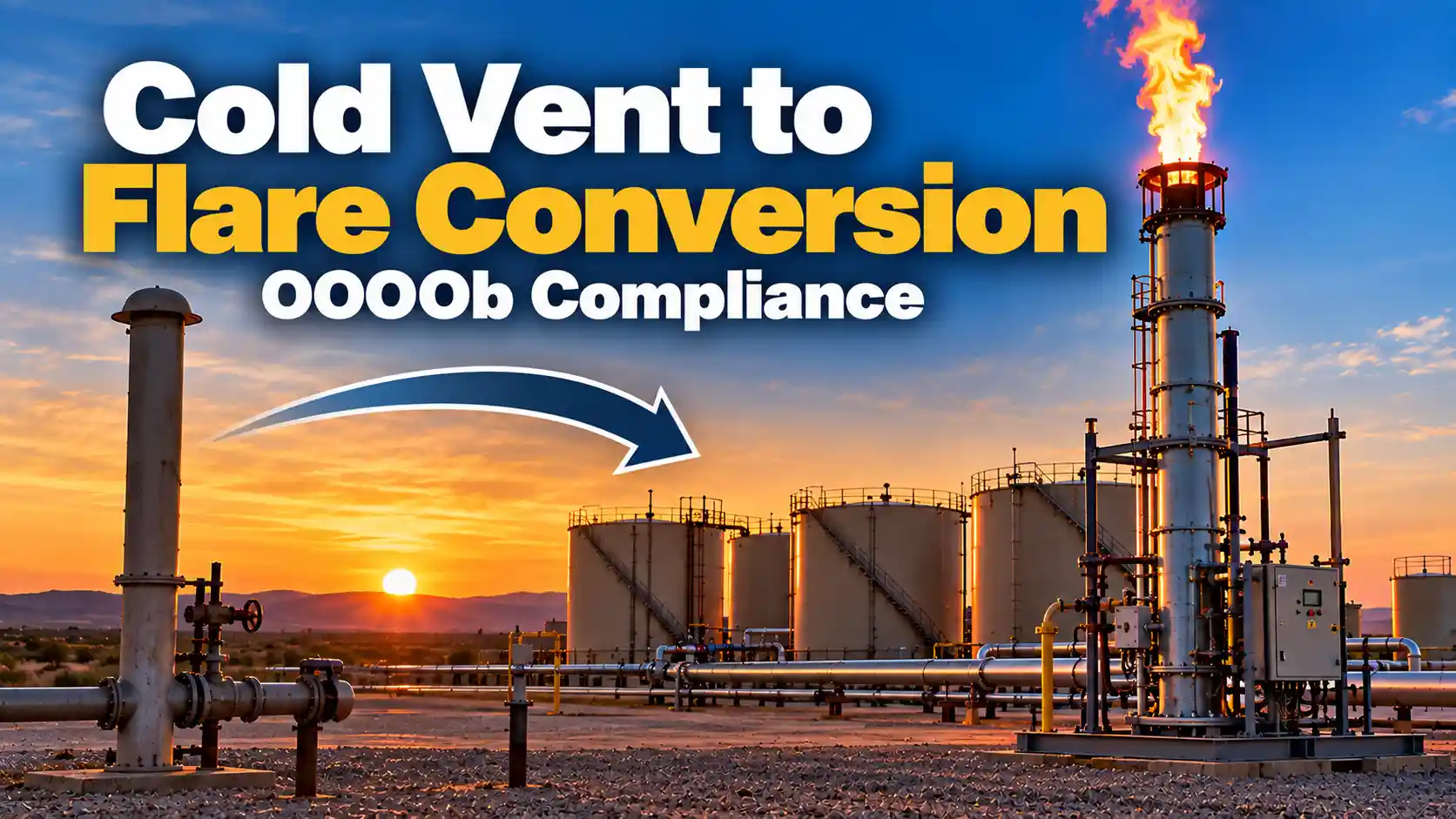
Cold venting, releasing hydrocarbon gas to atmosphere without combustion, was standard practice at many upstream and midstream sites for decades. New EPA regulations under 40 CFR 60 Subpart OOOOb, the IRA methane emissions fee, and state-level methane rules have made cold venting a compliance and economic liability at most facilities. Converting cold vents to flare or combustor service is one of the most common compliance projects in current oil and gas operations.
Hero Process Solutions, founded in 2011 and headquartered in Kellyville, Oklahoma with operations in Midland, Texas, engineers cold vent conversions, replacing atmospheric vents with industrial flares, low flow flares, or enclosed combustors across upstream and midstream service.
DIRECT ANSWER: Cold vent to flare conversion replaces an existing atmospheric vent with a combustion device, typically a low flow flare, an elevated flare, or an enclosed combustor unit. The conversion is driven by EPA OOOOb (98% DRE requirement on affected-facility vent controls), the IRA methane emissions fee ($900/metric ton in 2024 rising to $1,500 in 2026), and state agency rules. Engineering steps: define the vent gas profile, select the combustion technology, engineer the tie-in and knockout drum, complete safety review, update permits, and commission the new equipment. Payback is typically 6, 24 months at IRA-fee-exposed facilities.
1. What Cold Venting Is
Cold venting is releasing hydrocarbon gas to atmosphere without combustion. The vent gas can come from a tank battery, a separator vent, a compressor blowdown, or any other upstream vent source. Historically, cold venting was standard practice for low-volume streams where the operational cost of a flare was hard to justify against the environmental cost.
Cold venting has two problems. First, the vented gas is a direct methane emission, methane’s global warming potential (GWP) is 84 times CO₂ over 20 years, so cold vent methane has significant climate impact. Second, if the vent gas contains H₂S or heavier hydrocarbons, there are local air quality and safety impacts.
2. Regulatory Drivers for Conversion
Three regulatory layers now push operators to convert cold vents to combustion service.
EPA 40 CFR 60 Subpart OOOOb applies to well sites, gathering and boosting stations, and other affected facilities constructed, reconstructed, or modified after December 6, 2022. OOOOb requires 98% Destruction and Removal Efficiency on vent gas controls, which cold venting explicitly does not meet.
IRA methane emissions fee applies to large oil and gas facilities exceeding methane emission thresholds. The fee phases in at $900 per metric ton of methane in 2024, rising to $1,500 in 2026. Cold vent emissions count directly against the fee threshold.
State-level methane rules in New Mexico, Colorado, Pennsylvania, and other producing states impose additional restrictions on venting. Some states have effectively banned routine venting for specific facility categories.
3. Engineering Steps for Conversion
Cold vent to flare conversion follows a defined engineering workflow.
Step 1: Define vent gas profile. Measure or calculate flow rate, composition, pressure, and temperature at the existing vent. Sample the vent gas if composition is uncertain, the composition drives combustion technology selection.
Step 2: Select combustion technology. Low flow flare for unmanned upstream sites (battery/solar spark ignition). Enclosed combustor for tank battery vent with visibility constraints. Elevated flare for higher-flow midstream sites. Selection depends on flow rate, site infrastructure, and visibility requirements.
Step 3: Engineer the tie-in. Design piping from the existing vent point to the new combustion device. Add a knockout drum if the vent gas may contain condensate or liquid. Update the flare header safety framework.
Step 4: Safety review. Conduct HAZOP or equivalent safety review of the new configuration. Verify setback distance, ignition system, and emergency shutdown capability.
Step 5: Update permits. Notify air quality regulators of the conversion. Update facility air permits to reflect the new equipment. Verify OOOOb compliance documentation.
Step 6: Commission and start up. Install the new combustion device, complete OOOOb performance testing where required, and cut over from cold vent to combustion service.
4. Technology Selection
Three combustion technologies commonly replace cold vents.
Low flow flare is the standard choice for unmanned upstream well pads with low-volume routine vent gas (typically <100 SCFM). Battery/solar direct spark ignition eliminates pilot-loss failure mode.
Enclosed combustor is appropriate for tank battery vent gas control at sites with visibility constraints or higher volume. Quad O-certified units allow deployment without site-specific performance testing.
Elevated flare is used for higher-volume vent streams at midstream sites, or where an existing flare stack can be re-tied to receive the vent gas that was previously cold vented.
KEY INSIGHT: Where a site already has an existing flare with spare capacity, re-tying the previously cold-vented stream to the existing flare is usually the fastest and lowest-CAPEX conversion. Standalone new equipment is only needed when no existing flare has capacity for the additional load.
5. Economic Case
The economics of cold vent conversion combine three benefits.
IRA methane fee avoidance: For a facility above the IRA threshold, converting cold vents to 98% DRE combustion reduces methane emissions by 98%, dramatically cutting the fee. At $1,500 per metric ton in 2026, a 15-metric-ton reduction saves $22,500 per year.
OOOOb compliance risk avoidance: OOOOb requires 98% DRE on affected-facility vent controls. Cold venting is a documented compliance deviation with enforcement risk.
Optional gas recovery upside: If the vent gas is recoverable to a pipeline, a vapor recovery unit (VRU) captures the gas for sale rather than combusting it. VRU has higher OPEX than flare but offsetting revenue.
Combined, payback on cold vent conversion is typically 6, 24 months at facilities above the IRA fee threshold. Below the threshold, the compliance risk avoidance is the primary economic driver.
6. Common Cold Vent Conversion Mistakes
| Mistake | Why It Hurts | Fix |
|---|---|---|
| Skipping vent gas composition sampling | Wrong technology selected for actual gas | Sample vent gas before selecting combustion device |
| Ignoring existing flare spare capacity | New equipment installed when tie-in would suffice | Evaluate existing flare capacity before spec’ing new |
| Skipping knockout drum on liquid-heavy vent | Liquid carryover to new flare tip | Include knockout drum when vent may carry condensate |
| Missing state agency notification | Permit objection or enforcement action | Notify state agency of conversion before startup |
| Not evaluating VRU alternative | Miss gas recovery revenue at high vent volumes | Run VRU-vs-flare economic case at 50+ MSCFD |
| Deferring conversion beyond IRA fee onset | Compounding fee cost while equipment ships | Start conversion planning well before fee year |
Article Summary
- Cold vent to flare conversion replaces atmospheric venting with combustion (low flow flare, enclosed combustor, or elevated flare).
- Three regulatory drivers force conversion: EPA OOOOb, IRA methane fee, and state-level methane rules.
- Engineering workflow: profile the vent, select technology, engineer tie-in, safety review, permit updates, commissioning.
- Technology selection depends on flow rate, site infrastructure, and visibility constraints.
- Existing flare spare capacity is often the fastest and lowest-CAPEX conversion path.
- Economics combine IRA fee avoidance, compliance risk reduction, and optional VRU recovery upside.
- Payback typically 6, 24 months at facilities above the IRA fee threshold.
- Hero Process Solutions engineers cold vent conversions across upstream and midstream service.
Related resources: See our articles on EPA flare monitoring rules, flare gas recovery system ROI, Permian methane reduction, and enclosed combustor Quad O. Learn about our EPA OOOOb compliance services.
Frequently Asked Questions
What is cold venting?
Cold venting is releasing hydrocarbon gas to atmosphere without combustion. The vent gas can come from a tank battery, separator vent, compressor blowdown, or any other upstream source. Historically standard practice for low-volume streams, cold venting has now become a compliance and economic liability under new EPA and IRA regulations.
Why convert cold vents to flare?
Three drivers: EPA OOOOb requires 98% DRE on affected-facility vent controls, which cold venting does not meet; the IRA methane emissions fee ($900/metric ton in 2024, $1,500 in 2026) makes cold vent emissions expensive; state-level methane rules add additional restrictions and in some cases outright prohibitions on routine venting.
What combustion technology replaces cold vents?
Three common choices. Low flow flare with battery/solar spark ignition for unmanned upstream well pads. Enclosed combustor for tank battery vent gas at sites with visibility constraints. Elevated flare for higher-volume midstream sites. Where an existing flare has spare capacity, re-tying the vent stream to the existing flare is often the fastest option.
What is the engineering workflow?
Six steps: (1) define vent gas profile (flow, composition, pressure, temperature); (2) select combustion technology based on flow and site; (3) engineer the tie-in and knockout drum; (4) HAZOP safety review; (5) update air permits and OOOOb documentation; (6) commission and start up.
What is the payback on conversion?
Typically 6, 24 months at facilities above the IRA methane fee threshold. Below the threshold, compliance risk avoidance is the primary driver, so payback is harder to calculate directly but comes from avoided enforcement exposure and continuing regulatory compliance.
Should I install a VRU instead of a flare?
At vent volumes of 50+ MSCFD with pipeline access, a vapor recovery unit is often more economic than a flare because the recovered gas has sale value that offsets the higher OPEX. Below 50 MSCFD or without pipeline access, combustion (flare or enclosed combustor) is typically the better choice. Run an economic comparison at your specific volume before deciding.