
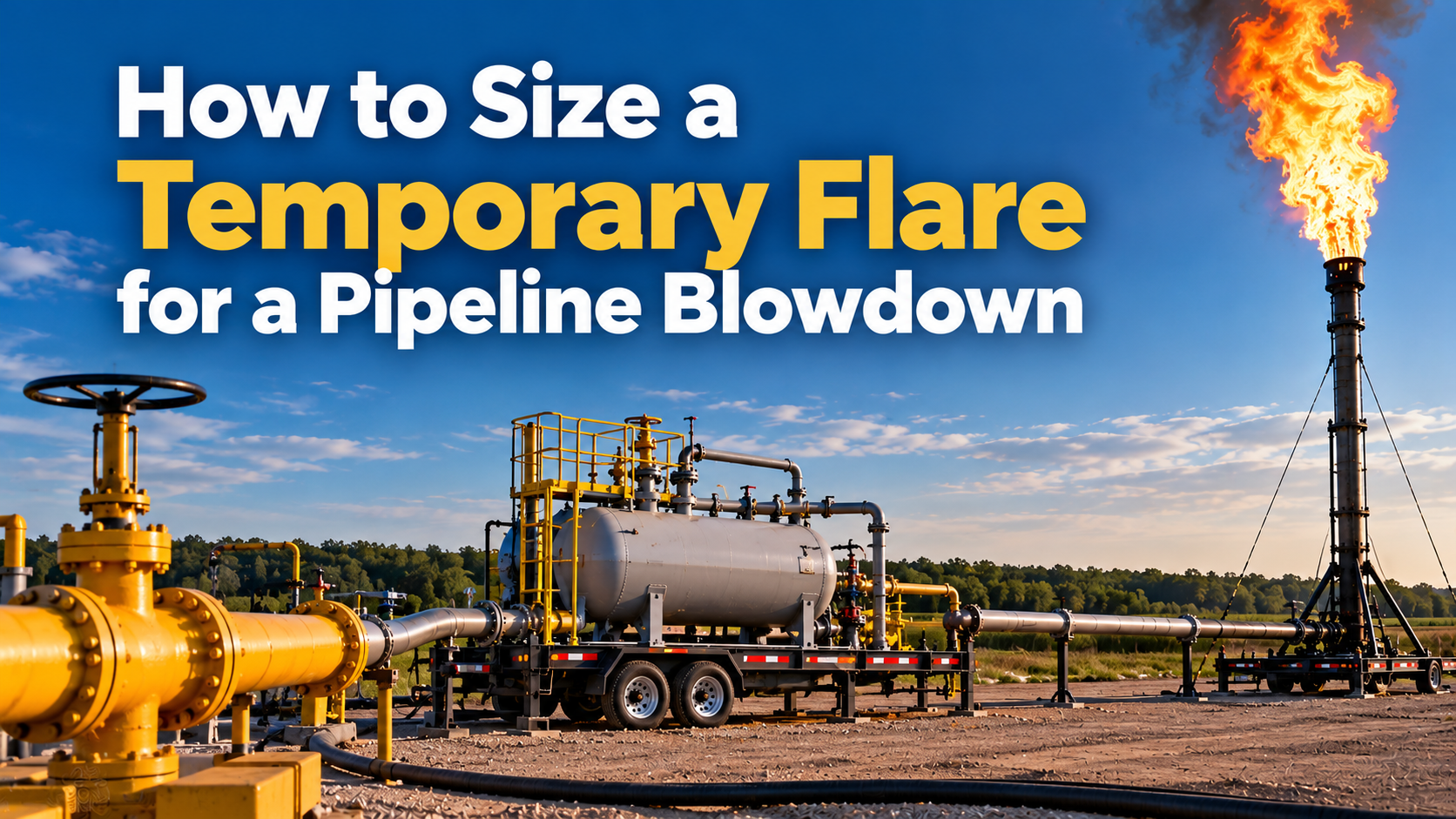
Pipeline blowdowns generate transient gas releases that differ from normal production loads in both volume and rate of flow. When an isolated segment is depressurized, flow peaks at the moment the blowdown valve opens, then decays exponentially as line pressure drops. That initial peak, not the time-averaged rate, determines whether the temporary flare handles the gas cleanly. Sizing to average flow is the most common error in temporary flare selection for pipeline blowdown operations, and it is the error most likely to result in equipment that cannot safely combust the gas during the first critical minutes of the event.
The following guidance covers the inputs required to size a temporary portable flare for a pipeline blowdown, the industry-standard calculation method, how gas composition affects flare selection, and the utility requirements that must be confirmed before the equipment is deployed. Hero Process Solutions provides portable flare rentals for pipeline blowdown, tie-in, and maintenance operations. Additional information on pipeline blowdown procedures is available at pipeline blowdown services.
1. Why Peak Flow, Not Average Flow, Determines Flare Selection
A pipeline blowdown does not release gas at a constant rate. During the first few minutes, when the blowdown valve opens and the segment pressure is still near the operating value, the flow rate can reach three to ten times what the line would carry under normal operating conditions. As segment pressure decays, flow decreases. Most blowdowns for segments of typical length and initial pressure reach below 50 psig within 30 minutes to four hours, after which flow transitions from choked to subsonic and declines more gradually.
The flare selected for a pipeline blowdown must handle the peak flow rate with sufficient combustion performance to meet the required destruction and removal efficiency (DRE). A flare sized only to handle the average or late-stage flow rate may be overwhelmed during the initial period, resulting in smoke, incomplete combustion, or tip damage. This is why the peak choked flow at the valve, calculated at initial line conditions, is the correct design basis for temporary flare sizing.
For segments with multiple taps, interconnected headers, or large-volume loops, the maximum credible flow scenario may be 40 to 60 percent higher than the rate calculated for a single valve at average segment pressure. The design basis should reflect the actual worst-case release configuration, not the simplified single-orifice scenario.
2. The API Standard 521 Sizing Method
The industry-standard method for sizing relief and blowdown flares is API Standard 521: Pressure-Relieving and Depressuring Systems. For a pipeline blowdown, the calculation proceeds from the choked orifice flow equation, which applies when upstream pressure at the blowdown valve exceeds approximately twice atmospheric pressure, as it does at the beginning of most blowdowns.
The orifice flow equation used in API 521 analysis is:
Q = C × A × P × √(M / (Z × T))
Where: Q = volumetric flow rate (MMSCFD or SCFH) | C = discharge coefficient (typically 0.72–0.82) | A = effective orifice area (in²) | P = upstream absolute pressure (psia) | M = molecular weight of the gas | Z = compressibility factor | T = upstream temperature (°R)
For a pipeline blowdown, P is the line operating pressure at the start of the event. If the blowdown valve or restriction orifice size is not known, the valve Cv and the line pressure provide an equivalent basis. After calculating peak choked flow at initial conditions, a safety factor of 1.1 to 1.25 is applied to the result before matching it to a flare tip capacity rating.
In practice, the pipeline operator, the rental flare supplier, or both will perform this calculation during the pre-job planning phase. Providing the orifice or valve size, the initial segment pressure, gas molecular weight and composition, and line temperature allows the calculation to be completed before equipment is ordered.
3. Gas Composition and Its Effect on Flare Selection
Standard natural gas with a heating value of 950 to 1,100 BTU per standard cubic foot is well suited to a standard portable open flare. The gas sustains pilot combustion reliably and burns cleanly at tip velocities within the allowable range under EPA 40 CFR Part 60.18. However, pipeline blowdowns do not always release standard natural gas.
Lean gas or inert-diluted gas that falls below approximately 300 BTU per standard cubic foot cannot sustain combustion at a standard open flare tip without supplemental fuel or forced air. Nitrogen-purged lines, pipelines with high CO2 or H2S content, and streams that have been diluted during isolation may fall below the self-sustaining threshold. For lean gas blowdowns, an air-assist portable flare, which supplies combustion air to the flare tip through a blower package, or an enclosed vapor combustor, which maintains combustion through chamber geometry and temperature, is the technically appropriate choice.
Sour gas blowdowns, defined here as streams with hydrogen sulfide content above approximately 500 parts per million, may require additional regulatory consideration in Texas, Oklahoma, and other jurisdictions with active SO2 monitoring programs. A consent-to-operate or H2S-specific permit condition may require continuous SO2 monitoring at the stack during the blowdown. Reviewing state permit conditions for sour gas blowdowns before the event avoids compliance exposure during execution.
Portable Flare Types by Application
| Flare Type | Capacity | Typical Application | Key Requirement |
|---|---|---|---|
| Low-Flow Portable | Up to 1.0 MMSCFD | Small gathering lines, test separators, wellheads | Stable pilot; header pressure below 50 psig |
| Standard Trailer-Mounted | 1.0–10 MMSCFD | Mid-size transmission lines, production manifolds | Knockout drum; instrument air for controls |
| High-Capacity Portable | 10–25 MMSCFD | Large transmission segments, processing plants | Utility package; auxiliary pilot fuel supply |
| Air-Assist Portable | 1.0–10 MMSCFD (lean gas) | Nitrogen-purged or inert-diluted gas streams | Blower package; available power supply |
4. Inputs Required to Size a Temporary Blowdown Flare
A complete sizing calculation for a pipeline blowdown flare requires the following information from the operator or pipeline engineer. Providing this data at the time of the rental inquiry allows Hero to match equipment to the application without a follow-up.
Orifice or valve data. The effective blowdown orifice area (in square inches), or the valve model and Cv rating if a full-bore valve controls the blowdown. If a fixed restriction orifice is used, its diameter and discharge coefficient.
Initial segment conditions. Operating pressure at blowdown initiation, in psig. Operating temperature, in degrees Fahrenheit. These establish the starting point for the choked flow calculation.
Gas composition or heating value. A gas analysis showing molecular weight, compressibility factor, and heating value is preferred. If a full composition is unavailable, the approximate BTU per SCF value is sufficient to determine whether a standard flare or a lean-gas-capable device is required.
Segment volume. The total gas volume in the isolated segment, in MMSCF or MCF. Segment volume, combined with initial pressure and temperature, determines blowdown duration. Duration affects rental period, not equipment sizing, but it is required to plan the total project scope.
Available utilities. Pilot fuel availability (propane bottle, separate gas supply), electrical power if required by the flare model, and instrument air if the unit requires pneumatic control. Sites with no available utilities require a flare configured for self-contained operation.
5. Utility Requirements for Pipeline Blowdown Flares
The pilot flame on a portable flare must remain lit throughout the blowdown. EPA 40 CFR Part 60.18(f)(1) requires that the pilot be lit at all times when the flare is used as a control device. Loss of pilot during an active blowdown means uncombusted gas is being vented. A portable flare configured for pipeline blowdown should use an independent pilot fuel source, not a tap from the blowdown stream, because stream composition and pressure at the blowdown valve change throughout the event.
Hero’s portable flares use propane-fueled pilots with battery-powered electronic igniters. On remote sites without electrical power available, a 12-volt battery with solar trickle charging maintains the ignition system for the duration of the blowdown. Electronic auto-re-ignition restores the pilot automatically if it is extinguished by wind or brief interruption of the gas flow without requiring a site visit.
A portable liquid knockout drum is required upstream of the flare tip whenever the blowdown segment contains any potential for liquid carryover. Condensate-rich lines, lines that have not been fully drained prior to blowdown, and segments at or near the hydrocarbon dew point can slug liquid into the flare header. Liquid at the flare tip produces incomplete combustion and can damage the tip. The knockout drum separates liquid from the gas stream and holds it safely while the dry gas continues to the flare. Hero’s rental scope for pipeline blowdown operations can include liquid knockout equipment as part of the total combustion package (portable flare and equipment rentals).
6. Compliance Parameters for Pipeline Blowdown Flares
When a portable flare is used as a control device for a regulated emission source, applicable federal and state performance standards apply. EPA 40 CFR Part 60.18 sets the minimum hydrocarbon DRE for flares used as control devices at 98 percent. Meeting this requirement depends on maintaining the net heating value of the gas at the flare tip at or above 300 BTU per standard cubic foot, keeping the tip velocity below 60 feet per second for non-assisted flares on gas above 1,000 BTU per SCF, and ensuring the pilot is lit continuously.
For pipeline and midstream facilities subject to EPA 40 CFR Part 60 Subpart OOOOb, the combustion device used during a blowdown may need to meet OOOOb performance standards depending on the affected facility category and whether the blowdown is a routine or emergency event. Reviewing OOOOb applicability for the specific source before the blowdown is part of the pre-job compliance checklist.
Hero’s portable flares are rated at 98 percent DRE or better under standard operating conditions. Providing gas composition data at the time of inquiry allows Hero to confirm that the proposed equipment meets the applicable DRE standard for the specific gas composition in the line. For temporary applications in jurisdictions with state-level air permits, the applicable permit conditions should be reviewed for any notification requirements before combustion equipment is brought on site (portable flare specifications).
Frequently Asked Questions
What gas flow information does Hero need to size a portable flare for a pipeline blowdown?
The key inputs are the blowdown orifice or valve size, initial segment pressure and temperature, gas composition or heating value, and segment volume. With those inputs, Hero can calculate peak choked flow, apply the appropriate safety factor, and match the calculated rate to a flare tip capacity. Contact Hero at contact Hero Process Solutions to start the sizing inquiry.
What happens if a flare is undersized for the blowdown peak flow?
An undersized flare will not handle the peak flow at the start of the blowdown. The flare tip velocity may exceed the smokeless design limit, resulting in incomplete combustion and visible smoke. In severe cases, the gas rate can exceed the stability limit of the tip, causing the flame to lift off or extinguish. Proper sizing to peak choked flow with a safety factor prevents these conditions.
Does Hero provide portable flares for lean gas or sour gas pipeline blowdowns?
Yes. For lean gas streams below approximately 300 BTU per SCF, Hero can supply air-assist portable flares that supplement combustion air at the tip, or enclosed vapor combustors that maintain combustion through chamber temperature and residence time. For sour gas blowdowns, applicable state permit requirements should be reviewed for SO2 monitoring obligations before the event.
Is a knockout drum always required for pipeline blowdown flare operations?
A knockout drum is required whenever there is potential for liquid carryover in the blowdown stream. For a clean, dry gas line that has been confirmed free of liquid, a knockout drum may not be necessary. For any line with condensate, water, or uncertain liquid content, a portable knockout drum upstream of the flare protects the tip and ensures complete combustion of the gas phase.
How quickly can Hero deploy a portable flare for an unplanned pipeline blowdown?
Hero operates 24 hours a day, 7 days a week for emergency deployments. Mobilization time from contact to equipment on site depends on location and the specific equipment required. For planned blowdowns in Hero’s service regions, reserving equipment in advance reduces deployment time and ensures availability. Contact Hero at (918) 941-2166 for emergency availability or visit portable flare and equipment rentals for scheduled rental inquiries.
Request a Pipeline Blowdown Flare Rental
Hero Process Solutions provides portable flare rentals sized for pipeline blowdown operations across the Permian Basin, Mid-Continent, Appalachia, and Rockies. Providing peak flow rate, gas composition, segment pressure, and site location at the time of inquiry allows Hero to confirm the right equipment and availability before the work begins.
Contact Hero at (918) 941-2166 or visit portable flare and equipment rentals to start the rental inquiry. For technical questions about flare sizing for a specific pipeline segment, Hero’s team can assist with the API Standard 521 calculation using the segment data provided.