
A standard gas flare is designed to combust vapor-phase hydrocarbons. Its burner tip, pilot system, and combustion configuration assume that what enters the stack is gas. When liquid hydrocarbon enters a gas flare as entrained droplets, carryover from an inadequately separated process stream, or as a slug from a condensate-rich pipeline, the result ranges from incomplete combustion to a burning liquid event that scatters flaming droplets downwind of the stack. Neither outcome is acceptable from a safety or regulatory standpoint.
The phrase “liquid flare” describes flare system configurations designed to handle streams that contain liquid hydrocarbons, either as a primary component or as a significant portion of a two-phase gas-liquid stream. Understanding what distinguishes a liquid flare from a standard gas flare, and which approach is appropriate for a given rental application, determines whether the temporary combustion equipment matches the actual process conditions on site. Hero Process Solutions provides portable flare rentals, liquid knockout systems, and thermal oxidizer equipment for applications where liquid handling is part of the combustion scope portable flare and equipment rentals.
1. What a Standard Gas Flare Is Designed to Handle
A standard portable open flare is engineered for gas-phase combustion. The burner tip is sized to create a stable combustion zone in the vapor stream at the stack exit. The pilot flame ensures ignition. The combustion air required for burning comes from the surrounding atmosphere, entrained by the momentum of the rising gas. As long as the gas arriving at the tip meets the minimum heating value requirement, flows at a velocity within the tip’s design range, and carries no significant liquid content, the system operates as designed.
EPA 40 CFR Part 60.18 establishes the operating conditions a flare must maintain to achieve the minimum 98 percent hydrocarbon destruction and removal efficiency required when the flare is used as a control device. These conditions include a net heating value of at least 300 BTU per standard cubic foot at the tip, a pilot lit at all times, and a tip velocity below the allowable maximum for the device type. All of these requirements are set in the context of gas-phase combustion. There is no provision in 40 CFR 60.18 for liquid at the flare tip.
When liquid reaches a standard gas flare tip, it does not combust cleanly. Large droplets fall through the flame zone without fully burning. Smaller droplets may partially combust but create visible black smoke from incomplete oxidation of the liquid-phase hydrocarbons. Either outcome reduces the effective DRE below the 98 percent threshold and creates the safety hazard of burning or uncombusted liquid leaving the stack.
2. What Makes a Liquid Flare Different
A liquid flare, also referred to as a two-phase flare or a liquid-handling flare, incorporates design elements that a standard gas flare tip does not have. The most common configurations are: a flare system that includes an atomizing injector to break the liquid stream into fine droplets before combustion, a flare with a submerged or ground-level liquid combustion chamber that handles the liquid component separately from the gas-phase combustion at the elevated tip, or a system that integrates forced air or steam injection to assist complete combustion of the liquid phase.
The defining characteristic of any liquid flare system, regardless of its specific configuration, is that it is designed and rated for liquid throughput. It has been tested and verified at liquid flow rates, not just gas rates. Its combustion zone accounts for the energy content, droplet size distribution, and residence time required to achieve complete combustion of the liquid component. A standard gas flare, even a high-capacity one, does not have this design basis and cannot be treated as a liquid flare by simply routing a liquid-bearing stream to it.
Liquid flare systems are less common in the rental fleet than standard portable gas flares, and for most temporary field operations involving liquid-bearing gas streams, the more practical approach is to separate the liquid upstream of a standard flare rather than route the combined stream to a liquid flare. This is the approach that Hero Process Solutions uses for rental applications involving two-phase streams.
3. The Knockout Drum Approach for Rental Operations
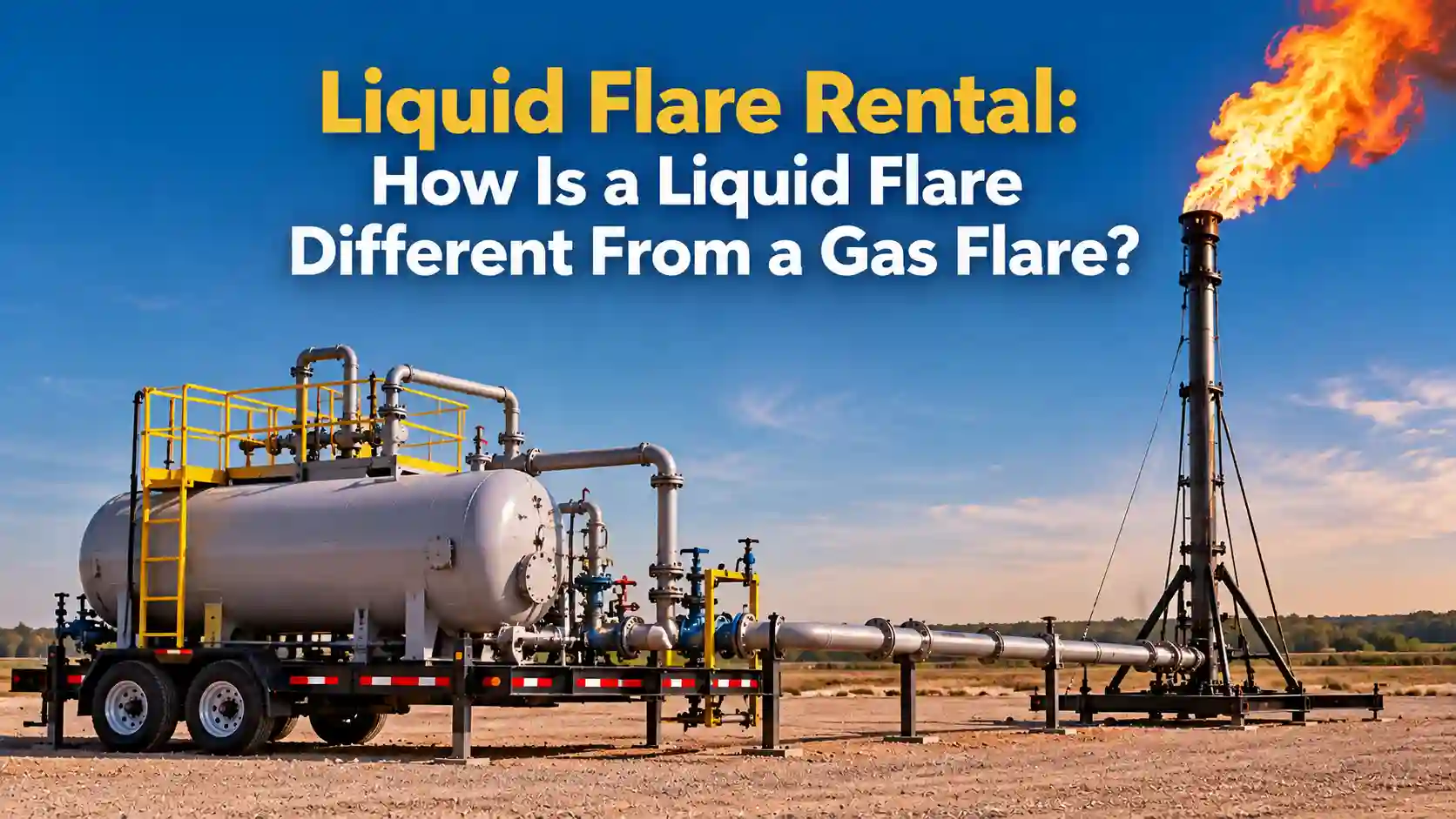
For temporary blowdown, venting, and maintenance operations where the gas stream may contain liquid hydrocarbons, the industry-standard approach is to install a liquid knockout drum upstream of the flare rather than route the two-phase stream to the flare tip directly. The knockout drum reduces vapor velocity, allows gravity to separate liquid droplets from the gas, collects the liquid in a sump, and passes only the dry gas to the flare stack. This approach is well established in permanent flare system design and translates directly to rental applications.
Hero Process Solutions rents liquid knockout systems as part of the combustion equipment package for operations involving condensate-rich gas, pipeline segments with liquid content, and process streams where phase separation is uncertain liquid knockout systems. The knockout drum is sized to the expected liquid volume and the liquid holdup requirement for the specific relief contingency, using the same API Standard 521 and Souders-Brown sizing methodology applied to permanent facilities.
The result is a rental combustion package that separates the liquid from the gas upstream, allows each phase to be handled appropriately, and delivers dry gas to a standard portable flare for compliant combustion at 98 percent DRE or better. The liquid collected in the knockout drum is held and removed by vacuum truck or pumped to an appropriate storage vessel. This approach is more readily available on a rental basis than a complete liquid flare system and is suitable for the majority of temporary field operations that encounter liquid-bearing gas streams.
4. When the Stream Is Primarily Liquid
The knockout drum approach applies when the process stream is predominantly gas with some liquid content. When the stream is primarily liquid hydrocarbon, the equipment required is different. A predominantly liquid stream cannot be processed through a standard portable flare even with an upstream knockout drum, because the volume of liquid is too large for a drum of practical rental size to handle, and the gas phase, if any, may not be sufficient to sustain stable flare combustion on its own.
For predominantly liquid streams that require combustion disposal, the appropriate rental equipment is a thermal oxidizer or a liquid-capable enclosed combustor. Thermal oxidizers are designed to handle liquid hydrocarbons by atomizing the liquid into a combustion chamber where temperature and residence time are controlled to achieve complete oxidation. Hero’s rental equipment line includes thermal oxidizers for applications that exceed the capability of a portable flare and knockout drum combination.
The practical test for which approach applies is the gas-to-liquid ratio at flowing conditions. Streams with a condensate-to-gas ratio in the range typical of condensate-rich natural gas streams (tens to a few hundred barrels per million standard cubic feet) are generally handled well by a knockout drum and portable flare combination. Streams with CGR values approaching or exceeding the range associated with gas condensate liquids or process condensate at separator conditions may require a thermal oxidizer evaluation. Providing the CGR and stream conditions at the time of the rental inquiry allows Hero to confirm the appropriate equipment.
Stream Type and Equipment Selection Summary
| Stream Type | Liquid Content | Recommended Approach | Hero Equipment |
|---|---|---|---|
| Dry gas blowdown | None or trace | Standard portable flare | Trailer-mounted portable flare |
| Gas with minor liquid carryover | Entrained droplets, low volume | KO drum upstream of portable flare | Liquid knockout drum + portable flare |
| Condensate-rich gas | Moderate liquid dropout at conditions | KO drum sized for liquid holdup + portable flare | Liquid knockout drum + portable flare |
| Predominantly liquid stream | Primary phase is liquid hydrocarbon | Thermal oxidizer or enclosed combustor | Thermal oxidizer rental |
| Two-phase PSV discharge | Mixed liquid and vapor from relief valve | Horizontal KO drum (slug capacity) + flare | Horizontal knockout drum + portable flare |
5. Sizing Inputs for Liquid-Bearing Stream Applications
Sizing a rental combustion package for a two-phase or liquid-bearing stream requires more information than sizing for a dry gas blowdown. In addition to the gas flow rate and composition, the following liquid-phase data must be provided to select and size the knockout drum and confirm flare suitability for the gas phase.
Condensate-to-gas ratio (CGR). Expressed in barrels of condensate per million standard cubic feet (bbl/MMSCF). The CGR at flowing conditions, not at stock tank conditions, is the relevant figure for sizing the knockout drum liquid holdup volume.
Free water production rate. Produced water that enters the flare header alongside gas must be accounted for in the knockout drum sizing. A three-phase knockout drum (gas, oil, water) may be required if both condensate and free water are present.
Slug potential. For pipeline pigging operations, the liquid slug volume from the pig run should be estimated from the line configuration and liquid fill rate. Slug capacity drives the knockout drum liquid holdup volume and typically requires a horizontal drum rather than a vertical unit.
Pipeline and separator configuration. Whether the gas entering the temporary flare system has passed through any upstream separator or has come directly from the line without prior separation. An unseparated line segment is more likely to deliver a two-phase stream than a line downstream of an operating separator.
6. Regulatory Considerations for Liquid-Bearing Streams
The combustion efficiency requirements under EPA 40 CFR Part 60.18 apply to the gas-phase hydrocarbon at the flare tip. When a knockout drum precedes the flare and effectively separates the liquid from the gas, the flare receives a dry gas stream and can achieve the required 98 percent DRE on that stream, provided gas composition and tip conditions remain within the allowable range.
The liquid collected in the knockout drum is not combusted and is not subject to the flare’s DRE performance standard. It is a liquid hydrocarbon stream that must be managed through appropriate storage and disposal methods. For facilities subject to EPA 40 CFR Part 60 Subpart OOOOb, the applicable requirements for tank storage of collected condensate, including any vapor recovery or control requirements on the storage vessel, should be reviewed before the collected liquid is transferred to a temporary storage tank.
For applications where the gas phase includes regulated VOCs or HAPs that are not adequately captured by the gas flare combustion zone, an enclosed vapor combustor with higher DRE performance, or a thermal oxidizer with a verified destruction efficiency above 98 percent for specific compounds, may be required. Providing the full gas composition and the applicable air permit conditions allows Hero to confirm whether the proposed rental equipment meets the regulatory requirements for the specific application.
Frequently Asked Questions
Can a standard portable gas flare handle any liquid carryover at all?
A portable gas flare is not designed for liquid throughput, and routing liquid-bearing streams to a standard gas flare tip without upstream separation creates incomplete combustion and safety hazards. For streams with even minor liquid carryover potential, a liquid knockout drum upstream of the flare is the correct approach. Hero includes liquid knockout equipment as part of the rental package when stream conditions indicate liquid presence.
What is a liquid knockout drum and why is it required with a portable flare for two-phase streams?
A liquid knockout drum is a pressure vessel installed upstream of the flare that reduces gas velocity so that gravity separates entrained liquid droplets from the gas stream. The liquid settles to the sump, and the dry gas continues to the flare stack. The drum is sized for the liquid holdup volume of the largest expected single release using API Standard 521 methodology. Without the knockout drum, liquid reaching the flare tip causes incomplete combustion and potential burnback or tip damage.
Does Hero rent liquid knockout drums alongside portable flares?
Yes. Hero rents liquid knockout systems as part of the combustion equipment package for operations involving condensate-rich gas or two-phase streams. The knockout drum is sized to the specific stream conditions and paired with the appropriate portable flare for the gas phase. Visit liquid knockout systems for product details or contact Hero at (918) 941-2166 to discuss the rental scope for a specific application.
When would a thermal oxidizer be more appropriate than a portable flare for a liquid-bearing stream?
A thermal oxidizer is the more appropriate choice when the stream is primarily liquid hydrocarbon rather than a gas with liquid carryover, when the liquid volume exceeds what a portable knockout drum can manage for the available project footprint, or when the permit requires DRE performance above what a portable flare system achieves on the combined stream. Hero’s rental combustion equipment includes thermal oxidizers for these applications.
What information should be provided when inquiring about rental combustion equipment for a liquid-bearing stream?
Provide the gas flow rate, gas composition or BTU value, the condensate-to-gas ratio at flowing conditions, any free water production rate, the anticipated liquid slug volume for pigging operations, the available pressure at the point of connection, and the applicable air permit conditions. With this information, Hero can size the knockout drum, confirm the appropriate portable flare capacity for the gas phase, and recommend whether a thermal oxidizer is required. Contact Hero at contact Hero Process Solutions to begin the equipment inquiry.
Request Rental Equipment for Liquid-Bearing Gas Streams
Hero Process Solutions provides rental liquid knockout systems, portable flares, and thermal oxidizers for operations involving condensate-rich gas, two-phase process streams, pipeline pigging, and well test operations where liquid handling is part of the combustion scope. The combination of a liquid knockout drum and a portable flare covers most temporary field applications that would otherwise require a liquid flare system.
Contact Hero at (918) 941-2166 or visit portable flare and equipment rentals to start the inquiry. Providing stream conditions and permit requirements at the time of contact allows Hero to confirm the right equipment package for the application.