
OIL & GAS EQUIPMENT | Updated May 2026 | 7 min read
What You’ll Learn in This Guide
- How to define the design basis for a utility flare system using API Standard 521 contingencies
- How to calculate worst-case relief mass flow from cooling-water failure, power loss, blocked outlet, and fire scenarios
- How to size utility flare stack diameter and height for emergency-only service
- How to set stack height using API 521 radiation criteria
- How to specify pilot and ignition redundancy for always-ready service
- How utility flare sizing differs from continuous-service flare sizing
- Common utility flare system sizing mistakes and how to avoid them
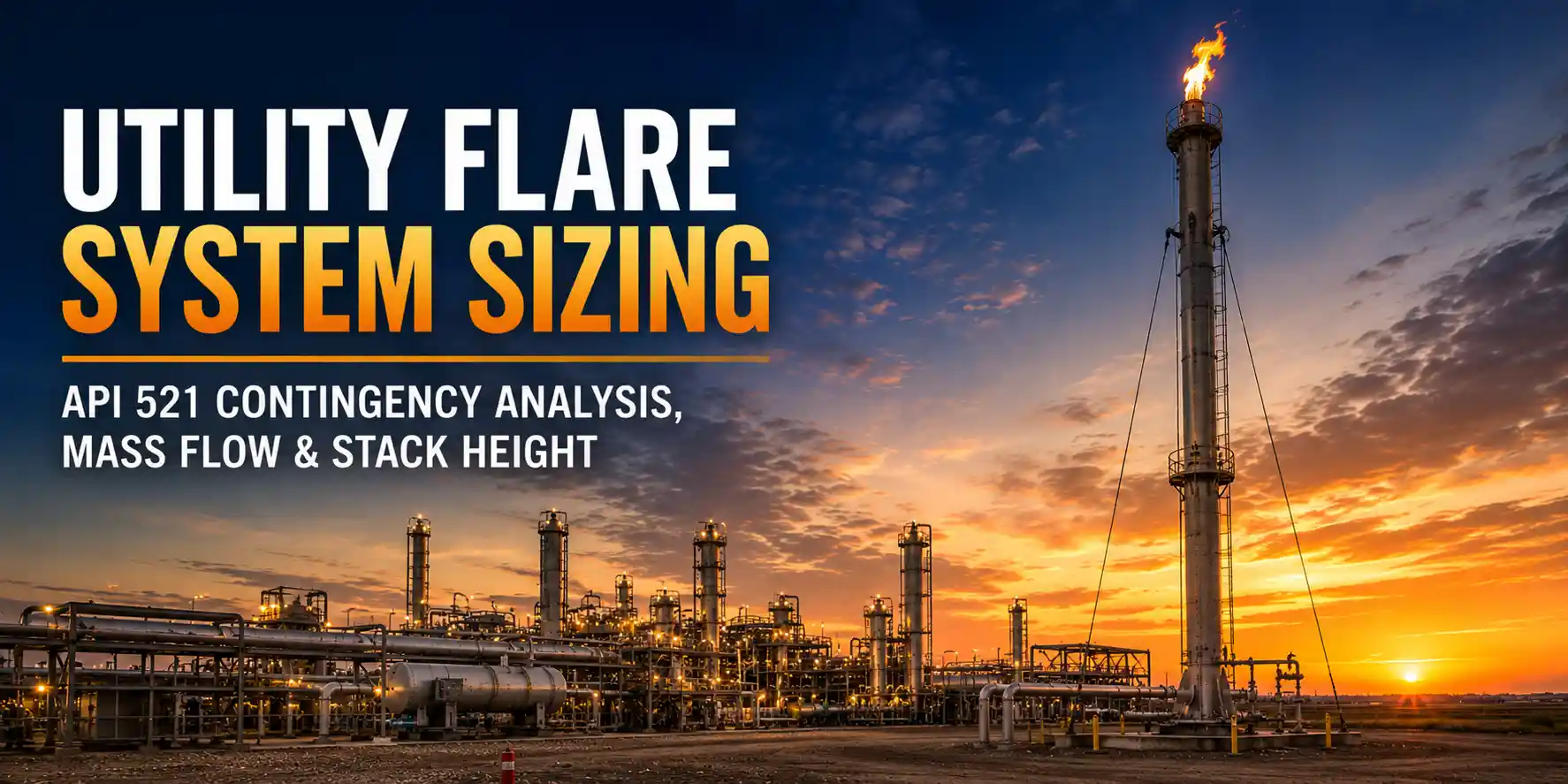
A utility flare system handles the worst-case emergency relief load a facility can produce — not the average flow, not the peak operating flow, but the catastrophic single-event release that the facility hopes will never happen. Get the sizing wrong and the relief header backpressures past PSV limits during the contingency that finally arrives. Oversize the stack and the project carries decades of unnecessary capital and maintenance. The correct approach is API Standard 521 contingency analysis followed by integrated stack and tip sizing.
Hero Process Solutions, founded in 2011 and headquartered in Kellyville, Oklahoma with operations in Midland, Texas, manufactures utility flare systems as turnkey emergency-relief packages for upstream production, midstream gas processing, refining, and petrochemical applications. This guide walks through the sizing methodology for a utility flare system specified to handle worst-case emergency relief without smoking violations, stack overheat, or backpressure-induced PSV failures.
DIRECT ANSWER: A utility flare system is sized by working backward from the worst-case API Standard 521 contingency relief load. The four standard contingencies — cooling water failure, power loss, blocked outlet, and fire case — each generate a different relief flow and composition. The utility flare must handle the largest of these, with stack diameter set by exit velocity limits (Mach 0.5 maximum for utility tips), stack height set by API 521 thermal radiation at 1,500 Btu/hr/ft² for emergency releases, and pilot system specified for always-ready operation regardless of how rarely the flare actually sees flow.
1. How to Define the Design Basis for a Utility Flare System
Utility flare system sizing starts with API Standard 521 contingency analysis. API 521 identifies the discrete emergency events a process facility can experience, the relief load each event produces, and the controlling design basis (typically the largest single relief event the system must handle). The standard contingencies include power loss to compressors and pumps, cooling-water failure, control system failure, fire case (external fire heating a vessel), blocked outlet, automatic control failure, reflux loss, and tube rupture in a heat exchanger.
Each contingency is evaluated independently to determine its relief flow rate, gas composition, temperature, and which PSVs lift. The utility flare must handle the largest of these — not the sum, because API 521 generally does not require simultaneous unrelated contingencies. The exception is when a single root cause (such as facility-wide power loss) triggers multiple PSVs at once, in which case the simultaneous load is the design basis.
2. How to Calculate Worst-Case Relief Mass Flow
Each contingency calculation follows the same workflow. Identify the equipment affected by the contingency. Calculate the heat input or pressure rise that the contingency imposes. Calculate the corresponding relief flow at the PSV. Sum the relief flows from all PSVs that lift during this contingency. The result is the contingency relief load in pounds per hour.
Fire case relief is calculated using API 521 wetted-area heat input equations, with Q = 21,000 × F × A^0.82 Btu/hr for typical hydrocarbon service, where F is an environment factor (1.0 for unprotected, lower for insulated or fireproofed equipment) and A is the wetted vessel area in square feet. The resulting heat input vaporizes liquid inventory; relief flow is heat input divided by latent heat of vaporization.
Power loss relief is calculated from the equipment affected — typically the largest reflux pump or compressor whose loss eliminates a normal heat sink. Cooling-water failure is calculated from the heat duty of the affected coolers, which becomes relief load when heat cannot be removed.
KEY INSIGHT: Fire case is almost always the largest contingency for a utility flare in oil and gas service. Power loss, cooling-water failure, and control failure each affect a subset of the plant; fire case can engulf an entire vessel inventory and produce relief loads many times larger than any operational contingency.
3. How to Size Utility Flare Stack Diameter
Once the worst-case mass flow is established, stack diameter is sized from exit velocity limits. API 521 limits exit velocity for utility (open-pipe) tips to approximately Mach 0.5 at the stack exit during peak design flow. Above Mach 0.5, flame stability begins to degrade and flame liftoff becomes a risk; high-velocity emergency flares are an exception requiring specialized tip designs.
Stack diameter is therefore calculated from D = sqrt((4 × actual volumetric flow) / (π × design exit velocity)). For a worst-case relief of 500,000 lb/hr of natural gas at flare exit conditions (approximately 1500°F flame temperature, 14.7 psia), the volumetric flow is roughly 6.5 million acfm, and a Mach 0.5 design velocity yields a stack inside diameter of approximately 6 to 8 feet depending on gas composition and exit temperature.
For lower-flow upstream and midstream utility flares, stack diameters typically run 24 inches to 48 inches.
4. How to Determine Utility Flare Stack Height
Stack height for a utility flare is set by the more conservative of two criteria. The first is API Standard 521 thermal radiation. Ground-level radiation at occupied areas is limited to 1,500 Btu/hr/ft² for emergency releases lasting less than 5 minutes (operator escape scenarios) and lower for personnel exposure. The second is dispersion: ground-level concentrations of unburned hydrocarbons during flameout, plus combustion products NOx and CO, must remain below applicable air-quality standards.
Radiation is calculated using q = τ × F × Q / (4π × d²), where Q is the heat release at peak relief, F is the heat-radiation fraction (0.15 to 0.30 for typical flare gases), τ is atmospheric transmissivity (about 0.85), and d is the distance from the flame center to the point of interest. Solve for d to find the radius at which radiation drops to the 1,500 Btu/hr/ft² limit, then position the flame center (top of stack plus half flame length) so that the limit is met at the property boundary or occupied area.
Utility flare stack heights typically range from 60 feet for small upstream applications to over 200 feet for major refinery installations.
5. How Utility Flare Sizing Differs from Continuous-Service Flare Sizing
A continuous-service flare (vapor combustor, low-flow flare, vent gas flare) is sized for the steady-state vent rate plus reasonable excursions. A utility flare system is sized for the single largest credible emergency event, which is often 10 to 100 times larger than any continuous flow the facility produces. That difference drives three engineering choices.
First, a utility flare is typically an open-pipe or simple-profile tip (no air-assist blower, no sonic profile) because emergency relief gases are usually clean light hydrocarbons that burn smokelessly at high velocity even without auxiliary mixing. Second, the stack is taller because peak heat release is much higher. Third, the pilot system must be engineered for high reliability over years of standby — the pilot is the critical component because the flare itself sees relief only rarely.
6. Utility Flare vs Other Flare Configurations
| Flare Type | Service | Capacity Range | When Utility Flare Wins |
|---|---|---|---|
| Utility Flare (open pipe) | Emergency relief only, light clean gases | Up to 1,000,000+ lb/hr | Worst-case contingency relief, infrequent flow |
| Sonic Flare | Continuous or emergency, high inlet pressure | Up to millions of lb/hr in staged designs | Smokeless service needed at high pressure |
| Air-Assisted Flare | Continuous smokeless service, low pressure | Up to 250,000+ lb/hr | Smokeless required, pressure too low for sonic |
| Low Flow Flare | Storage tank vent, well site | Low continuous flow | Not for emergency contingency loads |
| Portable Flare | Commissioning, blowdown, temporary | Variable | Short-term, not for permanent emergency duty |
Across the full industrial flare systems portfolio, the utility flare is the standard choice when the service is purely emergency relief of clean gases and the design driver is worst-case API 521 contingency load.
7. EPA OOOOb Compliance for Utility Flare Systems
For utility flare systems on affected oil and natural gas facilities, EPA OOOOb compliance applies whenever the flare is used as a control device for routine or non-emergency releases. Pure emergency-only utility flares may have reduced monitoring obligations under OOOOb’s emergency-flaring provisions, but they still require continuous pilot monitoring, periodic visual inspection, and recordkeeping for any flare event including initial commissioning and annual testing.
The compliance pathway depends on the facility’s permit and the specific use case for the utility flare. Field commissioning support for the initial OOOOb performance test is included with Hero’s turnkey utility flare packages.
8. Common Utility Flare System Sizing Mistakes
| Mistake | Why It Hurts | Fix |
|---|---|---|
| Sizing for normal operating relief instead of worst-case contingency | Stack and tip overwhelmed during fire case or power loss | Run full API 521 contingency analysis, design to the largest |
| Ignoring fire case in upstream and midstream applications | Fire case is almost always the largest single contingency | Always include fire case using API 521 wetted-area equations |
| Skipping radiation calculation at property boundary | Ground-level radiation exceeds API 521 limit, occupational hazard | Calculate q at property line and adjust stack height accordingly |
| Single pilot with no redundancy on always-ready service | Pilot failure means flare cannot ignite during emergency relief | Specify redundant pilots and self-checking ignition system |
| Designing exit velocity above Mach 0.5 for open-pipe tip | Flame liftoff, blowout risk during relief | Limit exit velocity per API 521; use high-velocity tip if higher needed |
| Treating utility flare like a continuous flare for OOOOb | Misclassification creates compliance complications | Confirm emergency vs control-device classification with permit |
Frequently Asked Questions
What is a utility flare system used for?
A utility flare system is used for emergency relief of waste gas during upset conditions — equipment failure, power loss, cooling-water failure, fire, or blocked outlet scenarios. It is sized to handle the worst-case single contingency identified under API Standard 521, not for routine operational venting. The flare sits in standby with a continuously lit pilot and ignites the relief stream only when a PSV opens upstream.
How is worst-case relief load calculated for a utility flare?
Each API 521 contingency is evaluated independently to determine its relief load. Fire case uses Q = 21,000 × F × A^0.82 Btu/hr for typical hydrocarbon service, with F being an environment factor and A the wetted vessel area. Power loss, cooling-water failure, and other operational contingencies are calculated from the affected equipment. The utility flare is sized for the largest single contingency, which in oil and gas is almost always fire case.
What is the maximum exit velocity for a utility flare tip?
API Standard 521 limits exit velocity for utility (open-pipe) flare tips to approximately Mach 0.5 at peak design flow. Above Mach 0.5, flame stability degrades and flame liftoff becomes a risk. Applications requiring higher exit velocity use specialized high-velocity tip designs with additional stability features.
How tall does a utility flare stack need to be?
Stack height is set by API Standard 521 thermal radiation at occupied areas (typically 1,500 Btu/hr/ft² for emergency releases under 5 minutes) or by dispersion modeling for ground-level concentrations during flameout, whichever is taller. Utility flare stacks typically range from 60 feet for small upstream applications to over 200 feet for major refinery installations.
Does a utility flare need a continuously lit pilot?
Yes. Because emergency relief can happen at any moment without warning, a utility flare system requires a continuously lit pilot ready to ignite the main flow. Pilot redundancy (multiple pilots) and self-checking ignition systems are typically specified because the flare’s value is entirely defined by its ability to ignite reliably when called. The pilot ignition system is the most critical reliability component in a utility flare.
What sizing data does Hero Process Solutions need to quote a utility flare?
Hero typically asks for worst-case relief mass flow from API 521 contingency analysis, gas composition with heating value and molecular weight, temperature at relief conditions, site layout for radiation modeling and property boundary distance, operating contingencies that drive the design, and OOOOb compliance classification. With those inputs, the utility flare system can be sized including stack, tip, pilot, ignition system, monitoring, and controls.