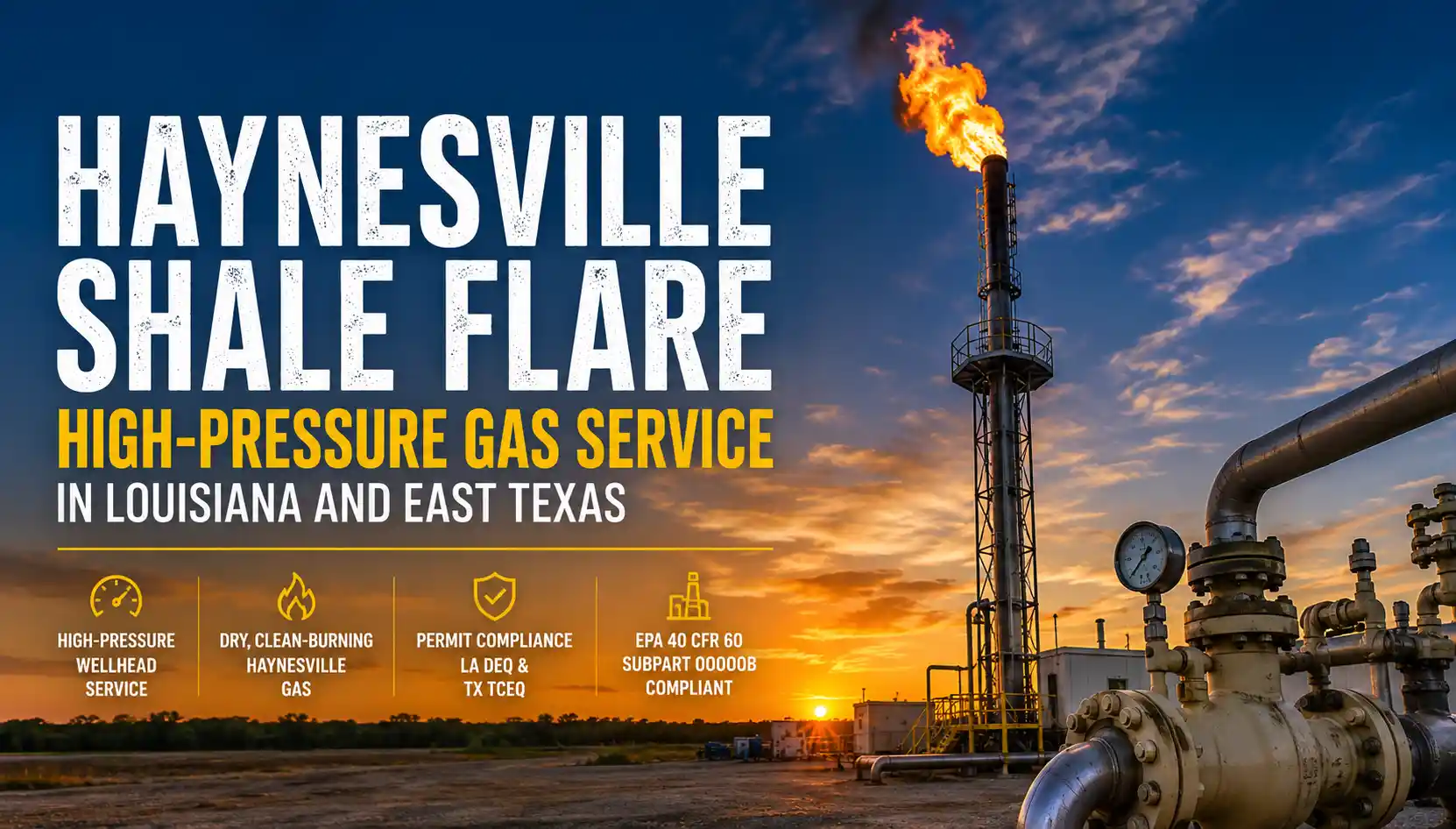
UPSTREAM COMBUSTION EQUIPMENT | HAYNESVILLE SHALE | Updated August 2026 | 8 min read
WHAT YOU’LL LEARN IN THIS GUIDE
- Why Haynesville shale high-pressure, high-flow wells create specific flare sizing requirements
- How dry Haynesville gas composition affects flare tip selection and combustion efficiency
- Louisiana DEQ and Texas TCEQ permit requirements for Haynesville shale flares
- EPA 40 CFR 60 Subpart OOOOb requirements for Haynesville shale production facilities
- Flare header and knockout drum design for high-pressure Haynesville well test and completions service
- How the proximity of Haynesville acreage to LNG export infrastructure affects flaring economics
- Equipment options for high-pressure Haynesville shale flare service
Haynesville shale wells produce dry gas at some of the highest wellhead pressures in the US onshore market. Initial production (IP) rates on Haynesville wells routinely exceed 20-30 MMscfd in the core of the play, and wellhead pressures during completions and flowback can exceed 5,000 psi. These operating conditions create flare system design requirements that differ significantly from lower-pressure shale plays, and equipment specified for Appalachian or Permian Basin service may not be adequate for Haynesville high-pressure gas service without design modifications.
Hero Process Solutions, founded in 2011 and headquartered in Kellyville, Oklahoma, manufactures combustion equipment for high-pressure gas service applications including Haynesville shale completions, well test, and production site flares. This guide covers the gas composition characteristics, pressure system design requirements, regulatory framework, and equipment choices specific to Haynesville shale flare applications in Louisiana and East Texas.
DIRECT ANSWER: Haynesville Shale Flare
A Haynesville shale flare is a combustion device for Louisiana and East Texas production sites where dry, high-pressure natural gas from the Haynesville formation cannot be captured and must be combusted during completions, well testing, or emergency relief operations. Haynesville flares must handle high wellhead pressures requiring pressure letdown systems upstream of the flare tip, large instantaneous flow rates during initial production, and Louisiana DEQ or Texas TCEQ permit compliance. EPA 40 CFR 60 Subpart OOOOb’s 98% combustion efficiency requirement applies to flares at affected Haynesville production facilities. Dry Haynesville gas is a clean-burning fuel that does not require steam or air assist for smokeless operation at most Haynesville flow conditions, which simplifies tip selection relative to NGL-rich plays.
1. Haynesville Shale Gas Characteristics and What They Mean for Flare Design
Haynesville shale gas is dry, methane-dominated gas with a heating value near 1,020-1,050 BTU/scf and minimal NGL content. This contrasts sharply with Permian Basin casinghead gas or southwestern Marcellus wet gas, where high NGL content drives smokeless capacity requirements and assist medium selection. For Haynesville dry gas, the flare tip smokeless performance requirement is relatively straightforward — dry methane-rich gas does not produce significant smoke in an open flare tip at flow rates within the tip’s design velocity range.
What makes Haynesville flare design challenging is not the gas composition but the pressure and flow conditions at which it must be controlled.
High initial wellhead pressure. Haynesville wells are completed into a formation with reservoir pressures of 8,000-10,000 psi in the core play area. Wellhead pressures at first production typically run 3,000-6,000 psi, which must be reduced to flare header operating pressure through a pressure letdown system before the gas reaches the flare tip. Pressure letdown through choke valves or pressure control valves generates significant noise and can create hydrate or ice formation risk if gas temperature drops below the hydrate formation temperature during expansion.
High instantaneous flow rates. IP rates on Haynesville wells require flare systems sized for very large instantaneous gas flows during completions flowback and the early production period. A flare tip sized for normal production operations may be undersized for the completions flowback rate, leading to tip overpressure or blowout conditions. Completions flare systems for Haynesville wells must be sized for the maximum expected flowback rate, not the plateau production rate.
2. Pressure Letdown and Flare Header Design for Haynesville Service
The pressure letdown system between the Haynesville wellhead and the flare tip is a critical component that does not exist in most lower-pressure shale plays. Design requirements include:
Choke valve or pressure control valve selection. The primary pressure letdown device must be sized for the full range of wellhead pressures and flow rates expected during the operation. For completions flowback service, this means sizing for the maximum flowback pressure and rate during the highest-pressure period of the flowback, which occurs in the first hours to days of opening the well to flow. Undersized choke valves erode rapidly in high-velocity Haynesville gas service.
Hydrate prevention. High-pressure dry gas expands across the pressure letdown device, and the resulting Joule-Thomson cooling can drop the gas temperature below the hydrate formation temperature. Hydrate plugging in the flare header or knockout drum is a documented operational problem at Haynesville sites during completions and early flowback. Chemical injection of methanol or glycol at the letdown valve inlet, or trace heat on the downstream piping, prevents hydrate accumulation.
Knockout drum sizing. Haynesville gas during completions flowback carries significant liquid loading from completion fluid returns and condensate. The knockout drum upstream of the flare must be sized to remove this liquid before it enters the flare header. Undersized knockout drums allow liquid carryover into the flare, which causes pilot flame instability, incomplete combustion, and potential fire at the base of the flare stack from liquid fallout.
KEY INSIGHT
The knockout drum for a Haynesville completions flare must be sized for the maximum liquid rate expected during the peak completions flowback period, which is typically 5-10 times higher than the liquid rate during the subsequent production phase. Operators who size the knockout drum for production operations and then use it for completions flowback often experience liquid carryover events in the first 24-72 hours of flowback, when liquid rates are highest and the consequences of incomplete liquid removal are most severe.
3. Louisiana DEQ Permit Requirements for Haynesville Shale Flares
The majority of the Haynesville shale play lies in northwestern Louisiana, primarily in DeSoto, Red River, Sabine, and Bossier parishes. Louisiana DEQ regulates air emissions at Haynesville production sites under the Louisiana Environmental Quality Act and Louisiana Administrative Code Title 33.
Production site flares in Louisiana are typically authorized under DEQ’s General Air Permit for Oil and Gas Production Facilities, which sets operational standards for flares including combustion efficiency requirements, pilot monitoring provisions, and reporting obligations. Facilities above the General Permit emission thresholds require a facility-specific Minor or Major Source Air Permit from Louisiana DEQ.
Louisiana DEQ has historically been more administratively streamlined for oil and gas permitting than some other producing states, but regulatory scrutiny of flaring practices has increased following EPA OOOOb implementation and increased public attention to methane emissions from the LNG corridor in southern Louisiana.
4. Texas TCEQ Requirements for East Texas Haynesville Flares
The East Texas extension of the Haynesville play covers Panola, Shelby, and Nacogdoches counties in Texas, where TCEQ jurisdiction applies. Texas TCEQ permit requirements for Haynesville shale production site flares follow the same framework as Permian Basin sites: GP-5A equivalent provisions under TCEQ Chapter 106 permit by rule for facilities below emission thresholds, and New Source Review permits for higher-emission facilities.
TCEQ’s active inspection and enforcement program in East Texas means that Haynesville operators on the Texas side of the play must maintain rigorous permit compliance documentation, including pilot monitoring records and combustion efficiency verification.
5. EPA OOOOb at Haynesville Shale Production Sites
EPA 40 CFR 60 Subpart OOOOb applies to new, modified, and reconstructed production sites at Haynesville shale operations. The 98% combustion efficiency requirement and continuous pilot monitoring requirements are the same as for other producing regions.
For Haynesville operators, the OOOOb pilot monitoring requirement has specific relevance during high-pressure completions flowback operations, when the instantaneous gas rate to the flare is highest and flare conditions are most dynamic. Pilot flame monitoring during these periods is both an OOOOb requirement and a safety-critical function. A pilot blowout during peak Haynesville flowback with 30 MMscfd unburned gas flowing to atmosphere is a serious safety event, not just a compliance issue.
The OOOOb compliance resources at Hero Process Solutions cover pilot monitoring system design and documentation requirements for Haynesville shale affected facilities.
6. LNG Proximity and the Economics of Haynesville Flaring
Haynesville shale gas flows to LNG export terminals on the Gulf Coast, making it some of the most economically valuable dry gas produced in the US. The proximity to LNG infrastructure gives Haynesville operators a stronger economic incentive to capture gas and a lower economic tolerance for flaring than operators in basins more distant from premium-price markets.
For Haynesville operators, investing in a higher-quality flare system with reliable pilot monitoring, adequate knockout drum capacity, and proper pressure letdown design reduces the risk of operational events that interrupt gas sales during completions and early production, when gas prices are highest relative to well cost.
7. Haynesville Shale Flare Equipment from Hero Process Solutions
Hero Process Solutions manufactures combustion equipment for high-pressure gas service, including configurations appropriate for Haynesville shale completions and production site applications.
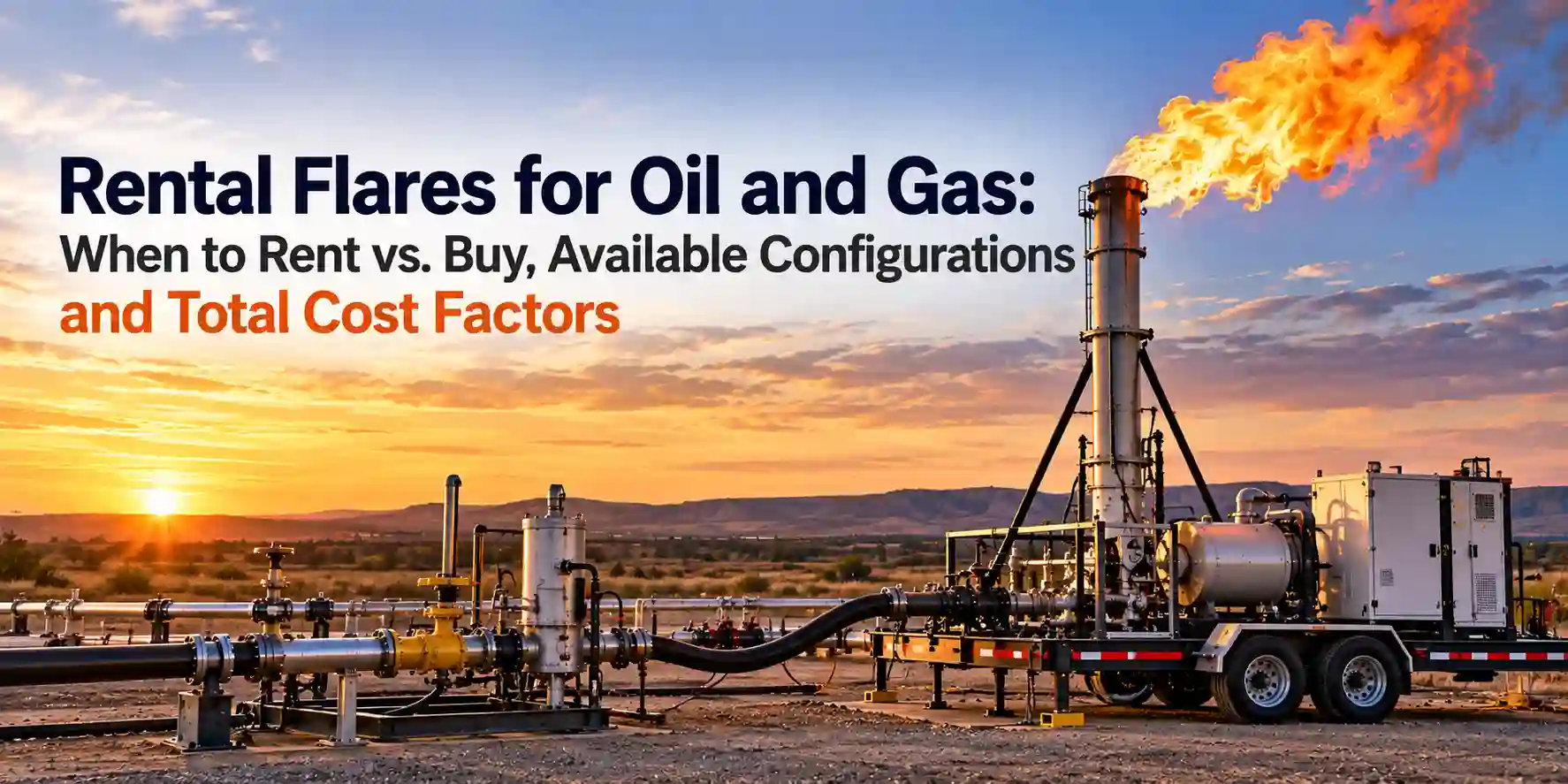
For completions and well test service, skid-mounted or trailer-mounted flare systems with integrated pressure letdown, knockout drum, and flare tip are available in flow capacities appropriate for Haynesville IP rates. The portable flares product line includes high-pressure configurations for completions flowback service.
For permanent production site flare installations, elevated utility or air-assist designs with fixed foundations and SCADA-compatible pilot monitoring outputs are the standard configuration. Contact sales@hero-ps.com or (918) 941-2166 to discuss equipment specifications for a Haynesville shale project in Louisiana or East Texas. Field services include commissioning and performance testing for new Haynesville installations.
Article Summary
- Haynesville shale wells produce dry, high-BTU gas at wellhead pressures of 3,000-6,000 psi and IP rates exceeding 20-30 MMscfd in the core play area, creating flare system design requirements that differ from lower-pressure shale plays.
- Dry Haynesville gas is a clean-burning fuel that does not require steam or air assist for smokeless combustion, simplifying tip selection relative to NGL-rich plays. The design complexity is in the pressure letdown system, knockout drum, and hydrate prevention, not the flare tip itself.
- Pressure letdown systems must be sized for maximum wellhead pressure and completions flowback rate. Hydrate prevention at the letdown valve is required because of Joule-Thomson cooling during high-pressure gas expansion.
- Knockout drums for Haynesville completions flares must be sized for the peak liquid rate during completions flowback, which is typically 5-10 times higher than the subsequent production-phase liquid rate.
- Louisiana DEQ General Air Permit and Texas TCEQ Chapter 106 Permit by Rule are the standard permit pathways for Haynesville shale production site flares. EPA OOOOb’s 98% combustion efficiency and pilot monitoring requirements apply at affected facilities.
- Haynesville’s proximity to Gulf Coast LNG export terminals makes captured gas especially valuable and strengthens the economic case for reliable, high-performance flare systems that minimize gas losses during completions events.
- Hero Process Solutions manufactures high-pressure flare systems for Haynesville completions and production site service, with field commissioning support for Louisiana and East Texas installations.
Frequently Asked Questions
What type of flare is used for Haynesville shale wells?
Haynesville shale wells produce dry, methane-dominated gas that combusts cleanly without steam or air assist, so open utility or elevated flare tips are the standard choice for production site flares. The more complex design elements are the pressure letdown system upstream of the flare (to reduce 3,000-6,000 psi wellhead pressure to flare header pressure) and the knockout drum (to remove completions fluid and condensate before the gas reaches the flare tip). Completions flowback flares must be sized for the maximum expected flowback rate, which substantially exceeds the plateau production rate.
Why is hydrate formation a concern at Haynesville flare systems?
Haynesville dry gas expands from 3,000-6,000 psi wellhead pressure to flare header pressure through a pressure letdown valve. The Joule-Thomson cooling that occurs during this high-pressure expansion drops the gas temperature, sometimes below the hydrate formation temperature, especially during cold ambient conditions. Hydrate plugging in the downstream piping and knockout drum is a documented Haynesville operational problem. Prevention requires methanol or glycol injection at the letdown valve inlet, or trace heat on downstream piping in cold-climate periods.
What EPA regulations apply to Haynesville shale flares?
EPA 40 CFR 60 Subpart OOOOb applies to new, modified, and reconstructed production sites throughout the Haynesville play in Louisiana and Texas. OOOOb requires 98% combustion efficiency for flares used as control devices at affected facilities, plus continuous pilot flame monitoring and record-keeping. Louisiana DEQ and Texas TCEQ permit requirements apply in addition to federal OOOOb for their respective state jurisdictions.
How should a Haynesville completions flare be sized?
Size a Haynesville completions flare for the maximum expected flowback rate during the high-pressure early flowback period, not for the plateau production rate. IP rates on core Haynesville wells exceed 20-30 MMscfd, and initial flowback can peak above this during choke opening in the first hours of the operation. The knockout drum must also be sized for peak completions liquid rates, which are substantially higher than production-phase liquid rates. Using production-phase sizing for a completions application results in tip overpressure and knockout drum liquid carryover events during the highest-risk operating period.
Do Haynesville operators have different flaring economics than other shale plays?
Yes. Haynesville gas flows to Gulf Coast LNG export infrastructure, making it among the most valuable dry gas produced onshore in the US. The strong economic incentive to capture rather than flare Haynesville gas means operators invest in reliable gathering and compression infrastructure. When flaring is unavoidable during completions or emergencies, the value of the gas being lost to flare makes a high-performance, reliable combustion system easier to justify economically than in basins where gas prices are lower.
Does Hero Process Solutions supply flares for Haynesville shale projects?
Yes. Hero Process Solutions manufactures combustion equipment for high-pressure gas service, including configurations for Haynesville shale completions flowback, well test, and permanent production site applications. Equipment includes skid-mounted and trailer-mounted systems with integrated pressure letdown, knockout drums, and flare tips for completions service, plus permanent elevated flare configurations for production site installations. Contact sales@hero-ps.com or (918) 941-2166 for project-specific specifications.