
OIL & GAS EQUIPMENT | Updated May 2026 | 7 min read
What You’ll Learn in This Guide
- How to define the design basis for a gas assisted flare from waste-gas flow and composition
- How to calculate the assist-gas-to-waste-gas mass ratio for smokeless combustion
- How to determine fuel gas pressure and supply requirements for tip operation
- How to select the right gas-assist tip geometry for heavy hydrocarbon streams
- How to calculate smokeless capacity for a gas assisted flare
- Why gas assist beats air assist when electricity is not available on site
- Common gas assisted flare sizing mistakes and how to avoid them
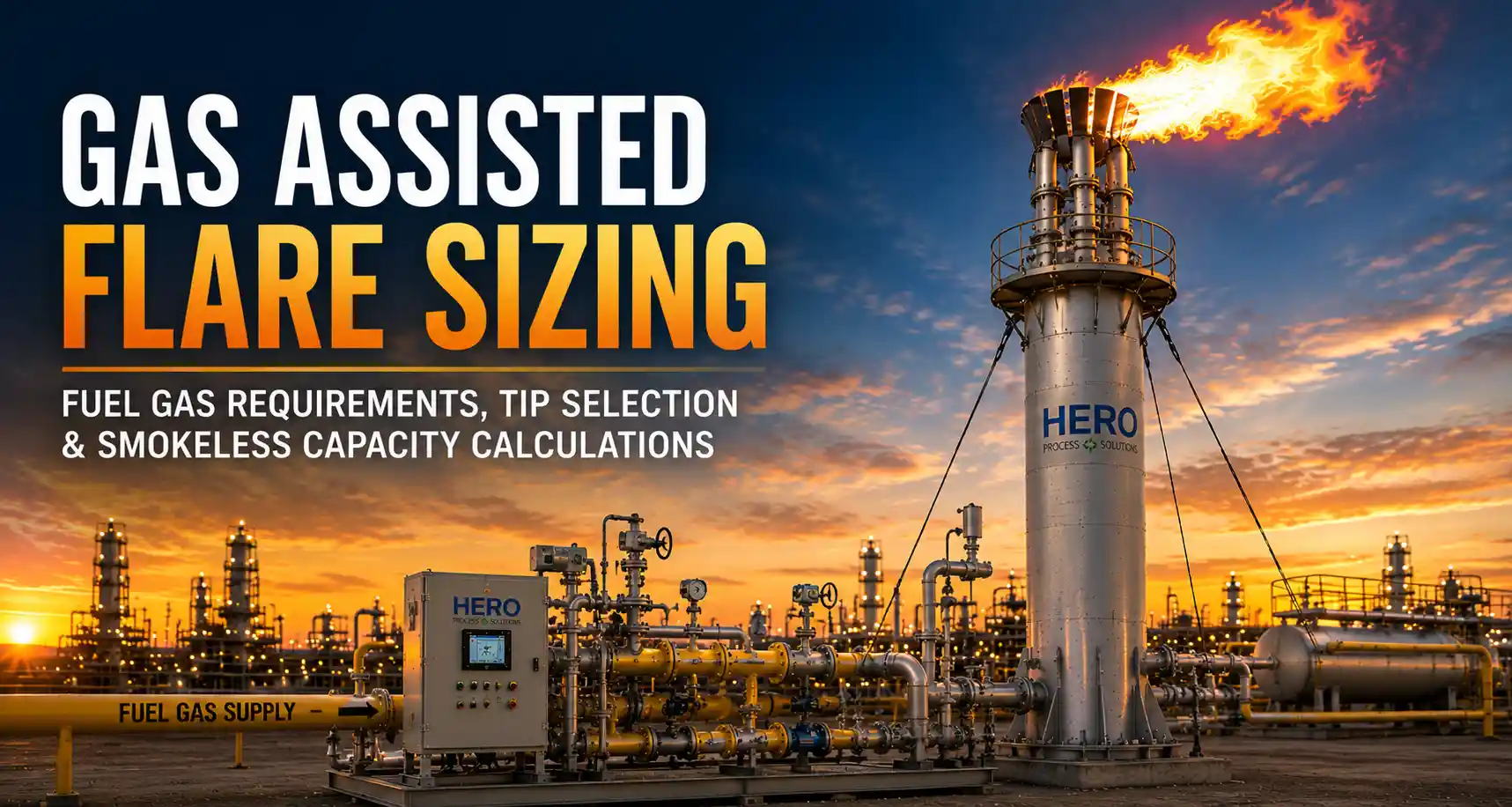
A gas assisted flare uses high-pressure fuel gas — not blower air — to inject momentum and turbulence at the flare tip, producing smokeless combustion of heavy hydrocarbons without rotating equipment. That single design choice changes the engineering brief from a steam-assisted or air-assisted flare. Sizing depends on the assist-gas-to-waste-gas mass ratio, fuel gas pressure at the tip, the tip geometry that converts pressure energy into useful turbulence, and the resulting smokeless capacity over the operating range. Get any one of those wrong and the flare smokes during normal service, fails EPA 40 CFR 60.18 visible-emissions limits, and drops below the 98% Destruction and Removal Efficiency the gas assist tip was specified to deliver.
Hero Process Solutions, founded in 2011 and headquartered in Kellyville, Oklahoma with operations in Midland, Texas, manufactures gas assisted flare systems for upstream production, midstream gas processing, refining, and petrochemical applications. This guide walks through the sizing methodology and explains why gas assist is the right choice at sites where air assist is impractical.
DIRECT ANSWER: A gas assisted flare is sized using four locked-in inputs: peak waste-gas mass flow, waste-gas composition, available fuel gas pressure (typically 50 to 150 psig), and required smokeless capacity. The assist-gas-to-waste-gas mass ratio is typically 0.05 to 0.20 lb fuel gas per lb waste gas for hydrocarbon vapors, with higher ratios for olefin-rich or heavy aromatic streams. Gas assisted flares deliver 98% or better DRE under EPA 40 CFR 60.18 without blowers, motors, or auxiliary electric power.
1. How to Define the Design Basis for a Gas Assisted Flare
The design basis starts with the same two waste-gas inputs that drive every flare sizing exercise: peak mass flow rate (lb/hr) and gas composition. Composition matters more for gas assist than for many other flare types because the assist gas must overcome the soot-formation tendency of heavy hydrocarbons and unsaturated streams. Saturated lighter gases need less assist; heavier or olefin-rich streams need more.
The third critical input is available fuel gas pressure at the flare base. Gas assist tips depend on high-pressure fuel gas — typically 50 to 150 psig delivered at the tip — to inject momentum into the waste-gas stream. If the site cannot reliably supply fuel gas at the design pressure, the gas assist tip cannot do its job. Confirm fuel gas pressure availability under all operating contingencies before committing to gas assist as the flare technology.
The fourth input is the operating envelope. Gas assist flares serve well in continuous smokeless duty up to about 200,000 SCFD of waste gas, with retrofit applications often replacing existing non-assisted or steam-assisted tips on sites where steam or electric is not available.
2. How to Calculate the Assist-Gas-to-Waste-Gas Mass Ratio
The assist-gas-to-waste-gas mass ratio is the central sizing variable. It sets the smokeless capacity, fuel gas consumption, and indirectly the operating cost of the flare over its service life.
For typical hydrocarbon waste gas, the required mass ratio is 0.05 to 0.20 pounds of assist fuel gas per pound of waste gas. The lower end works for saturated light hydrocarbons (methane, ethane) where smokeless combustion is easy to achieve. The upper end is required for streams dominated by C4 and heavier saturates or significant olefin content. Aromatic-heavy streams may push the ratio higher still.
For a 50,000 lb/hr peak waste-gas flow at a 0.15 mass ratio, fuel gas consumption at the tip is 7,500 lb/hr at peak — approximately 4 to 5 MMSCFD of natural gas. That assist fuel gas consumption is the dominant OPEX driver, which is why composition-based control strategies matter so much.
KEY INSIGHT: Sizing the assist-gas ratio at the average waste-gas composition leaves the flare smoking during heavier or olefin-richer excursions. Size for the worst-case composition envelope, not the average, and use composition-based control to reduce fuel gas consumption at lighter compositions.
3. How to Determine Fuel Gas Pressure and Supply Requirements
Gas assist tips require fuel gas pressure at the tip in the 50 to 150 psig range, depending on tip geometry and the targeted smokeless capacity. Fuel gas pressure provides the momentum that drives turbulence at the combustion zone, which is what makes the gas assist tip smokeless.
Three fuel gas supply parameters must be locked into the specification. First, the minimum sustained pressure at the tip across all operating contingencies — not just nominal, because pressure dips during upstream events directly degrade smokeless performance. Second, the fuel gas supply flow capacity at peak waste-gas relief, including the rapid response needed when waste-gas flow spikes. Third, the fuel gas composition, because heating value affects momentum delivery for a given mass flow.
For sites where electric power for an air-assist blower is unavailable or unreliable, gas assist is often the preferred path to OOOOb-grade smokeless flaring — provided the fuel gas supply meets the pressure and flow criteria above.
4. How to Select the Right Gas Assist Tip Geometry
Gas assist tip geometry converts fuel gas pressure energy into turbulent mixing at the combustion zone. Tip selection depends on three variables.
Waste-gas composition drives the choice between a high-stability tip (best for variable composition with heavier components) and a single-stage smokeless tip (best for lighter, more consistent compositions). Hero’s high stability tips use stainless steel construction to ensure long tip life under variable thermal loads.
Smokeless capacity target sets the tip throat area and the number of assist gas injection points. Higher smokeless flow tips require more injection points distributed around the throat circumference to maintain uniform mixing.
Retrofit constraints matter for projects upgrading existing non-assisted or steam-assisted flares. Retrofit tips use “lift and bolt” installation that matches existing stack connections, avoiding stack rework. Most retrofits include spark-ignited pilots and control panels in the same package.
5. How to Calculate Smokeless Capacity for a Gas Assisted Flare
Smokeless capacity is the maximum waste-gas mass flow the tip can burn without visible smoke, given the design assist-gas ratio. EPA 40 CFR 60.18 limits flares to no more than five minutes of visible emissions during any consecutive two-hour period; OOOOb tightens this further for affected sources and adds 98% DRE.
Gas assist tip smokeless capacity scales with both tip throat geometry and assist gas flow rate. Hero’s gas assisted flare tips deliver guaranteed 98% or better hydrocarbon destruction efficiency at the design point, where the design point is set by the worst-case waste-gas composition the flare will see.
Typical practical capacity range for gas assist flaring is up to 200,000 SCFD waste-gas continuous flow, with peak emergency relief capability above that. For higher continuous loads, multi-tip staged configurations are used.
6. Gas Assist vs Air Assist vs Steam Assist: Where Gas Assist Wins
| Flare Type | Smokeless Mechanism | Site Requirement | When Gas Assist Wins |
|---|---|---|---|
| Gas Assisted | High-pressure fuel gas injection at tip | 50-150 psig fuel gas, no electricity needed | Site lacks electric power for blower or steam supply |
| Air Assisted | VFD blower injects ambient air at tip | Reliable electric power for blower motor | Steady continuous service with electric availability |
| Steam Assisted | Steam injection rings at tip | Reliable steam supply (refinery scale) | Refinery sites with available steam infrastructure |
| Sonic | High inlet pressure produces choked-flow turbulence | Waste-gas inlet pressure 15+ psig sustained | Pressure available in waste gas itself |
The most common reason to select gas assist over other smokeless technologies is the absence of reliable electric power or steam at the site. Across the full industrial flare systems portfolio, gas assist is the right answer for upstream and midstream sites without on-site utilities.
7. Retrofit Applications and Smoke Remediation
A common gas assist application is retrofitting an existing non-assisted or steam-assisted flare that is smoking under current operating conditions. The retrofit replaces the existing tip with a gas assist tip sized for the actual waste-gas composition the flare sees in service. Hero retrofitted one customer’s flare stack with a new high-pressure gas-assisted tip and achieved 100% smokeless performance in continuous operation.
The retrofit scope typically includes the new gas assist tip designed for “lift and bolt” installation on the existing stack connections, a spark-ignited pilot ignition system, a control panel, and commissioning support. Site downtime for the tip change is typically measured in days, not weeks.
8. Gas Assist Flare and EPA OOOOb Compliance
For gas assisted flares on affected oil and natural gas sources, EPA OOOOb compliance requires 98% DRE on initial and annual performance tests, continuous monitoring of pilot and combustion zone presence, vent-gas flow measurement, five-year recordkeeping, and CEDRI reporting. Hero’s gas assisted flares deliver 98% or better DRE at design conditions, positioning them well for OOOOb pass on the initial performance test.
The compliance risk for gas assist is at sub-design fuel gas pressure or wrong assist gas ratio. The OOOOb-grade specification therefore includes continuous fuel gas pressure monitoring at the tip, alarm and shutdown logic if pressure falls below the smokeless threshold, and documented control loop tuning across the waste-gas composition envelope.
9. Common Gas Assisted Flare Sizing Mistakes
| Mistake | Why It Hurts | Fix |
|---|---|---|
| Sizing assist-gas ratio at average waste-gas composition | Smokes during heavier composition excursions, fails 60.18 limit | Size for worst-case composition envelope plus margin |
| Ignoring fuel gas pressure dips during upstream upsets | Tip loses smokeless performance exactly when most needed | Specify guaranteed minimum sustained fuel gas pressure across contingencies |
| Choosing gas assist where fuel gas pressure cannot meet tip requirement | Tip cannot deliver smokeless combustion at design | Confirm 50-150 psig fuel gas availability before flare technology selection |
| Skipping retrofit fit-check before specifying lift-and-bolt installation | Existing stack connections may not match new tip geometry | Verify stack flange and connection dimensions in retrofit engineering |
| Single-tip design for variable composition service | Fixed assist ratio cannot handle full composition envelope | Specify composition-based control logic on fuel gas supply |
| Missing sample-port placement for OOOOb annual test | Cannot run EPA Method 1-compliant performance test | Locate ports per Method 1 during fabrication |
Frequently Asked Questions
What fuel gas pressure does a gas assisted flare need?
Gas assisted flare tips require fuel gas pressure at the tip in the 50 to 150 psig range, depending on tip geometry and targeted smokeless capacity. The pressure must be sustained across all operating contingencies, not just nominal — pressure dips during upstream events directly degrade smokeless performance.
What is the typical assist-gas-to-waste-gas mass ratio?
For typical hydrocarbon waste gas, the assist-gas-to-waste-gas mass ratio is 0.05 to 0.20 pounds of fuel gas per pound of waste gas. Lighter saturated streams use the lower end; heavier saturates, olefins, and aromatics require the upper end or higher. Size for the worst-case composition envelope, not the average.
Can a gas assisted flare meet EPA 40 CFR 60.18 and OOOOb?
Yes. Gas assisted flare tips are guaranteed for 98% or better hydrocarbon destruction efficiency at design conditions, which positions them to pass EPA 40 CFR 60.18 Method 22 visible-emission compliance and the OOOOb 98% DRE requirement on initial and annual performance tests. The OOOOb-grade specification adds continuous fuel gas pressure monitoring and composition-based control logic.
When is gas assist a better choice than air assist?
Gas assist is preferred over air assist when reliable electric power for a blower motor is unavailable at the site. Many upstream and remote midstream sites lack the electrical infrastructure for an air-assist blower; in those locations, gas assist delivers OOOOb-grade smokeless flaring without rotating equipment. Gas assist also avoids the maintenance burden of a blower with VFD over the flare’s service life.
What is the smokeless capacity of a gas assisted flare?
Typical continuous smokeless capacity for a gas assisted flare is up to 200,000 SCFD of waste gas, with higher peak emergency capability. For higher continuous loads, multi-tip staged configurations distribute flow across multiple tips. Exact capacity for a specific design depends on tip throat area, fuel gas pressure, and waste-gas composition.
Can an existing flare be retrofitted with a gas assist tip?
Yes. Hero designs retrofit gas assist tips with “lift and bolt” installation to match existing stack flange and connection dimensions. The retrofit scope typically includes the new tip, a spark-ignited pilot system, a control panel, and commissioning support. One customer retrofit achieved 100% smokeless performance in continuous operation after upgrading from a non-assisted tip.