

OIL & GAS EQUIPMENT | Updated May 2026 | 8 min read
What You’ll Learn in This Guide
- Why fuel gas consumption is the dominant OPEX driver for a gas assisted flare
- How to build a fuel gas consumption model from waste-gas flow and composition data
- How fixed-ratio control wastes fuel gas at light waste-gas compositions
- How composition-based variable assist control reduces fuel gas OPEX without losing smokeless performance
- How to specify online composition measurement for OOOOb-grade variable assist control
- How to validate fuel gas savings after a control system upgrade
- Common gas assist OPEX optimization mistakes and how to avoid them
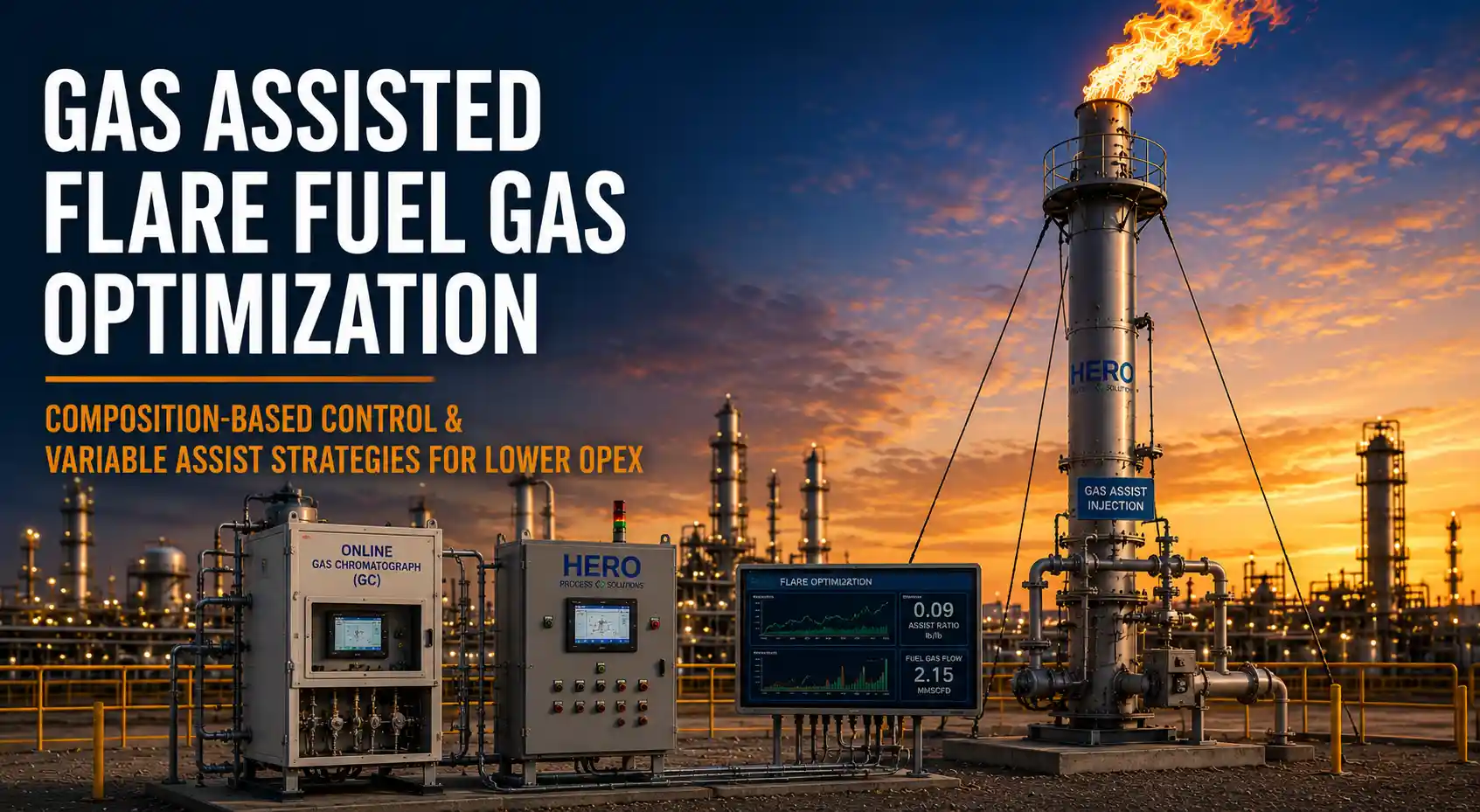
A gas assisted flare delivers smokeless combustion through fuel gas injection at the tip, and that fuel gas consumption is the largest single operating cost across the flare’s service life. A typical 50,000 lb/hr peak waste-gas service running at a fixed 0.15 assist-gas mass ratio burns roughly 4 to 5 MMSCFD of natural gas at peak — and continues burning a meaningful fraction of that even when actual waste-gas flow drops to 10% of design. Multiplied by years of service and current natural gas prices, the OPEX impact runs into seven-figure totals for many oil and gas facilities. Composition-based variable assist control routinely cuts that consumption by 30 to 60 percent without sacrificing smokeless performance or OOOOb compliance.
Hero Process Solutions, founded in 2011 and headquartered in Kellyville, Oklahoma with operations in Midland, Texas, manufactures gas assisted flare systems with composition-based control logic that holds 98% Destruction and Removal Efficiency across the operating envelope while modulating fuel gas consumption to the minimum required for actual waste-gas conditions. This guide walks through the optimization strategy and the engineering decisions that determine how much OPEX can be recovered.
DIRECT ANSWER: Gas assist fuel gas OPEX is reduced by replacing fixed-ratio control (constant assist-gas-to-waste-gas ratio) with composition-based variable assist control. The variable control loop reads waste-gas mass flow and composition in real time, calculates the actual assist-gas requirement (0.05 lb/lb for light saturated gas, up to 0.20+ lb/lb for heavy or olefin-rich streams), and modulates the fuel gas supply to match. Typical savings range from 30% to 60% versus fixed-ratio control, while holding EPA 40 CFR 60.18 visible-emission compliance and OOOOb 98% DRE.
1. Why Fuel Gas Consumption Dominates Gas Assist OPEX
Gas assist flares have low CAPEX relative to air-assisted flares because they avoid blower motors, VFDs, and electric power infrastructure. They have low maintenance OPEX because there are no rotating components to fail. But every pound of waste gas that flows to the flare requires roughly 0.05 to 0.20 lb of fuel gas to burn smokelessly, and that fuel gas comes from the facility’s natural gas supply at full sales-quality price.
For a 50,000 lb/hr peak waste-gas service at 0.15 fixed mass ratio, peak fuel gas consumption is 7,500 lb/hr — about 200,000 standard cubic feet per hour, or 4.8 MMSCFD if peak-rate continuous. Even at lower utilization rates, total annual fuel gas consumption frequently exceeds 1 BCF and represents a six- or seven-figure annual cost. Reducing this by 30% to 60% through smarter control is the single most impactful OPEX lever on a gas assist flare.
2. How to Build a Fuel Gas Consumption Model
Fuel gas consumption modeling requires four data streams from the flare control system or historian. Waste-gas mass flow rate at the relief header inlet, sampled at least every minute. Waste-gas composition or molecular weight, sampled either continuously (online GC or analyzer) or by representative grab samples at frequencies that capture composition shifts. Fuel gas mass flow rate at the assist gas supply, sampled at the same cadence as waste gas. And the resulting visible-emission and DRE performance, tracked via combustion-zone monitor or OOOOb continuous monitor data.
With those four streams, calculate the actual operating mass ratio over time (fuel gas mass flow divided by waste-gas mass flow). Compare against the minimum mass ratio required for smokeless combustion at each composition observed (using historical performance data or pilot test data). The gap between actual ratio and required ratio is the recoverable fuel gas savings.
KEY INSIGHT: Most fixed-ratio gas assist flares operate at the worst-case design ratio across all conditions, even when the actual waste gas is at the lightest end of the composition envelope. That gap between design ratio and required ratio at actual composition is where the 30% to 60% savings come from — it is not theoretical, it is wasted fuel gas being burned every operating hour.
3. Why Fixed-Ratio Control Wastes Fuel Gas at Light Compositions
Fixed-ratio control sets the assist-gas-to-waste-gas mass ratio at a constant value sized for the worst-case waste-gas composition the flare will see — typically the heaviest, most olefin-rich stream in the operating envelope. That fixed ratio is correct when the actual waste gas matches the design composition. It is excessive whenever the actual composition is lighter.
For a flare sized at 0.18 mass ratio for worst-case ethylene-rich vent gas, the actual operating composition is often dominated by methane and lighter saturates with a 0.08 minimum requirement. The fixed-ratio control burns 0.10 lb of excess fuel gas per lb of waste gas — roughly 55% of total fuel gas consumption is unnecessary. The smokeless performance is identical; the fuel gas is just being wasted.
This pattern is the rule, not the exception, in oil and gas gas assist flare service.
4. Composition-Based Variable Assist Control Logic
Composition-based variable assist control modulates the fuel gas supply based on real-time waste-gas composition. The control loop has four inputs: waste-gas mass flow rate from a Coriolis or ultrasonic meter, waste-gas composition (or surrogate property like density or net heating value) from an online analyzer, ambient conditions affecting combustion, and combustion-zone performance feedback from the OOOOb continuous monitor.
The control output is the fuel gas mass flow setpoint to the assist supply. The control algorithm uses a lookup table or model relating waste-gas composition to required assist-gas ratio, applies the calculated setpoint, and trims based on combustion-zone monitor feedback to maintain 98% DRE under all conditions. Trim range is bounded by hard minimums (so fuel gas cannot fall below the smokeless threshold) and maximums (so the system protects against composition measurement errors).
The Hero gas assist control package implements this logic on a PLC or DCS as a standard offering and integrates with the broader flare pilot ignition system and monitoring instrumentation.
5. Online Composition Measurement Options
| Measurement Method | Response Time | Composition Resolution | Best For |
|---|---|---|---|
| Online GC (gas chromatograph) | 1-5 minutes per cycle | Component-by-component speciation | Variable composition with significant olefin or aromatic content |
| Tunable diode laser (TDL) | Seconds | Selected species (methane, ethylene, etc.) | Fast-response control on a few critical components |
| Calorimeter or net heating value monitor | Seconds to minutes | Bulk heating value | Surrogate when full speciation is not needed |
| Density / molecular weight transmitter | Seconds | Bulk molecular weight | Lowest-cost surrogate for compositions that track MW |
The right measurement depends on the composition envelope. For relatively stable composition with occasional excursions, a density transmitter plus periodic GC sampling is often sufficient. For wide-range variable composition with significant unsaturation, an online GC with 1- to 5-minute cycle time captures the variability needed to drive variable assist control accurately.
6. Variable Assist Control and OOOOb Compliance
For gas assisted flares on affected oil and natural gas sources, EPA OOOOb compliance requires 98% DRE across the full operating range, continuous parametric monitoring of pilot and combustion zone, and continuous monitoring of vent-gas flow. Variable assist control is compatible with OOOOb provided three conditions are met.
First, the control loop must have hard minimum assist-gas ratios that prevent the fuel gas supply from falling below smokeless conditions even in transient excursions. Second, the combustion-zone monitor must verify 98% DRE in real time, and any monitor signal indicating sub-spec performance must immediately bias the control loop toward higher fuel gas. Third, the variable assist setpoints, control logic, and monitor performance must be documented in the OOOOb compliance file with the initial performance test report.
Properly designed variable assist control is fully OOOOb-compliant; it simply uses less fuel gas to deliver the same compliance.
7. How to Validate Fuel Gas Savings After Upgrade
After a control system upgrade from fixed-ratio to variable assist, validate the actual fuel gas savings against the projected savings to confirm the investment performed as designed. The validation workflow has three steps.
First, collect baseline fuel gas consumption data for at least three months under the old fixed-ratio control. Capture waste-gas flow, composition, and the resulting fuel gas mass flow at minute-level granularity. Second, after commissioning the variable assist control, collect equivalent data for at least three months under the new logic. Operate across the same waste-gas conditions wherever possible. Third, normalize fuel gas consumption to waste-gas throughput and composition, then compare the normalized rates. Real-world savings typically land between 30% and 60% with well-tuned composition-based control.
Hero’s field services team supports customers through commissioning of variable assist control and the subsequent savings validation.
8. Common Gas Assist Optimization Mistakes
| Mistake | Why It Hurts | Fix |
|---|---|---|
| Running fixed-ratio control sized for worst-case composition | Wastes 30% to 60% of fuel gas at lighter actual compositions | Implement composition-based variable assist control |
| Setting variable assist minimum too aggressively | Smokes during composition measurement lag or sensor failure | Specify hard minimum assist ratio with safety margin |
| Ignoring transient response of the composition measurement | Control responds too slowly to composition excursions, smokes | Match measurement response time to operating dynamics |
| Skipping combustion-zone feedback in the control loop | Cannot detect when measurement is wrong; OOOOb deviation risk | Always close the loop on combustion-zone monitor |
| Failing to validate savings post-commissioning | Cannot prove the investment performed; future projects starved of data | Collect baseline plus post-upgrade data, normalize, document |
| Treating fuel gas optimization as separate from OOOOb compliance | Documentation gaps in OOOOb file create audit risk | Integrate variable assist setpoints into OOOOb compliance plan |
Article Summary
- Fuel gas consumption is the largest single OPEX driver for a gas assisted flare, often six or seven figures annually.
- Fixed-ratio control wastes fuel gas at lighter actual compositions because the design ratio is sized for the worst-case composition envelope.
- Composition-based variable assist control modulates fuel gas supply to match actual waste-gas composition in real time.
- Typical fuel gas savings from variable assist are 30% to 60% versus fixed-ratio, with no loss of smokeless performance.
- Online composition measurement options include GC, TDL, calorimeter, and density transmitters, selected based on composition variability.
- Variable assist control is OOOOb-compatible when minimum ratios, combustion-zone feedback, and documentation are properly specified.
- Post-upgrade validation requires baseline plus post-upgrade fuel gas data, normalized to waste-gas throughput and composition.
- Hero Process Solutions ships composition-based variable assist control as a standard option on A+ Series gas assisted flares from Kellyville, Oklahoma.
Frequently Asked Questions
How much fuel gas does a gas assisted flare consume?
Fuel gas consumption depends on waste-gas flow and the assist-gas mass ratio. For a 50,000 lb/hr peak waste-gas service at a 0.15 fixed ratio, peak fuel gas consumption is approximately 7,500 lb/hr (4 to 5 MMSCFD of natural gas). Annual consumption depends on utilization rate but frequently exceeds 1 BCF for sustained continuous service. Composition-based variable assist control typically reduces this by 30% to 60%.
What savings can composition-based variable assist control deliver?
Typical fuel gas savings range from 30% to 60% versus fixed-ratio control, depending on how variable the waste-gas composition is in actual service. Sites with composition that frequently runs lighter than the worst-case design composition see the largest savings. The savings translate directly into reduced natural gas purchase OPEX without any loss of smokeless performance or OOOOb compliance.
Does variable assist control affect OOOOb compliance?
No, provided three conditions are met. The control loop has hard minimum assist-gas ratios that prevent fuel gas falling below smokeless conditions. The combustion-zone monitor verifies 98% DRE in real time and biases the control loop upward if monitor signals indicate sub-spec performance. And the variable assist control logic is documented in the OOOOb compliance file with the initial performance test report.
What composition measurement is required for variable assist?
Online gas chromatography is the gold standard for full speciation with 1- to 5-minute cycle time, suited to variable composition with olefin or aromatic content. Tunable diode laser, calorimeter, and density transmitters serve as faster-response surrogates for sites where full speciation is not required. The right choice depends on the operating composition envelope and the required control response time.
How do I validate fuel gas savings after a control upgrade?
Collect baseline fuel gas consumption data for at least three months under the original fixed-ratio control, with waste-gas flow and composition logged at minute-level granularity. After commissioning the variable assist control, collect equivalent data for at least three months under the new logic. Normalize both datasets to waste-gas throughput and composition, then compare normalized fuel gas rates. The difference is the validated savings.
Can existing gas assist flares be upgraded with variable assist control?
Yes. The upgrade requires installing online composition measurement (or using existing analyzer data), updating the PLC or DCS control logic to implement composition-based assist, retuning the combustion-zone monitor feedback loop, and updating the OOOOb compliance documentation. Hero’s field services team supports controls upgrades on existing gas assist flares, including baseline data collection and post-commissioning savings validation.