
OIL & GAS EQUIPMENT | Updated May 2025 | 8 min read
• How to determine the right separator capacity for your production volumes and fluid properties
• Which pressure vessel materials are appropriate for sweet vs. sour service applications
• What ASME and other certifications mean and why they matter for your permit and inspection
• Internal components that separate a well-engineered separator from a generic vessel
• How to evaluate a 3-phase separator vendor’s design capabilities before ordering
• Lead times, documentation, and what to request in a purchase specification
• Integration requirements with downstream gas and liquid handling systems
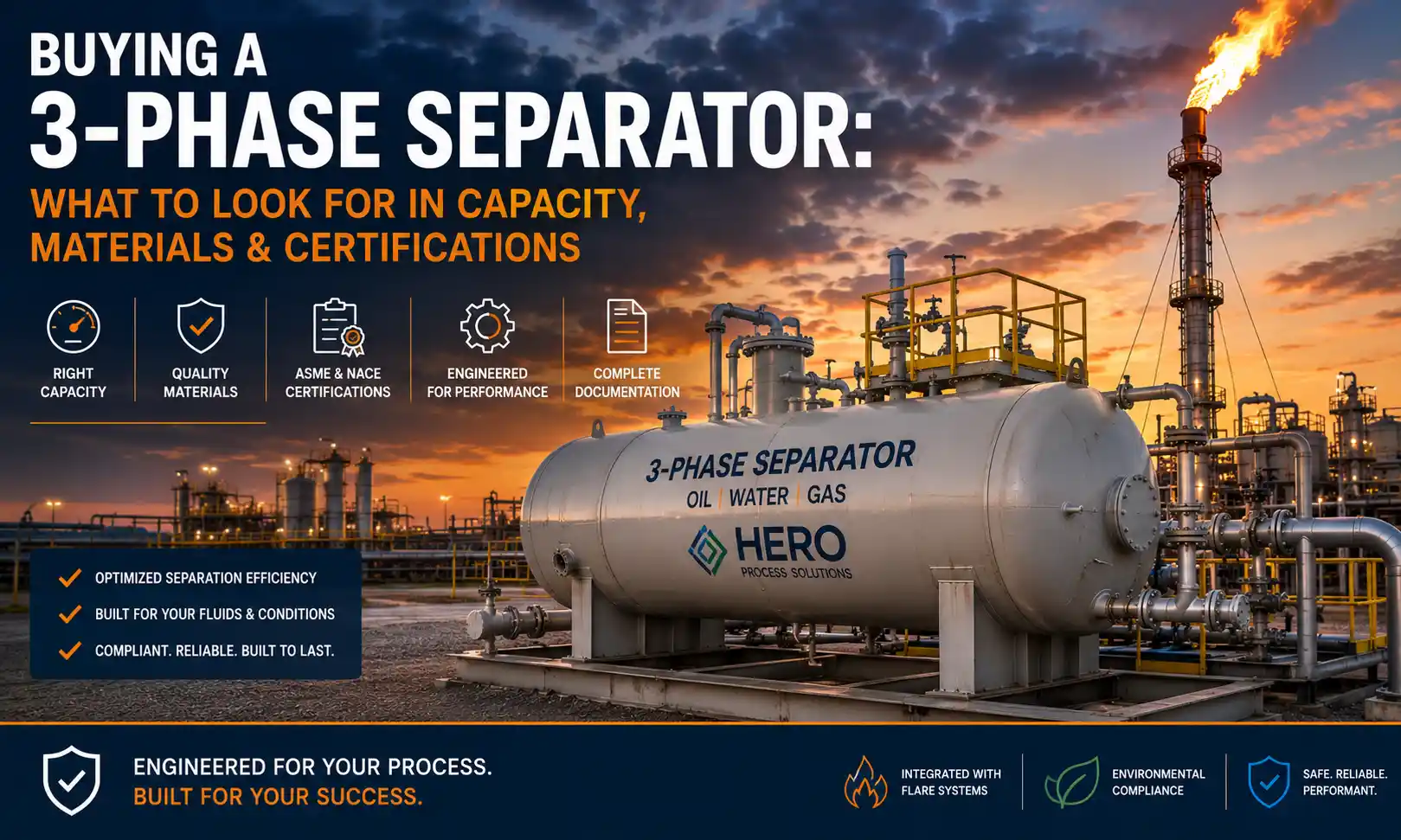
Buying a 3-phase separator for oil and gas production is not a catalog transaction. The vessel capacity, operating pressure rating, material selection, internal component design, and certification requirements all vary by application, and a separator specified incorrectly for your produced fluid conditions will either fail to meet outlet quality requirements or create compliance issues with your downstream vapor control system under EPA 40 CFR 60 Subpart OOOOb. The time to resolve these variables is during the purchase specification — not after the vessel arrives on location.
Hero Process Solutions, headquartered in Kellyville, OK with manufacturing operations and field service support in Midland, TX, designs and fabricates 3-phase separator vessels for upstream oil and gas production. Founded in 2011, Hero PS provides integrated equipment solutions that pair separator design with the vapor control systems — flares, VRUs, and combustors — that the separator feeds.
When buying a 3-phase separator, the critical evaluation criteria are: design flow rate and retention time calculations based on actual fluid properties, pressure vessel material suitable for service (sweet vs. sour, operating temperature), ASME Section VIII Division 1 certification for pressure vessel compliance, and internal component quality (inlet diverter, mist extractor, weir configuration). Vendor documentation should include design calculations, material certifications, and a data sheet matching your purchase specification.
1. Capacity Sizing: Getting the Design Basis Right
Separator capacity is defined by two independent constraints: the gas handling capacity and the liquid handling capacity. Both must be evaluated; whichever is more limiting sets the required vessel size.
Gas Capacity
Gas capacity is controlled by the maximum gas velocity inside the vessel that allows liquid droplets to fall out of the gas stream. For the gas capacity calculation, you need: design gas flow rate (MMscfd or MSCFD), operating pressure, operating temperature, gas specific gravity, and the liquid droplet size specification for the mist extractor selection.
Liquid Capacity
Liquid capacity is controlled by the required retention time in the vessel. For 3-phase oil-water separation, minimum retention times are typically: Light crude (API above 40): 3 to 5 minutes; Medium crude (API 25 to 40): 5 to 8 minutes; Heavy crude (API below 25): 8 to 15 minutes or more, depending on emulsion tendency. For the liquid capacity calculation, you need: design liquid flow rate (BOPD + BWPD), fluid densities and viscosities at operating temperature, API gravity of the crude, and expected water cut range.
One of the most consequential mistakes in separator purchasing is sizing for current water cut when the well’s water cut is expected to increase over its producing life. A well that starts at 10% water cut may reach 70% water cut within 5 years. Size the separator for the expected peak water cut over the vessel’s operating life, not the initial production conditions.
2. Operating Pressure and Pressure Rating Selection
Standard 3-phase separator pressure ratings for upstream oil and gas applications include: Low-pressure (LP) at 125 to 285 PSIG MAWP for wellhead separators on low-pressure wells; Medium-pressure (MP) at 500 to 720 PSIG MAWP for higher-pressure wellhead applications; and High-pressure (HP) at 1,000 to 1,440 PSIG MAWP for high-pressure gas wells. Every pressure vessel must include pressure safety valves (PSVs) or pressure relief valves (PRVs) sized and set to prevent overpressure, certified per ASME PTC 25.
3. Material Selection: Sweet Service vs. Sour Service
Material selection for a 3-phase separator depends on whether your gas and liquid streams contain hydrogen sulfide (H2S) at concentrations that create sour service conditions. For sweet service (H2S partial pressure below 0.05 psia per NACE MR0175 definition), carbon steel ASTM A516 Grade 70 is the standard specification. When H2S partial pressure exceeds 0.05 psia (or total H2S concentration exceeds 50 ppmv at low pressures), the equipment is in sour service per NACE MR0175/ISO 15156. Sour service requirements affect base material (sour-rated carbon steel with controlled hardness, HRC 22 or less), welds (post-weld heat treatment to reduce residual stresses), internal components (alloy selections), and fasteners (sour-rated bolting).
If your produced fluid has H2S at any detectable concentration, request the H2S partial pressure calculation before finalizing the vessel material specification. The NACE MR0175/ISO 15156 sour service threshold is determined by H2S partial pressure in the gas phase, not just by ppmv concentration. Even low H2S concentrations at high operating pressures can exceed the sour service threshold.
4. ASME and Other Certifications
The primary certification standard for 3-phase separator vessels is ASME Boiler and Pressure Vessel Code, Section VIII, Division 1. An ASME-certified vessel carries the ASME “U” stamp, meaning it was designed per ASME Section VIII calculations, reviewed by an ASME-authorized inspector, materials are certified to ASME-accepted specifications, it was hydrostatically tested at 1.3 times the MAWP before shipment, and a data package (ASME Form U-1) is provided with the vessel. Beyond the engineering quality assurance it represents, the ASME stamp is practically required for most oil and gas operating companies’ procurement specifications, required by insurance companies, and recognized by state inspection authorities (Oklahoma Corporation Commission, Texas Railroad Commission).
| Certification | Covers | Practical Requirement |
|---|---|---|
| ASME U Stamp (Section VIII Div. 1) | Pressure vessel design, fabrication, testing | Required by most operators and regulators |
| API RP 12J | Oilfield separator design details | Recommended; indicates O&G specific design experience |
| NACE MR0175/ISO 15156 | Sour service material requirements | Required when H2S is present above threshold |
| National Board Registration | Pressure vessel registration with states | Required in most states for inspections |
5. Internal Component Quality: What Separates a Well-Engineered Vessel
The ASME stamp certifies the pressure boundary. What happens inside the vessel — the separation quality — depends on the internal component design. A well-designed inlet diverter conditions the incoming fluid stream before it enters the separation zone; quality options include tangential inlet (cyclonic), half-pipe diverter, or Schoepentoeter for high gas-liquid ratios. The wire mesh mist extractor is standard for most upstream separators, specified by wire diameter, mesh density, and pad thickness — an improperly sized mesh pad passes liquid into the gas outlet. Adjustable weirs in horizontal 3-phase separators allow field modification of the interface set point without opening the vessel and are worth specifying if you expect significant changes in oil-water ratio over the vessel’s operating life.
6. Vendor Evaluation: What to Ask Before Buying
Request a design calculation package with the vendor’s proposal, including: gas capacity calculations per API RP 12J or equivalent, liquid retention time calculations, pressure vessel design per ASME Section VIII, and mist extractor sizing basis. Confirm the vendor holds current ASME “U” stamp certification and that the fabrication shop is certified by an ASME-recognized National Board inspector. Hero Process Solutions designs 3-phase separators from the Kellyville, OK facility with ASME U-stamp certification and API RP 12J design standards, providing design calculation packages with quotations and coordinating with the vapor control system to ensure correct integration. Hero PS field services support commissioning of new vessels at operating sites.
7. Documentation Package and Lead Times
For a compliant 3-phase separator purchase, the following documents must be delivered with the vessel: ASME Form U-1, vessel nameplate (ASME stamping), material certifications (mill certs) for all pressure-boundary components, pressure safety valve certification and sizing documentation, hydrostatic test report, weld inspection records, PWHT records (if sour service), as-built dimensional drawing, and instrument and level control specifications.
Standard upstream 3-phase separators (common sizes and pressure ratings, sweet service) typically have fabrication lead times of 6 to 14 weeks from order. Sour service vessels, large vessels (above 12-foot diameter), or vessels with extensive alloy content have longer lead times. A liquid knockout drum downstream of the separator gas outlet is also part of the integrated system design — confirm Hero PS integration of this with the overall OOOOb-compliant vapor control train at your site.
Common Mistakes to Avoid
| Mistake | Why It Hurts | Fix |
|---|---|---|
| Sizing for current water cut only | Separator undersized as well matures; oil quality degrades | Size for expected peak water cut over vessel life |
| Specifying carbon steel for sour service | Sulfide stress cracking risk; potential vessel failure | Determine H2S partial pressure; specify NACE MR0175 materials if above threshold |
| Buying without ASME U stamp | Non-compliant vessel; cannot pass state inspection; insurance issues | Require ASME U stamp in all 3-phase separator purchase specifications |
| No mist extractor specification review | Liquid carryover into gas system; downstream equipment damage | Request vendor’s mist extractor sizing basis and confirm it matches your gas velocity |
| Not requesting design calculations with quote | Vendor may be quoting a generic vessel, not one engineered for your conditions | Require design basis document with every 3-phase separator quotation |
Article Summary
- Buying a 3-phase separator requires specifying both gas capacity (based on settling velocity) and liquid capacity (based on retention time) from actual fluid property data.
- Size for peak expected water cut over the vessel’s operating life, not initial production conditions.
- Material selection for sour service (H2S partial pressure above 0.05 psia per NACE MR0175) requires sour-rated steel with controlled hardness and post-weld heat treatment.
- ASME Section VIII, Division 1 certification (U stamp) is effectively mandatory for oil and gas production vessels.
- API RP 12J provides oilfield-specific separator design guidance beyond the pressure code requirements.
- Internal component quality — inlet diverter, mist extractor, weir configuration — determines actual separation efficiency.
- A complete vendor documentation package includes ASME Form U-1, material certifications, PSV sizing, hydrostatic test report, and as-built drawings.
- Hero Process Solutions provides design calculation packages with 3-phase separator quotations and integrates separator design with the downstream vapor control system.
Frequently Asked Questions
What ASME certification should a 3-phase separator have?
A 3-phase separator for oil and gas production should carry the ASME “U” stamp under ASME Boiler and Pressure Vessel Code, Section VIII, Division 1. This certifies that the vessel was designed, fabricated, and tested per the code requirements, and that an ASME-authorized inspector witnessed the fabrication. The ASME Form U-1 (Manufacturer’s Data Report) is the documentation that accompanies the stamp and should be delivered with every new vessel.
How do I know if my application needs sour service material specifications?
Sour service is determined by the H2S partial pressure in the gas phase, defined under NACE MR0175/ISO 15156. The threshold is 0.05 psia H2S partial pressure. Calculate H2S partial pressure as: (H2S mole fraction) x (operating pressure in psia). If this result exceeds 0.05 psia, your application requires sour service material specifications, including controlled-hardness carbon steel, PWHT of welds, and alloy components per NACE MR0175.
What is a typical lead time for a 3-phase separator?
Standard upstream 3-phase separators in common sizes and pressure ratings for sweet service typically have fabrication lead times of 6 to 14 weeks from order placement. Sour service vessels, very large vessels, or highly customized configurations have longer lead times. Confirm lead time with Hero Process Solutions at the start of the procurement process to allow adequate schedule margin.
What internal components are most important for oil-water separation quality?
The three most important internal components for 3-phase oil-water separation quality are: the inlet diverter (conditions the inlet stream to minimize turbulence in the separation zone), the weir plate configuration (controls the oil-water interface and prevents phase cross-contamination), and the level control system (maintains stable interface and overall liquid levels). Poor performance of any of these three components produces off-spec oil or water outlet quality.
What documents should I receive when I buy a 3-phase separator?
A complete documentation package for a new 3-phase separator should include: ASME Form U-1 (Manufacturer’s Data Report), the vessel nameplate, material certifications (mill certs) for all pressure-boundary materials, pressure safety valve certification and sizing basis, hydrostatic test report, weld inspection records, PWHT records (if sour service), as-built dimensional drawing, and instrument/level control specifications.