
OIL & GAS EQUIPMENT | Updated May 2025 | 9 min read
• How to calculate the capacity you actually need from a mobile flare system
• Why gas heating value changes the flare tip design you should specify
• The difference between fuel gas options for pilot operation at remote sites
• Which federal and state regulations govern mobile flare selection and operation
• Material and hardware specs that determine long-term reliability in field conditions
• When an air-assist flare is required vs. a simple utility-type unit
• How to compare rental vs. purchase economics for mobile flare deployments
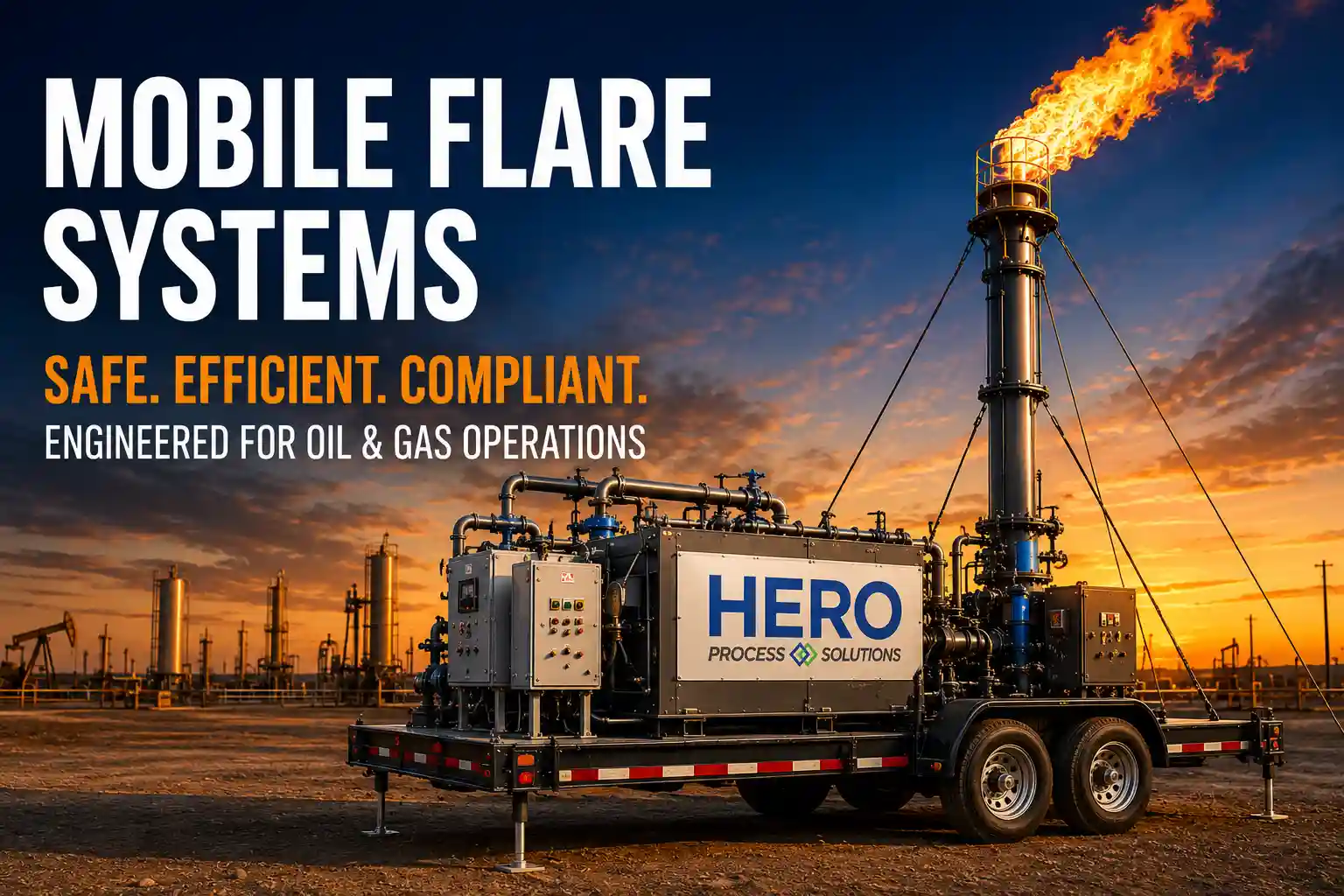
Selecting a mobile flare system for oil and gas operations requires more than picking a trailer-mounted unit within your flow rate range — the gas composition, heating value, H2S content, liquid carryover potential, and EPA regulatory classification of the source all affect which unit will actually work and stay compliant on your site. Getting the selection wrong means either a unit that cannot maintain the 98% combustion efficiency required under 40 CFR 60 Subpart OOOOb, or one oversized for your application that costs more to mobilize and operate than necessary.
Hero Process Solutions, headquartered in Kellyville, OK with operations in Midland, TX, has engineered and deployed mobile flare systems across upstream Permian Basin production sites, midstream gathering operations, and pipeline maintenance events since 2011. The selection principles below reflect real-world deployment experience and the regulatory framework that governs flare operation at oil and gas facilities.
Selecting a mobile flare system for oil and gas requires matching the unit’s combustion design to your gas composition and peak flow rate, then confirming compliance with EPA 40 CFR 60 Subpart OOOOb’s 98% combustion efficiency requirement. Key selection inputs are: maximum design flow rate (MMscfd), gas heating value (BTU/scf), H2S content (ppmv), liquid loading, and whether the deployment requires attended or unattended operation. Fuel type for the pilot system must be confirmed before mobilization.
1. Capacity Sizing: Start with Peak Flow, Not Average Flow
The single most common mistake in mobile flare selection is sizing the unit for the average expected gas flow rather than the peak rate. A flare sized for average flow will be overwhelmed during completion flowback, gas blowdown events, or facility upsets — exactly the conditions that create the highest compliance and safety risk.
Determining Your Design Flow Rate
Your design flow rate is the maximum sustained gas volume the flare must handle without going out of spec. For completion flowback, this is typically the peak rate during the gas cleanup phase, which can be 3 to 5 times the stabilized production rate. For pipeline pigging operations, it is the maximum purge gas volume dischargeable at the blowdown point within the planned operational window.
Turndown Ratio
A mobile flare must also maintain stable combustion at the minimum expected flow rate, not just the peak. The ratio between maximum and minimum stable operating flow is the turndown ratio. Most standard mobile flare designs handle a 10:1 to 20:1 turndown, but if your minimum flow rate is very low, verify that the flare tip design maintains pilot stability and flame stability without lifting off or pulsing at that flow.
2. Gas Heating Value and Its Effect on Flare Selection
The net heating value of your waste gas stream determines whether a given flare tip design will achieve 98% combustion efficiency at your expected flow conditions.
Rich Gas vs. Lean Gas
Rich gas, typical of associated gas from oil production in the Permian Basin, has a high heating value (often 1,100 to 1,400 BTU/scf) due to propane, butane, and heavier hydrocarbon content. These streams combust readily and maintain stable combustion across a wide flow range. Lean gas, typical of dry natural gas or gas near the flammability threshold, can have heating values approaching or below 300 BTU/scf. At these heating values, stable flare combustion requires careful attention to tip design, crosswind performance, and potentially a gas enrichment strategy.
Under 40 CFR 60.18(b)(2), a flare must operate with a net heating value of the gas stream at the flare tip of at least 300 BTU/scf, or with a heat content that maintains combustion. Streams below this threshold may require gas enrichment or a different combustion technology (such as a vapor combustor) to meet the 98% efficiency requirement.
3. Fuel Type Options for Pilot Operation
The pilot flame on a mobile flare must burn continuously to comply with 40 CFR 60.18. The fuel source for that pilot depends on what is available at the remote site.
Sales Gas or Field Gas Pilot
If your site has a regulated gas line or can tap the produced gas stream, field gas is the most economical pilot fuel. This is the standard configuration for mobile flares deployed at producing wells with active flow.
Propane Pilot
For sites with no gas supply, a propane tank supplying the pilot burner is the practical solution. Propane pilots are self-contained and do not require a gas line connection. For a 30-day unattended deployment, verify that the pilot fuel consumption rate and the tank capacity provide adequate margin.
Dual-Fuel Pilot Systems
Some mobile flare units include a dual-fuel pilot that starts on propane and transitions to field gas once the well is flowing. This design eliminates the need to restage the propane supply as the well comes online, reducing the number of crew visits to a remote location during the early production phase.
4. Air-Assist vs. Utility-Type Mobile Flares: Which Do You Need
Not every mobile flare application requires an air-assist design. Understanding when air assist is necessary and when it is unnecessary cost and complexity saves time and money.
When Air Assist Is Required
Air-assist flares use a forced-air blower to introduce combustion air into the base of the flare tip, enabling smokeless combustion at flow rates that would otherwise produce visible smoke. You need an air-assist mobile flare when your gas stream contains heavy hydrocarbons (C4+ content above 10-15%), when your site has visible emissions regulations that prohibit smoking flares, during completion flowback gas with high liquid hydrocarbon content, or when the applicable permit requires smokeless operation.
When a Utility-Type Mobile Flare Is Sufficient
For lean gas streams, low-flow production venting, and short-duration pipeline purge operations with dry gas, a utility-type mobile flare without forced air is adequate and more cost-effective to rent or purchase. The simpler design has fewer components to maintain and easier commissioning in the field.
| Flare Type | Smoke Control | Best Gas Type | Power Required | Relative Cost |
|---|---|---|---|---|
| Utility/low-flow mobile | Smoke possible at high flow | Lean or dry gas | None or minimal | Lower |
| Air-assist trailer flare | Smokeless at design flow | Rich or heavy gas | Blower motor (1-10 HP typical) | Higher |
| Gas-assist mobile unit | Smokeless via fuel gas | Variable | Fuel gas only | Moderate |
| Sonic/Coanda mobile | High efficiency smokeless | High flow/rich gas | None (pressure-driven) | Higher |
5. Regulatory Compliance Requirements for Mobile Flare Selection
The regulatory framework governing mobile flare selection is the same as for permanent flares. “Mobile” does not mean “exempt.” For a full overview of OOOOb compliance requirements for flare systems, see our dedicated compliance page.
Federal Requirements: 40 CFR 60 Subpart OOOOb
EPA 40 CFR 60 Subpart OOOOb establishes new source performance standards for methane and VOC emissions from oil and natural gas production, processing, and transmission facilities. For flare systems at affected facilities: 98% combustion efficiency is required; continuously burning pilot flame, verified by thermocouple or UV scanner; no visible emissions (opacity less than 5%) except during startup; and gas composition and flow rate records must be maintained. For mobile flares, the compliance trigger is the source classification, not the flare’s temporary nature.
Confirm your permit pathway with the applicable state agency before deploying a mobile flare system to a new location. TCEQ and Oklahoma DEQ both have specific notification and permit requirements that differ from federal OOOOb compliance obligations. Operating without authorization exposes the operator to penalty.
6. Material Specifications for Field Reliability
A mobile flare system that cannot operate reliably in field conditions is not a compliance asset; it is a compliance liability. For sour gas service (H2S greater than 100 ppmv), specify stainless steel or alloy steel wetted parts per NACE MR0175/ISO 15156. The liquid knockout drum protects the flare tip from liquid slug damage; size the drum based on inlet gas velocity and anticipated liquid-to-gas ratio, with a safety factor for worst-case liquid loading during flowback. The ignition control panel should be NEMA 4X rated for outdoor oil field environments with main gas pressure regulators, pilot fuel regulators, high/low pressure shutoffs, and thermocouple monitoring.
7. Rental vs. Purchase Economics for Mobile Flare Deployments
The rental vs. purchase decision comes down to deployment duration, frequency of use, and capital availability. Rental is the right choice when the deployment is under 6 months, you need the equipment immediately (rental stock is available vs. 8-16 week fabrication lead time for new equipment), or the application is one-time. Hero Process Solutions maintains a rental flare fleet dispatched from Kellyville, OK and Midland, TX with units available for short-notice deployment.
Purchase makes more sense when you have continuous or recurring flaring needs across multiple wells over a multi-year horizon, or when the cumulative rental cost over the expected deployment period exceeds the purchase price — typically the crossover point is 12-18 months of continuous use.
Common Mistakes to Avoid
| Mistake | Why It Hurts | Fix |
|---|---|---|
| Sizing for average flow instead of peak flow | Unit overwhelmed during flowback; compliance failure | Use peak design flow rate as the sizing basis |
| Ignoring gas heating value | Lean gas below 300 BTU/scf cannot maintain stable combustion | Get a full gas analysis before specifying the flare |
| Selecting air-assist for lean gas applications | Unnecessary cost and complexity | Match air-assist selection to gas composition and smokeless requirement |
| No permit pathway confirmation before mobilization | State enforcement action; fines | Confirm TCEQ or DEQ authorization before staging |
| Omitting turndown analysis | Flame instability at low flow; pilot blowout | Verify stable combustion at minimum expected flow rate |
Article Summary
- Mobile flare system selection starts with peak design flow rate, not average flow, to prevent capacity failures during high-rate events.
- Gas heating value determines whether a standard flare tip achieves the 98% combustion efficiency required by 40 CFR 60 Subpart OOOOb.
- Pilot fuel options include sales gas, propane, and dual-fuel systems; the right choice depends on gas availability at the remote site.
- Air-assist flares are required for heavy hydrocarbon gas streams; utility-type flares are adequate for lean or dry gas applications.
- EPA Subpart OOOOb applies to mobile flares handling gas from affected sources, with no exemption for temporary deployment.
- Sour gas service requires H2S-compatible materials per NACE MR0175/ISO 15156 in all wetted components.
- Rental is economically superior for deployments under 12-18 months; purchase makes more sense for continuous multi-year programs.
- Hero Process Solutions maintains a rental fleet with rapid dispatch from Kellyville, OK and Midland, TX for urgent deployments.
Frequently Asked Questions
How do I calculate the right capacity for a mobile flare system?
Start with your maximum expected gas flow rate in MMscfd — for completion flowback, this is the peak flowback rate, which may be 3 to 5 times the stabilized production rate. Then confirm the gas heating value in BTU/scf and check whether the anticipated flow range falls within the flare’s design turndown ratio. Hero Process Solutions’ engineering team can review your well completion program and production forecast to recommend the appropriate unit.
What is the minimum net heating value for a flare to meet EPA standards?
Under 40 CFR 60.18(b)(2), flares must operate with gas streams at a minimum net heating value of 300 BTU/scf unless an alternative means of achieving 98% combustion efficiency is demonstrated. Streams below 300 BTU/scf may require gas enrichment, blending with higher-heating-value gas, or an alternative combustion device such as a vapor combustor or thermal oxidizer.
Do I need an air-assist flare for completion flowback operations?
It depends on the gas composition. If the flowback gas is rich in heavier hydrocarbons (pentane-plus fractions from tight oil completions), an air-assist flare is generally required to prevent visible black smoke, which violates opacity standards. For dry gas completions where the flowback is primarily methane and ethane, a utility-type flare may be sufficient. Confirm with a gas analysis before making the selection.
How long does it take to fabricate a custom mobile flare system?
Custom-fabricated mobile flare systems typically have lead times of 8 to 16 weeks depending on specifications and shop workload. For immediate needs, rental units from Hero Process Solutions’ fleet can be on location within 24 to 72 hours.
What permits do I need before deploying a mobile flare in Texas?
In Texas, flaring from oil and gas production typically falls under either TCEQ’s Standard Permit for Oil and Gas Sites (SPOG) or requires an individual permit for larger or longer-duration events. The specific authorization pathway depends on the emission rates, the classification of the source, and the duration of the flaring event. TCEQ’s Air Quality Division should be consulted before deploying a mobile flare to any new Texas location.