
OIL & GAS EQUIPMENT | Updated May 2026 | 8 min read
What You’ll Learn in This Guide
- What a high-pressure (HP) sonic flare is and how it differs from standard sonic flares
- What inlet pressure range qualifies as “high-pressure” sonic service
- How HP sonic flares achieve smokeless combustion without auxiliary air or steam
- When to specify HP sonic for refinery, midstream, and petrochemical applications
- How HP sonic flares interact with relief header backpressure and PSV sizing
- What OOOOb 98% DRE looks like at HP sonic operating conditions
- Common HP sonic flare specification mistakes and how to avoid them
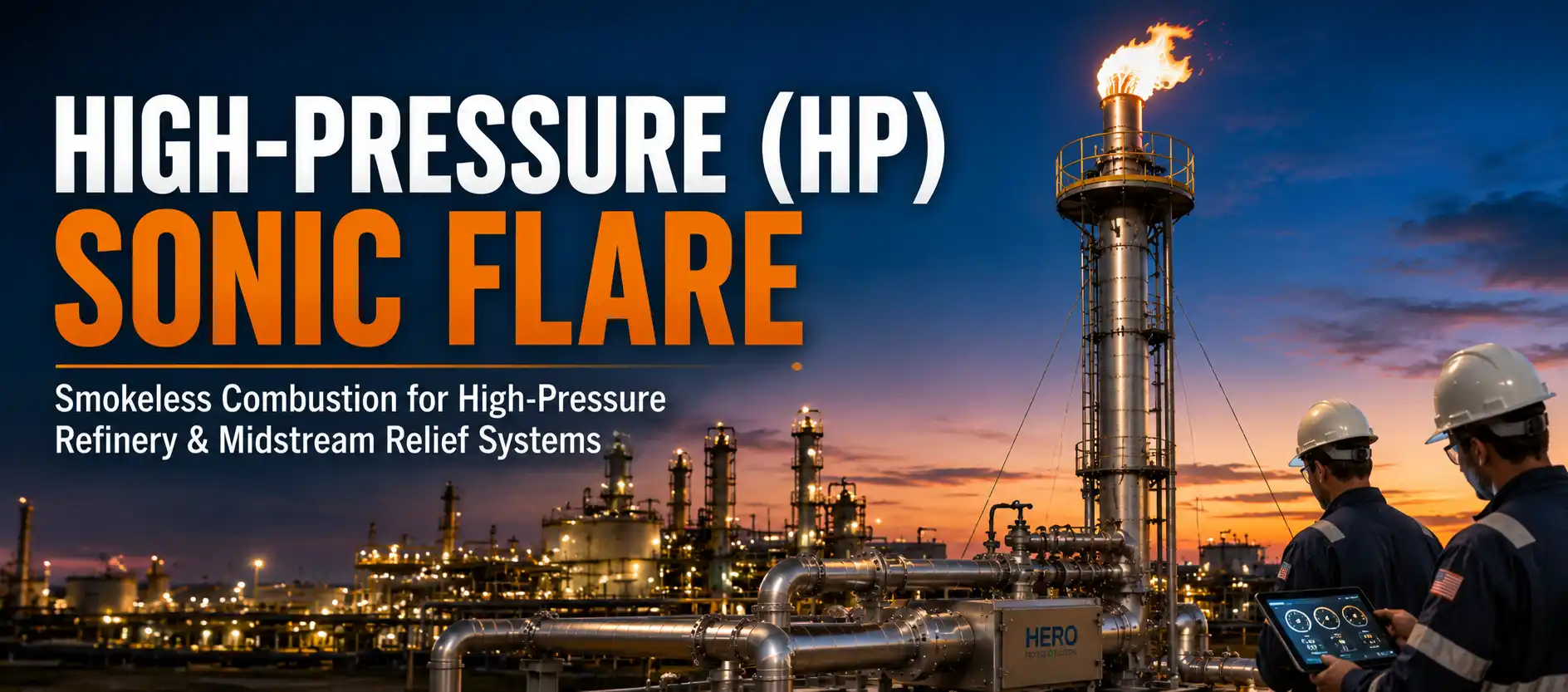
Standard sonic flares achieve smokeless combustion through choked-flow exit velocity at the tip, typically requiring sustained inlet pressure of 15 to 30 psig. High-pressure sonic flares operate at substantially higher inlet pressure — 50 psig and above — and exploit the additional pressure to deliver higher capacity per tip, lower flame radiation per pound of waste gas, and improved smokeless performance on heavier hydrocarbons. For refinery and midstream operators with high-pressure relief streams, HP sonic flares are often the right specification choice.
Hero Process Solutions, founded in 2011 and headquartered in Kellyville, Oklahoma with operations in Midland, Texas, manufactures sonic flares across the full pressure range needed for upstream, midstream, refining, and petrochemical applications. HP sonic configurations are a standard part of the portfolio.
DIRECT ANSWER: A high-pressure (HP) sonic flare is a sonic flare designed for sustained inlet pressure of 50 psig and above, typically 75 to 150 psig in refinery and petrochemical service. The additional inlet pressure enables higher mass flow per square inch of tip throat area, shorter and more compact flame envelope, and reliable smokeless combustion on heavier hydrocarbons and olefin-rich streams that lower-pressure sonic flares struggle to burn cleanly. HP sonic flares require relief header design that delivers sustained inlet pressure across operating contingencies, with backpressure analysis on every connected PSV.
1. What Qualifies as “High-Pressure” Sonic Service
Standard sonic flare designs operate at sustained inlet pressure of 15 to 30 psig, sufficient to choke the tip at typical natural gas k values. Below 15 psig, the tip un-chokes and smokeless behavior is lost.
HP sonic flare designs operate at sustained inlet pressure of 50 psig and above, commonly 75 to 150 psig at the tip inlet. The elevated pressure enables higher mass flow capacity per tip and improves combustion performance on heavier hydrocarbons. Very high-pressure sonic configurations above 200 psig exist for specialized refinery and petrochemical service but represent a smaller portion of the market.
2. How HP Sonic Flares Achieve Higher Capacity Per Tip
The choked-flow mass equation is the key. Mass flow through a choked nozzle is proportional to upstream absolute pressure times throat area divided by the square root of upstream absolute temperature, with a coefficient set by gas k value. At fixed throat area and gas composition, mass flow scales linearly with upstream absolute pressure.
A standard sonic flare at 30 psig (44.7 psia) handles a certain choked mass flow per square inch of throat. The same tip geometry at 100 psig (114.7 psia) handles approximately 2.5 times that mass flow. The higher inlet pressure simply pushes more mass through the same throat at sonic velocity.
KEY INSIGHT: Doubling the inlet absolute pressure approximately doubles the choked mass flow capacity per tip. For projects with sustained high upstream pressure, this scaling makes HP sonic flares the most capacity-efficient configuration available — typically 2 to 4 times more capacity per square inch of tip throat than standard sonic flares at lower pressure.
3. HP Sonic Performance on Heavier Hydrocarbons
Standard sonic flares perform very well on light saturated hydrocarbons (methane, ethane) but struggle on heavier hydrocarbons (propane, butane, pentane) and olefins (ethylene, propylene). The heavier and olefin-rich streams have higher soot-formation tendency and require more aggressive mixing for clean combustion.
HP sonic flares deliver more aggressive mixing through the higher-velocity, higher-momentum exit jet that results from elevated inlet pressure. The Coanda-profile tip geometry that produces 1,400 fps exit velocity at 30 psig delivers significantly higher effective momentum at 100 psig, which entrains more ambient air and produces more complete combustion of heavier components.
4. When to Specify HP Sonic vs Standard Sonic
| Application Profile | Best Choice | Why |
|---|---|---|
| Upstream tank battery vent (5-15 psig) | Air-assist or low flow flare | Pressure insufficient for sonic |
| Midstream gas processing routine (15-30 psig) | Standard sonic flare | Sustained pressure adequate; HP not justified |
| Midstream high-pressure separator (30-75 psig) | Standard or HP sonic | Either works; choose based on capacity needs |
| Refinery FCC overhead relief (75-150 psig) | HP sonic flare | Higher capacity, better olefin combustion |
| Petrochemical olefins service | HP sonic flare | Heavier hydrocarbons combust cleanly under HP turbulence |
| Refinery emergency relief (variable pressure) | Utility flare | Worst-case API 521 contingency drives sizing |
5. HP Sonic Relief Header and PSV Backpressure
HP sonic flares interact with relief header backpressure differently than standard sonic flares because the higher inlet pressure shifts the choke point closer to the tip inlet. The tip pressure drop is similar (approximately 12 to 15 psi at the critical pressure ratio), but the upstream pressure profile is at a higher absolute level.
For PSV backpressure analysis, total backpressure (built-up plus superimposed) at the PSV outlet must remain within the allowable for each PSV type. Conventional PSVs tolerate approximately 10% of set pressure; balanced-bellows tolerate 30% to 50%; pilot-operated tolerate up to 50%. At HP sonic operating conditions, conventional PSVs are often inadequate and balanced-bellows or pilot-operated PSVs become necessary.
6. OOOOb 98% DRE at HP Sonic Conditions
EPA 40 CFR 60 Subpart OOOOb requires 98% Destruction and Removal Efficiency on flares used as control devices at affected facilities. HP sonic flares satisfy this requirement under their choked-flow operating conditions. The monitoring system must continuously verify pilot status, inlet pressure (to verify sustained choked-flow conditions), and vent-gas flow rate. See our EPA OOOOb compliance resource for the full requirements.
If inlet pressure drops below the HP sonic design threshold, the tip un-chokes and DRE drops below 98%. The monitoring system must alert operators to pressure events that trigger off-design operation so corrective action can be taken before extended deviation occurs.
7. HP Sonic vs Other Smokeless Technologies
| Technology | Best Application | Key Trade-Off |
|---|---|---|
| HP Sonic | Sustained high inlet pressure (50+ psig); heavier hydrocarbons | Requires pressure availability; no rotating equipment |
| Standard Sonic | Sustained moderate inlet pressure (15-30 psig) | Lower capacity per tip; lighter stream preference |
| Air-Assist | Continuous service with reliable electric power | Blower OPEX; broader pressure tolerance |
| Steam-Assist | Refinery sites with steam supply | Steam OPEX; broader pressure tolerance |
| Gas-Assist | Sites without electric or steam, fuel gas available | Fuel gas OPEX; broader pressure tolerance |
HP sonic is the lowest-OPEX smokeless technology when sustained high inlet pressure is available. The absence of blower, steam, or fuel gas auxiliaries eliminates the operational cost that other technologies carry across the service life.
8. Common HP Sonic Flare Specification Mistakes
| Mistake | Why It Hurts | Fix |
|---|---|---|
| Specifying HP sonic without confirmed sustained high inlet pressure | Tip un-chokes under operating contingencies, smokes | Verify pressure availability across all operating contingencies |
| Ignoring relief header backpressure on conventional PSVs | PSVs fail at HP sonic operating backpressure | Run backpressure analysis, replace conventional PSVs as needed |
| Sizing tip for design flow at design pressure only | Capacity insufficient at lower pressure during contingency | Size for worst-case (lowest sustainable) pressure plus peak flow |
| Missing inlet pressure monitoring on OOOOb-affected service | Cannot prove sustained choked-flow conditions for compliance | Specify continuous inlet pressure monitoring with logging |
| Specifying HP sonic for variable-pressure relief duty | Pressure variability moves operation in and out of choking | Specify standard sonic with multi-tip staging or air-assist for variable pressure |
| Treating HP sonic as drop-in replacement for air-assist | Pressure profile and OPEX assumptions differ | Verify full relief system analysis before flare technology change |
Frequently Asked Questions
What inlet pressure qualifies as HP sonic?
HP sonic flares operate at sustained inlet pressure of 50 psig and above, commonly 75 to 150 psig at the tip inlet. Standard sonic flares operate at 15 to 30 psig. Very high-pressure configurations above 200 psig exist for specialized service but represent a smaller portion of the market.
How much more capacity do HP sonic tips deliver vs standard sonic?
Mass flow through a choked nozzle scales linearly with upstream absolute pressure. Doubling the inlet absolute pressure approximately doubles the choked mass flow per square inch of throat. HP sonic at 100 psig handles approximately 2.5 times the mass flow of standard sonic at 30 psig from the same tip geometry.
Why are HP sonic flares better on heavier hydrocarbons?
Heavier hydrocarbons and olefins have higher soot-formation tendency and require aggressive mixing for smokeless combustion. HP sonic flares deliver more aggressive mixing through higher-momentum exit jets that entrain more ambient air. The result is smokeless combustion on streams that standard sonic flares struggle to burn cleanly without auxiliary fuel gas supplementation.
What relief header changes does HP sonic require?
Total backpressure at PSV outlets must be analyzed and the PSVs must tolerate the resulting backpressure. Conventional PSVs (10% set pressure tolerance) are often inadequate at HP sonic conditions. Balanced-bellows PSVs (30-50% tolerance) or pilot-operated PSVs (up to 50% tolerance) are typical upgrades. The relief header design should include the backpressure analysis at the project’s engineering phase.
Can HP sonic flares meet OOOOb 98% DRE?
Yes, under their choked-flow operating conditions. OOOOb compliance requires continuous monitoring of pilot or combustion zone presence, inlet pressure (to verify sustained choked conditions), and vent-gas flow rate. If inlet pressure drops below the HP sonic design threshold, the tip un-chokes and DRE drops below 98%, so the monitoring system must alert operators to off-design pressure events for corrective action.
Can Hero Process Solutions supply HP sonic flares?
Yes. Hero manufactures HP sonic flares with Coanda-profile tips sized for refinery, midstream, and petrochemical applications across the 50 to 150 psig operating range and above. The selection between standard sonic and HP sonic is supported by Hero’s engineering team during project assessment with consideration of inlet pressure availability, stream composition, capacity requirements, and OOOOb compliance pathway.