OIL & GAS EQUIPMENT | Updated September 2026 | 8 min read
WHAT YOU’LL LEARN IN THIS GUIDE
- When a flare rental is the right solution vs. a permanent installation
- How gas composition determines equipment type
- The critical difference between fixed-volume blowdowns and continuous process vents
- Why available pressure matters as much as flow rate when sizing a rental flare
- What utilities a temporary flare package typically requires on site
- What ancillary equipment comes with a complete rental package
- How to contact Hero Process Solutions and what information speeds the quote process
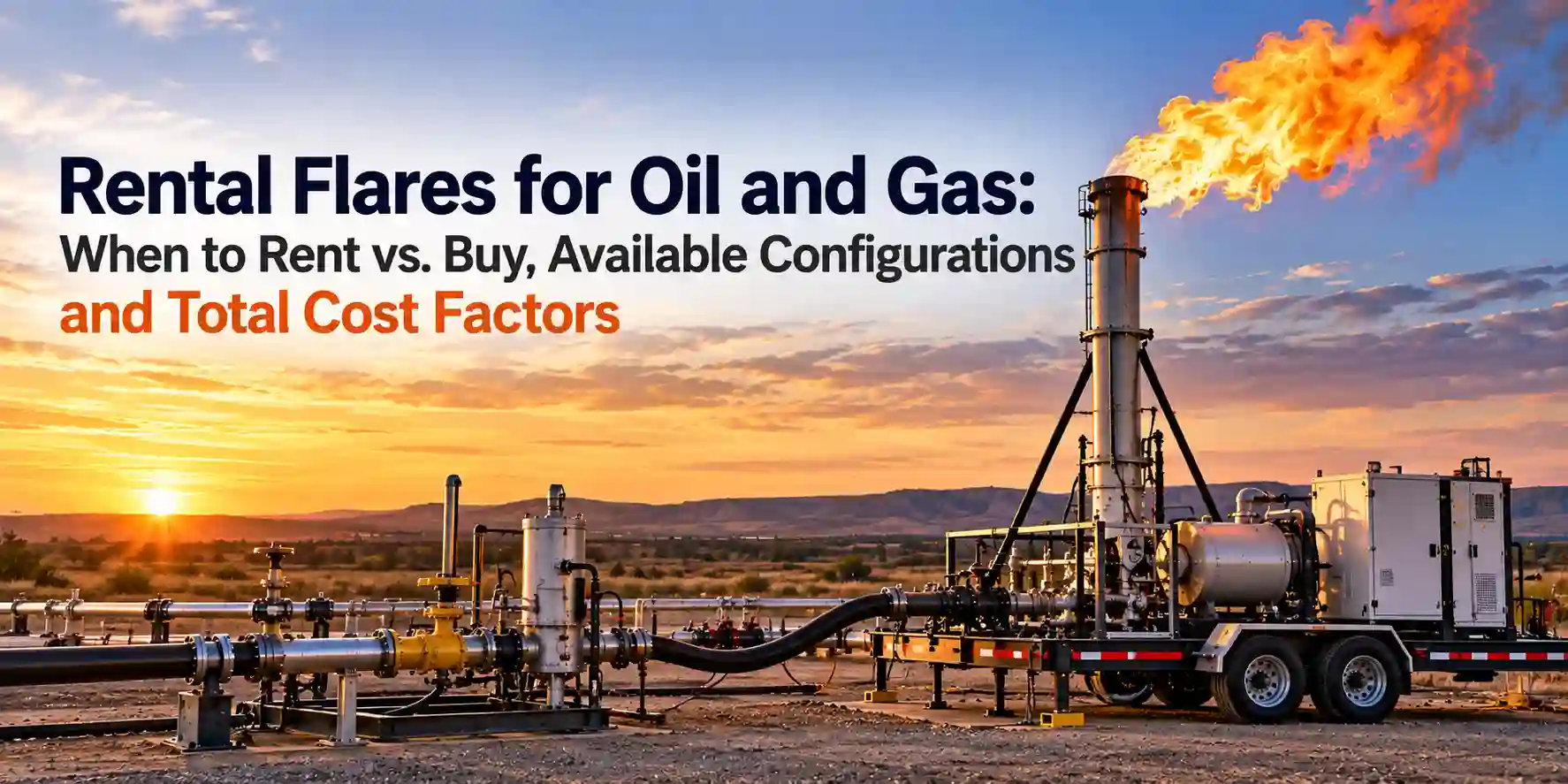
A flare rental provides temporary combustion capacity for gas or liquid disposal without purchasing and installing permanent equipment. Rental flares are used across pipeline, midstream, refining, petrochemical, LNG, and terminal operations whenever a project requires temporary combustion capacity on a defined schedule.
Hero Process Solutions, founded in 2011 and headquartered in Kellyville, OK with operations in Midland, TX, maintains a rental fleet of portable and trailer-mounted flares, vapor combustors, and liquid flare systems. The company provides the flare, ancillary equipment, and field support as a complete temporary combustion package.
DIRECT ANSWER: Flare Rental
A rental flare is a portable or trailer-mounted combustion system deployed for temporary gas or liquid disposal at a pipeline, facility, or well site. Selecting the right rental flare requires knowing the process stream composition, whether the job is a fixed-volume blowdown or a continuous vent, the available pressure, and the project location and schedule. EPA 40 CFR 60.18 requires combustion efficiency of 98% or greater for flares used on regulated streams, including temporary applications.
1. When Is a Rental Flare Used?
Rental flares are called into service when a combustion need is temporary, time-limited, or project-specific. Common applications include:
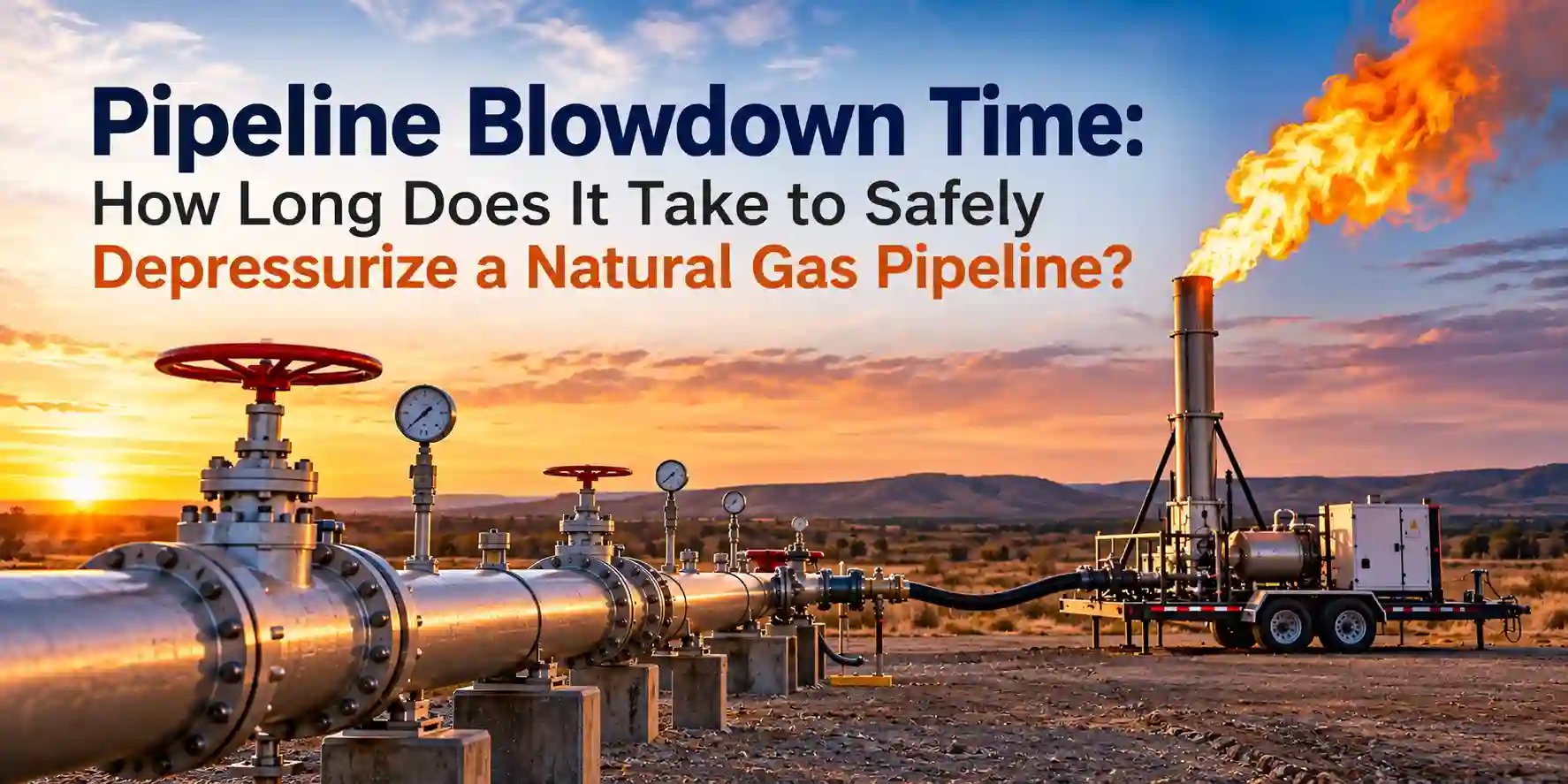
- Pipeline blowdowns before inspection, repair, valve replacement, tie-ins, or pigging
- Pipeline maintenance and purging operations
- Plant turnarounds, refinery outages, and facility shutdowns
- Commissioning and startup operations
- Well testing and production operations
- Temporary process vents during equipment maintenance
- Emergency flare replacement when permanent equipment is offline
- LNG and natural gas handling projects
- Liquid hydrocarbon blowdowns requiring a liquid-capable flare system
Portable and trailer-mounted flares can be mobilized specifically for the project and demobilized when the work is complete. The rental model eliminates capital expense for a short-duration combustion requirement and removes the permitting burden of permanent flare installation.
2. What Are You Flaring? Composition Determines Equipment Selection
The first step in selecting a rental flare is understanding the process stream. Gas flares and liquid flares are not interchangeable. Most portable flares are designed for combustible gases and vapors. If the stream contains liquid hydrocarbons, a liquid flare with an atomizing tip is required.
Provide a gas or liquid composition whenever possible. A full analysis is ideal, but even identifying the primary component (natural gas, propane, hydrogen, or liquid hydrocarbon) helps narrow the equipment quickly. Also clarify whether the stream is gas, vapor, liquid, or potentially two-phase. Two-phase streams require a liquid knockout drum upstream of the flare tip to protect the flare from liquid slugging.
Hero Process Solutions’ Liquid Knockout Systems can be supplied as part of the rental package where the process stream contains entrained liquids.
3. Fixed-Volume Blowdown or Continuous Process Vent: The Critical Distinction
Fixed-volume blowdown: A defined inventory of gas or liquid must be removed. Pipeline blowdowns, vessel depressurizations, and equipment purges are fixed-volume jobs. The key inputs are how much material must be removed and how quickly the operator needs it done. For a natural gas pipeline, that means pipeline diameter, length, initial and final pressure, temperature, and composition.
Continuous process vent: The flare receives an ongoing flow for an extended period, such as a temporary process vent during turnaround operations. The key inputs are maximum and minimum flow rates and the corresponding inlet pressures.
Both types require knowing the composition and available pressure at the flare connection point. These determine whether the selected flare can handle the job within the required timeframe.
4. Why Pressure Matters as Much as Flow Rate
Flare capacity cannot be evaluated from flow rate alone. The pressure available at the flare connection point determines how much gas can be moved through the temporary system.
Every component between the pipeline or vessel and the flare tip creates pressure drop: temporary piping, flexible hose, isolation valves, flow meters, knockout drums, separators, adapters, and the flare tip itself. The complete temporary piping system must be evaluated as a whole, not just the flare tip in isolation.
KEY INSIGHT
A larger flare tip does not automatically increase throughput if the limiting restriction is the blowdown connection diameter, a temporary piping bottleneck, or available inlet pressure. System-level evaluation is required before specifying rental flare size.
When contacting Hero for a rental flare, provide the available pressure at the connection point along with the flow rate. For fixed-volume blowdowns, provide the initial and final pressures rather than a single flow rate assumption.
5. What Utilities Does a Rental Flare Package Require?
- Pilot gas: Most flares require a continuous pilot flame. A natural gas or propane supply is usually needed unless the flare uses an electric ignition system.
- Electrical power: Controls, instrumentation, and flame monitoring systems require power. Generator sets can be included in the rental scope if site power is unavailable.
- Compressed air: Air-assisted flares and liquid flares with atomizing tips require compressed air. Hero’s portable liquid flare is designed around a readily available 185-CFM towable compressor at approximately 100 psig, which is common on industrial job sites.
- Instrument air: Some control packages require clean instrument air separate from process air.
Knowing what utilities are available on site allows Hero Process Solutions to build the simplest and most cost-effective rental package. If site power or pilot gas is unavailable, the package can be configured to include what is needed.
6. Ancillary Equipment in a Rental Flare Package
- Temporary rigid piping and flanged adapters
- Flexible hose for connection to the blowdown point
- Flow meters for volume tracking and reporting
- Liquid knockout drums and separators where liquid carryover is possible
- Isolation and control valves
- Flame monitoring and control panels
- Field technicians for installation, commissioning, and on-site support during the operation
Bundling ancillary equipment through Hero Process Solutions simplifies logistics, ensures equipment compatibility, and provides a single point of contact for the project.
7. Hero Process Solutions Rental Flare Equipment
Hero maintains rental inventory across several combustion equipment types. The right selection depends on the process stream, required flow, environmental requirements, and site conditions.
| Equipment Type | Best Application | Key Specification | Available From |
|---|---|---|---|
| Portable / Trailer-Mounted Gas Flare | Pipeline blowdowns, natural gas process vents, commissioning | Varies by model; contact for sizing | Portable Flares |
| T30L2 Liquid Flare | Liquid hydrocarbon blowdowns, trap blowdowns, liquid disposal | 30-ft stack, 2-in air-assisted tip, max 40 GPM propane, max 150 psig, 98%+ DRE | Rentals |
| Vapor Combustor | Low-flow gas and vapor destruction, permit-required enclosed combustion, 99%+ DRE applications | Enclosed combustion; contact for flow range | Vapor Combustors |
For applications where an open flare cannot meet permit requirements, a vapor combustor rental may be appropriate. See Hero’s Rentals page for current fleet availability.
8. Regulatory Requirements for Temporary Flare Systems
Temporary flares are not exempt from environmental regulations simply because they are short-duration. EPA 40 CFR 60.18 establishes general flare performance standards that apply to flares used on regulated emission streams, including combustion efficiency requirements and pilot flame specifications.
For projects subject to EPA 40 CFR 60 Subpart OOOOb (methane and VOC control for oil and natural gas operations), the combustion device must meet the applicable destruction and removal efficiency requirement. Most portable flare systems are rated for 98% or greater hydrocarbon DRE. Applications requiring 99% or greater DRE may need an enclosed combustor rather than an open flare.
CRITICAL RULE
Confirm the applicable DRE requirement from your facility’s air permit or applicable EPA subpart before selecting between an open rental flare and an enclosed combustor rental. The permit, not the equipment vendor, determines which technology is compliant for your project.
State-level air quality regulations in Texas, Oklahoma, Colorado, and other states may impose additional requirements on visible combustion, flare location, or permitting for temporary installations. Contact your environmental compliance team to confirm requirements before mobilizing equipment.
9. How to Request a Flare Rental From Hero Process Solutions
You do not need a complete engineering package to start the conversation. Providing four pieces of information allows Hero to begin evaluating the right equipment:
- What are you flaring? Gas, vapor, liquid, or two-phase. Composition if available.
- What is the application? Pipeline blowdown, vessel depressurization, continuous process vent, turnaround support.
- How much and at what pressure? Volume and initial pressure for blowdowns; flow rate and inlet pressure for continuous vents.
- Where and when? Project location, required on-site date, and estimated rental duration.
From that starting point, Hero Process Solutions can identify the appropriate equipment, determine ancillary needs, and provide a rental scope. Contact the team at sales@hero-ps.com or (918) 941-2166.
Common Mistakes When Specifying a Rental Flare
| Mistake | Why It Hurts Operations | Fix |
|---|---|---|
| Providing flow rate without inlet pressure | Undersized or mismatched flare; system cannot achieve required throughput | Always provide available pressure at the connection point |
| Assuming any flare handles liquids | Gas flares cannot atomize liquid hydrocarbons; liquid carryover damages tips | Confirm stream phase; specify liquid flare for liquid-service applications |
| Ordering a larger flare to speed up a blowdown | If the connection or piping is the bottleneck, a bigger flare tip does not help | Evaluate the complete temporary piping system, not just the flare |
| Ignoring utilities at the start | Pilot gas or power unavailability discovered on-site delays mobilization | Confirm available utilities before finalizing the rental package |
| Skipping composition data | Incorrect DRE estimate; potential permit non-compliance | Provide gas analysis or at minimum identify primary component and any known contaminants |
| Waiting until the project starts to contact the supplier | Equipment availability, freight, and field scheduling require lead time | Contact Hero as early as the project schedule is known |
Article Summary
- A flare rental provides temporary combustion capacity without permanent equipment installation, used across pipeline, midstream, refining, and LNG operations.
- The most common applications are pipeline blowdowns, plant turnarounds, refinery outages, commissioning operations, and emergency flare replacement.
- Gas flares and liquid flares are not interchangeable. Two-phase streams require a liquid knockout drum upstream of the flare tip.
- The distinction between a fixed-volume blowdown and a continuous process vent determines how the job is scoped and how the flare is sized.
- Available inlet pressure is as important as flow rate. Temporary piping, hose, valves, and meters all create pressure drop that must be accounted for in system sizing.
- Rental packages from Hero Process Solutions can include temporary piping, flexible hose, flow meters, knockout drums, controls, and field service in addition to the flare itself.
- EPA 40 CFR 60.18 and, where applicable, Subpart OOOOb requirements apply to temporary flare installations on regulated streams.
- Applications requiring greater than 99% DRE should evaluate an enclosed vapor combustor rental rather than an open portable flare.
- Four pieces of information are enough to start the quote process: what you’re flaring, the application type, flow/pressure, and project location and schedule.
Frequently Asked Questions
What is a rental flare and when is it used?
A rental flare is a portable or trailer-mounted combustion system deployed temporarily for gas or liquid disposal at a pipeline, facility, or well site. It is used when a project requires combustion capacity for a defined period, such as a pipeline blowdown before maintenance, a plant turnaround, refinery shutdown, well test, or emergency replacement of a permanent flare that is offline. A rental eliminates the capital cost and permanent permitting requirements of an installed flare system.
What information does Hero Process Solutions need to size a rental flare?
To begin selecting the right equipment, Hero needs to know what you are flaring (composition or at minimum the primary component), whether the job is a fixed-volume blowdown or a continuous process vent, the available inlet pressure at the connection point, the required flow rate or gas volume, the project location, the required on-site date, and the estimated rental duration. Utility availability (pilot gas, electrical power, compressed air) is also relevant to finalizing the package.
Can a rental flare handle liquid hydrocarbons?
Standard gas flares are not designed for liquid service. Liquid hydrocarbons must be atomized before combustion, which requires a flare tip specifically designed for liquid application. Hero Process Solutions offers the T30L2 portable liquid flare for temporary liquid-flaring applications, rated for up to 40 GPM of propane with a 2-inch air-assisted atomizing tip and 98% or greater hydrocarbon DRE. For liquid-service applications, always specify a liquid-capable flare rather than a standard gas flare.
Do temporary rental flares have to meet EPA emissions requirements?
Yes. A temporary or rental flare operating on a regulated emission stream must still comply with applicable EPA regulations, including 40 CFR 60.18 combustion efficiency requirements. For projects subject to EPA 40 CFR 60 Subpart OOOOb, the combustion device must meet the applicable destruction and removal efficiency requirement. Verify the DRE required by your permit before selecting between an open portable flare (typically 98% DRE) and an enclosed combustor rental (for applications requiring greater than 99% DRE).
What ancillary equipment is included in a rental flare package?
A complete temporary flare package from Hero Process Solutions may include temporary rigid piping, flexible hose, flanged adapters, isolation and control valves, flow meters, liquid knockout drums, separators, flame monitoring equipment, controls, and field technicians for commissioning and operational support. The specific scope depends on the process conditions and site requirements. Bundling ancillary equipment through Hero simplifies logistics and ensures all components are compatible with the flare system.
How far in advance should I contact Hero Process Solutions for a flare rental?
Contact Hero as early as the project schedule allows. Equipment availability, freight to the project location, and field technician scheduling all require lead time that is difficult to compress once a project is underway. For pipeline blowdowns and turnarounds with fixed dates, providing several weeks of advance notice gives the best chance of securing the right equipment on the required schedule. For emergency situations, contact Hero directly at (918) 941-2166 to discuss availability.