

OIL & GAS EQUIPMENT | Updated May 2026 | 7 min read
What You’ll Learn in This Guide
- What flare purge gas does and why every elevated flare needs it
- How molecular seals prevent air ingress and flashback into flare headers
- Nitrogen vs fuel gas purge, which one wins in what applications
- API 521 purge rate calculations and Reynolds number checks
- Molecular seal sizing and pressure drop considerations
- OOOOb-grade instrumentation and monitoring for purge and seal systems
- Common purge and seal design mistakes and how to avoid them
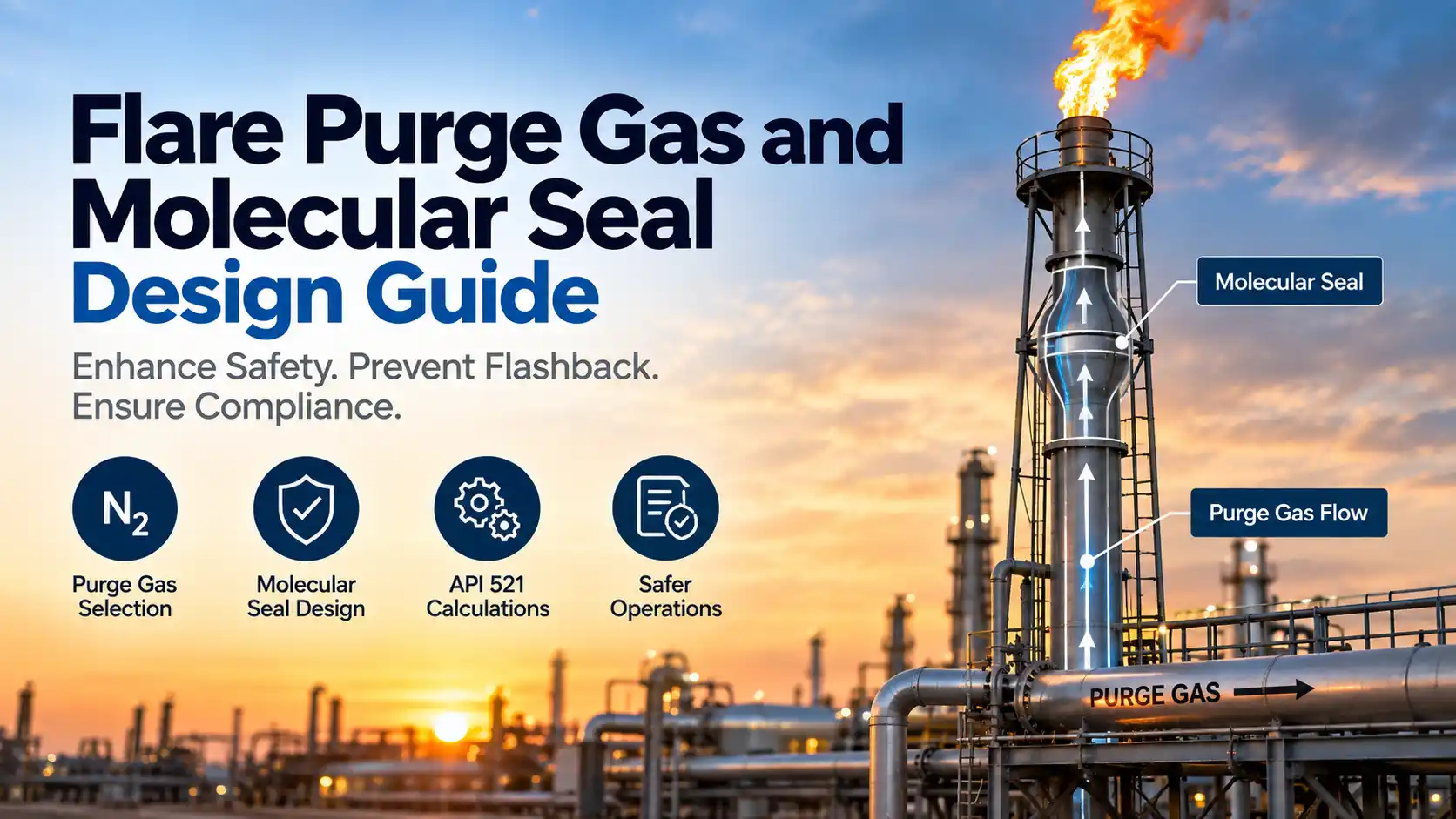
Flare purge gas and molecular seal design is one of the most safety-critical elements of an industrial flare system. Air ingress into a flare header, backward diffusion from the tip through the stack and header, creates a potentially explosive fuel-air mixture inside process piping. A flashback event from the flare tip through the header can propagate all the way back to upstream vessels, causing catastrophic damage. Purge gas and molecular seal design prevent this by maintaining a continuous forward flow of inert or fuel gas through the stack.
Hero Process Solutions, founded in 2011 and headquartered in Kellyville, Oklahoma with operations in Midland, Texas, engineers industrial flare systems with integrated purge and molecular seal design across upstream, midstream, and refinery service.
DIRECT ANSWER: Flare purge gas is a continuous forward flow of nitrogen or fuel gas maintained through the flare stack that prevents air ingress from the tip back into the flare header. Molecular seals are physical geometry in the flare stack that create a density-driven barrier between the combustion zone and the header. Together they eliminate the flashback risk that would otherwise occur when flare gas flow drops to near-zero and outside air begins diffusing backward into the stack. API 521 provides the framework for purge rate calculation and molecular seal sizing.
1. What Flare Purge Gas Does
The flare header carries hydrocarbon gas to the flare tip for combustion. When flare gas flow is high, the gas fills the header, moves through the stack, and combusts cleanly at the tip. When flare gas flow drops to near-zero, during quiet operating periods, between relief events, or after depressurization completes, outside air begins to diffuse backward through the tip into the stack.
If enough air enters the stack and header, the mixture inside can reach an explosive concentration. A flashback event from the pilot or from atmospheric ignition can then propagate through the header, potentially reaching upstream vessels. Purge gas prevents this by maintaining a continuous forward flow through the stack that keeps outside air from entering.
2. How Molecular Seals Work
A molecular seal is physical geometry within the flare stack, typically a diameter increase followed by a diameter decrease, or an inverted trap, or a series of vertical baffles, that creates a barrier to backward gas diffusion. The seal exploits the density difference between the flare gas (typically lower molecular weight than air) and the outside air.
The most common seal design is the Molecular Seal (sometimes called a Fluidic Seal or K-Seal) that combines a diameter change with a vertical downward-facing section. Gas flowing up through the stack easily traverses the seal, but air trying to move down against the flare gas density is trapped by buoyancy, the lighter flare gas stays on top and prevents air from moving downward.
Combined with purge gas flow, the molecular seal dramatically reduces the purge rate required to prevent air ingress, typically by an order of magnitude compared to no-seal designs.
3. Nitrogen vs Fuel Gas Purge
Two purge gas sources are used depending on site infrastructure and operational preference.
Nitrogen purge uses a nitrogen tank or nitrogen generator to supply purge gas. Nitrogen is inert, so it eliminates any risk of combustion within the header if air did enter. Nitrogen purge is preferred for high-severity service (refinery, high-pressure sonic flares, sour service) where the safety margin justifies the operational cost. Nitrogen also allows a lower purge rate because the gas is a clean inert without any flammability envelope concerns.
Fuel gas purge uses treated facility fuel gas as the purge stream. Fuel gas is combustible, so any air ingress would create a flammable mixture, but the fuel gas source is typically cheap and available at the site. Fuel gas purge is common at upstream and midstream sites where operational cost is a factor and where site infrastructure makes nitrogen supply difficult.
KEY INSIGHT: For refinery service, nitrogen purge is typically the right choice because the safety margin from inert gas outweighs the operational cost. For upstream and midstream service where fuel gas is abundant, fuel gas purge is standard. Sour service can go either way, nitrogen for cleanest safety margin, or sour fuel gas with special corrosion consideration on purge piping.
4. API 521 Purge Rate Calculation
API 521 provides the framework for calculating minimum purge rate. The calculation depends on the flare stack diameter, the gas density and the molecular seal configuration.
For a molecular-sealed elevated flare with fuel gas purge, typical purge rates are 0.005, 0.02 velocity ft/sec at the stack tip, much lower than the ~1 ft/sec required without a seal. For nitrogen purge, the rate can be even lower because the inert eliminates flammability envelope concerns.
The Reynolds number check verifies that purge flow remains turbulent enough to prevent stratification within the stack. Laminar purge flow can allow air to move downward against the purge in localized zones.
5. Molecular Seal Sizing and Pressure Drop
Molecular seal geometry is sized to match the flare stack diameter, expected gas velocities, and target sealing effectiveness. Typical seal geometries include a 2:1 diameter increase followed by a return to stack diameter, with a specific vertical downward-facing length.
Pressure drop across the seal is a design consideration. At peak flare gas flow, the seal adds a small pressure drop (typically 0.1, 0.5 psi) that must be accommodated in the flare header pressure profile. Undersized seals create excessive pressure drop; oversized seals may lose sealing effectiveness at low purge rates.
6. Instrumentation and Monitoring
Purge gas flow rate is monitored continuously in OOOOb-affected service. Low flow alarms trigger operator response if purge falls below the calculated minimum. The purge gas source (nitrogen tank pressure or fuel gas header pressure) is also monitored to ensure supply availability.
Pilot flame status verification, combustion zone monitoring, and header pressure monitoring integrate with the purge/seal system as part of the overall OOOOb parametric monitoring scope. For the complete framework, see our EPA OOOOb compliance resource.
7. Common Purge and Seal Design Mistakes
| Mistake | Why It Hurts | Fix |
|---|---|---|
| Skipping molecular seal on elevated flare | Purge rate 10x higher required to prevent air ingress | Include molecular seal on all elevated flares as standard |
| Undersized purge rate calculation | Air ingress and flashback risk during low flare flow | Use API 521 methodology with Reynolds number check |
| Missing purge flow monitoring | Silent failure of purge supply undetected | Continuous flow monitoring with low-flow alarm |
| Nitrogen purge without backup supply | Nitrogen tank runs empty, no purge, unsafe operation | Include backup nitrogen source or fuel gas fallback |
| Molecular seal sized without pressure drop check | Excessive pressure drop at peak flare flow | Size seal for target pressure drop at peak flow |
| Missing OOOOb integration of purge/seal system | Compliance gap on parametric monitoring | Include purge flow in OOOOb parametric monitoring scope |
Article Summary
- Flare purge gas maintains continuous forward flow through the flare stack to prevent air ingress and flashback.
- Molecular seals create a density-driven barrier that reduces required purge rate by an order of magnitude.
- Nitrogen purge is preferred for high-severity service; fuel gas purge is common upstream and midstream.
- API 521 provides the framework for purge rate calculation and Reynolds number check.
- Molecular seal sizing balances sealing effectiveness against pressure drop at peak flare flow.
- Continuous purge flow monitoring with low-flow alarms is required in OOOOb service.
- Backup purge supply prevents silent failure of nitrogen or fuel gas primary source.
- Hero Process Solutions integrates purge and molecular seal design in all industrial flare packages.
Related resources: See our companion articles on flare system safety standards, API 537 flare design, ISO 25457 flare details, and flare pilot monitoring and auto-relight. Explore our sonic flare systems.
Frequently Asked Questions
What is flare purge gas?
Flare purge gas is a continuous forward flow of nitrogen or fuel gas maintained through the flare stack that prevents air ingress from the flare tip back into the header. When flare gas flow drops to near-zero, outside air can diffuse backward through the tip; purge gas eliminates this risk by keeping air out of the stack.
What is a molecular seal on a flare?
A molecular seal is physical geometry within the flare stack, typically a diameter change combined with a vertical downward-facing section, that creates a density-driven barrier to backward gas diffusion. It uses the density difference between flare gas and outside air to trap air on top of the seal and prevent it from moving downward into the header.
Nitrogen or fuel gas for purge?
Nitrogen purge is preferred for high-severity service (refinery, high-pressure sonic, sour service) because the inert eliminates flammability envelope concerns. Fuel gas purge is standard for upstream and midstream where fuel gas is cheap and available, and where operational cost matters. Sour service can use either with special corrosion consideration on purge piping.
How is purge rate calculated?
API 521 provides the framework. Typical rates for a molecular-sealed elevated flare with fuel gas purge are 0.005, 0.02 ft/sec velocity at the tip. Nitrogen purge can be lower because the inert eliminates flammability concerns. A Reynolds number check verifies purge flow remains turbulent enough to prevent stratification within the stack.
Does OOOOb require purge flow monitoring?
Yes. Purge gas flow is monitored continuously in OOOOb-affected service, with low-flow alarms triggering operator response if purge falls below the calculated minimum. The purge gas source (nitrogen tank pressure or fuel gas header pressure) is also monitored to ensure supply availability. Integration with pilot flame status and combustion zone monitoring is part of the overall OOOOb parametric monitoring scope.
Can you skip the molecular seal on a small flare?
For very small enclosed combustors or low-flow flares that always have some minimum flow, some designs omit the molecular seal because the continuous flow itself acts as a purge. For elevated flares of any size that experience quiet periods with zero flare gas flow, molecular seal is standard, the purge rate required without a seal would be operationally impractical.