OIL & GAS EQUIPMENT | Updated May 2026 | 7 min read
What You’ll Learn in This Guide
- What well testing operations require of a flare and how those requirements differ from routine service
- How to size a well test flare for the specific test flow profile
- Portable vs trailer-mounted configuration for test flares
- Sour and condensate handling on well test flares
- Regulatory context: OOOOb, state agency requirements, and green completion rules
- Deployment, staffing, and safety framework for a well test event
- Common well testing flare specification mistakes and how to avoid them
Well testing, production testing during exploration and appraisal, extended well tests before permanent facility construction, or short-term flow testing after workovers, requires a flare capable of handling the well’s actual flow profile safely and in compliance with air quality regulations. Well test flares operate at the peak flow rate the well produces during the test, then demobilize when testing completes. Getting the flare specification, deployment, and operation right is the difference between a successful test and a costly regulatory or safety event.
Hero Process Solutions, founded in 2011 and headquartered in Kellyville, Oklahoma with operations in Midland, Texas, manufactures portable flare systems and operates a rental fleet sized for well testing across North American upstream operations.
DIRECT ANSWER: Well testing flares combust flowback gas during production testing, exploration, and appraisal operations. They are typically portable or trailer-mounted to deploy to remote wellsite locations and demobilize when the test completes. Sizing depends on peak well flow rate (typically 5, 50 MMSCFD for a typical exploration well), gas composition, and expected liquid handling. EPA OOOOb and state agency rules apply to well test flares at affected facilities, typically 98% DRE and continuous parametric monitoring. Sour formations require NACE MR0175 metallurgy.
1. What Well Testing Operations Require
Well testing operations measure well flow rate, pressure decline, and gas/liquid composition to characterize the reservoir and support facility engineering decisions. The test is conducted before a permanent facility is built, so temporary equipment, including the flare, handles the flowback gas.
Four operational requirements shape the flare specification. Sizing must handle the peak well flow rate over the entire test duration. Location must be accessible to the wellsite, typically remote and with limited utility infrastructure. Timing must fit the test schedule, typically 3, 30 days for a full production test. Safety must integrate with the well test operation as a whole, including safe distances from the wellhead and adjacent facilities.
2. Sizing a Well Test Flare
Well test flare sizing starts with the peak flow rate expected during the test. This is typically established from offset well data, formation characteristics, and the specific test objectives.
For typical exploration wells, peak well test flow rates range from 5 to 50 MMSCFD (million standard cubic feet per day), though larger wells can exceed this. For appraisal wells testing behind pipe or in a specific interval, peak rates may be lower.
Peak flow drives the flare tip and stack sizing. Sustained flow over the test duration drives the pilot fuel and instrument battery/solar sizing. The composition of the flowback, particularly the liquid fraction and any sour components, drives materials selection and knockout drum requirements.
3. Portable vs Trailer-Mounted Configuration
Two portable configurations serve well testing service.
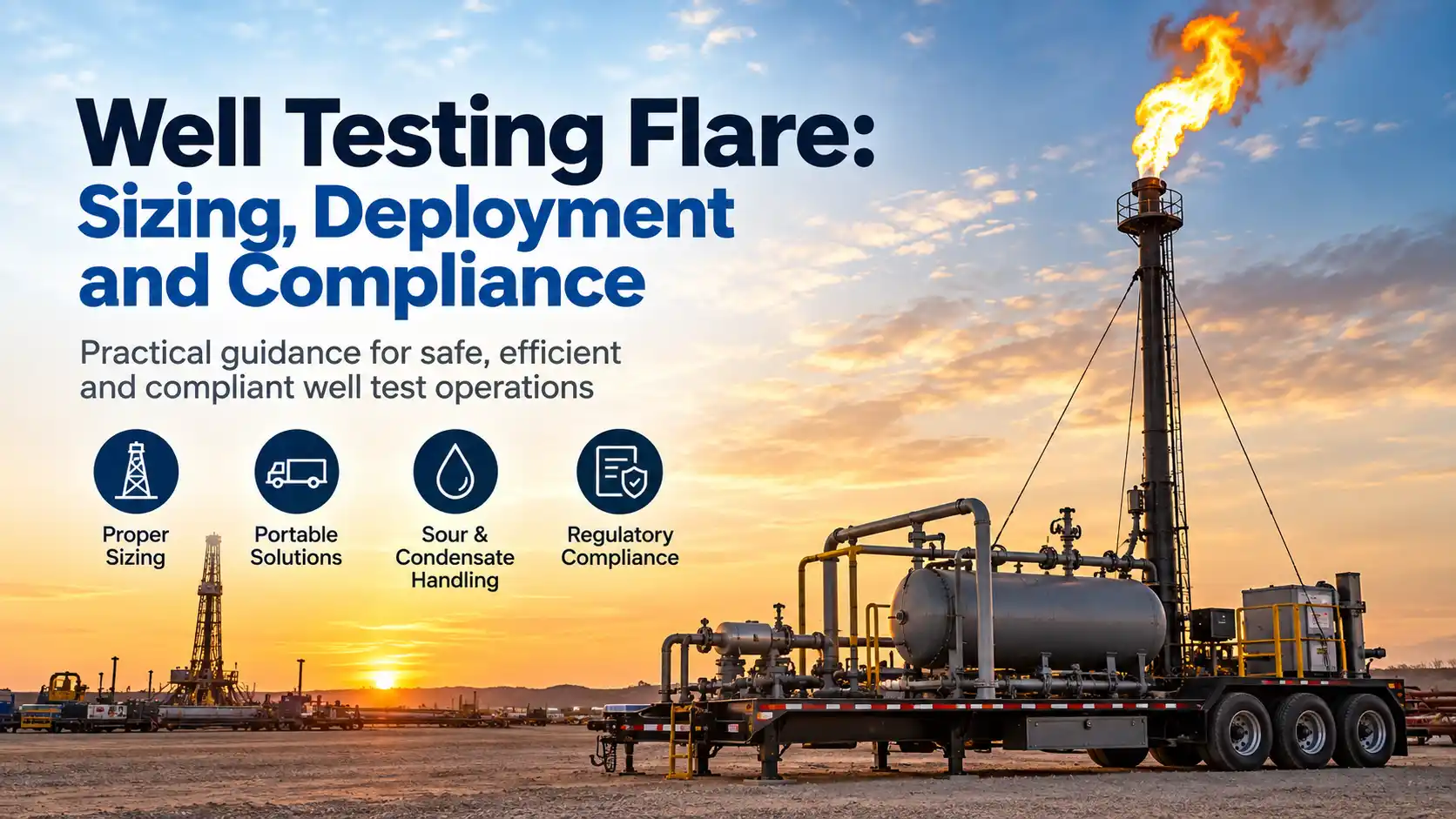
Portable skid-mounted flares are self-contained on a transportable skid, flare stack, tip, pilot system, and control panel on one framework. The skid loads onto a flatbed truck for transport, positions at the wellsite, connects to the test separator or flowback tank, and operates during the test. Skid-mounted flares handle mid-range well test flows.
Trailer-mounted flares are towable with the flare permanently mounted on the trailer. The trailer can be positioned rapidly at multiple wellsites and provides independent battery/solar power plus self-contained pilot fuel storage. Trailer-mounted flares handle larger well test flows and longer test durations.
4. Sour and Condensate Handling
Well testing in sour-producing formations requires NACE MR0175-compliant metallurgy on the flare stack, tip, and instrumentation. The Permian Wolfcamp, Bone Spring, and some Marcellus and Haynesville formations produce sour gas at concentrations requiring sour service specifications.
Well testing typically produces significant condensate volumes along with the gas. Condensate is separated in a test separator upstream of the flare and either recovered to a tank or, if the volume is small enough, combusted alongside the gas at the flare. Liquid knockout drum sizing must handle the expected condensate volume plus any slugging.
KEY INSIGHT: Most well test operations use a test separator upstream of the flare to knock out condensate for recovery, then flare only the gas stream. This gives cleaner combustion at the flare and creates a saleable liquid product from the test.
5. EPA OOOOb and State Requirements
Well test flares at OOOOb-affected facilities must meet OOOOb requirements, 98% Destruction and Removal Efficiency, continuous parametric monitoring during operation, and reporting per OOOOb rules. The affected-facility determination depends on the facility construction date and OOOOb’s specific applicability rules.
State agencies impose additional requirements. TCEQ (Texas), NMED (New Mexico), TRRC (Texas Railroad Commission for oil and gas), and other state agencies each have specific requirements for well testing, temporary flare operation, and reporting.
Green completion rules (EPA 40 CFR 60 Subpart OOOO) may apply to well test flowback in some circumstances, typically requiring gas recovery to a pipeline rather than flaring where a pipeline is available. Operators should verify green completion applicability early in the test planning.
6. Deployment and Staffing
Well test flare deployment typically follows a standard timeline.
Pre-mobilization (weeks before): Confirm flare sizing, order rental or schedule owned unit, coordinate with well test crew and wireline/pipe services, verify permit compliance, and confirm safety protocols with the operator.
Mobilization (1, 2 days before): Transport flare to wellsite, position at safe distance from wellhead and adjacent equipment, connect to test separator or flowback tank, install monitoring, and complete pre-test functional testing.
Test execution (days to weeks): Ignite pilot, verify ignition, initiate flowback, monitor flare operation throughout test period, adjust flow as needed, and verify continuous flame.
Post-test demobilization (1, 2 days after): Confirm well is shut in, extinguish pilot, disconnect from separator, transport flare back to inventory.
Staffing typically includes a rental operator on site during flare operation, coordination with the operator’s well test supervisor, and 24/7 operational coverage if the test runs continuously.
7. Common Well Testing Flare Specification Mistakes
| Mistake | Why It Hurts | Fix |
|---|---|---|
| Undersizing for peak well flow | Flame instability during peak production | Size for peak flow with 20% safety margin |
| Missing sour service metallurgy on sour formations | Sulfide stress cracking risk | Verify formation composition and specify MR0175 |
| Insufficient setback distance from wellhead | Radiation and blowout risk overlap | Follow well test safety protocol setback (typically 300-500 ft) |
| Skipping OOOOb parametric monitoring | Compliance gap during test | Deploy OOOOb-compliant instrumentation with the flare |
| Missing green completion evaluation | Regulatory finding if pipeline is available | Verify green completion applicability early in planning |
| Inadequate condensate knockout capacity | Liquid carryover to flare tip | Size test separator and KO drum for expected condensate volume |
Article Summary
- Well testing flares combust flowback gas during production testing, exploration, and appraisal operations.
- Portable and trailer-mounted configurations both serve well testing service depending on flow rate and duration.
- Sizing depends on peak well flow (typically 5-50 MMSCFD), gas composition, and condensate handling.
- Sour formations require NACE MR0175 metallurgy on all flare and instrumentation components.
- EPA OOOOb applies at affected facilities; state agencies (TCEQ, NMED) add additional requirements.
- Green completion rules may require gas recovery to pipeline instead of flaring where a pipeline is available.
- Standard timeline: pre-mobilization, mobilization, test execution, demobilization.
- Hero Process Solutions supplies portable and trailer-mounted well test flares plus rental fleet across North American upstream.
Related resources: See our companion articles on temporary flare stacks for upstream, portable flare buyer guide, and mobile flare systems for wellsite. For sour formations, review sour gas flare service design. Learn about our flare rental fleet.
Frequently Asked Questions
What is a well testing flare?
A well testing flare is a temporary flare deployed to combust flowback gas during well testing operations, production testing during exploration, appraisal wells, or extended flow tests before permanent facility construction. Most well test flares are portable or trailer-mounted so they can deploy to remote wellsites and demobilize when testing completes.
How do you size a well test flare?
Sizing starts with the peak well flow rate expected during the test, typically 5, 50 MMSCFD for a typical exploration well. Peak flow drives tip and stack sizing; sustained flow drives pilot fuel and instrumentation sizing. Composition drives materials selection and knockout drum requirements. A 20% safety margin above expected peak is standard.
Do OOOOb requirements apply to well testing flares?
Yes, at OOOOb-affected facilities. 98% DRE, continuous parametric monitoring during operation, and OOOOb reporting all apply. The affected-facility determination depends on facility construction date and specific OOOOb applicability rules. Not-yet-constructed exploration wells typically fall under OOOOb requirements once the facility is defined.
Portable or trailer-mounted, which is right for well testing?
Portable skid-mounted flares handle mid-range well test flows and shorter events. Trailer-mounted flares handle larger flows and longer durations with independent power and pilot fuel. For exploration or appraisal wells expected to flow at 20+ MMSCFD or for tests running weeks, trailer-mounted is typically the right choice.
Does the well test need a separate condensate knockout?
Most well test operations use a test separator upstream of the flare to knock out condensate for recovery, then flare only the gas stream. This gives cleaner combustion and creates a saleable liquid product from the test. The knockout drum sizing must handle expected condensate volume plus slugging risk.
How far should the flare be from the wellhead?
Setback distances typically range 300, 500 feet from the wellhead, though the specific setback follows the operator’s well test safety protocol combined with flare radiation calculations. The setback ensures worker safety in the event of a wellhead upset and provides adequate distance from any wind-borne combustion products.