
UPSTREAM COMBUSTION EQUIPMENT | APPALACHIAN BASIN | Updated August 2026 | 8 min read
WHAT YOU’LL LEARN IN THIS GUIDE
- How wet and dry Marcellus shale gas compositions drive different flare specifications
- Pennsylvania DEP and West Virginia DEP permit requirements for Marcellus shale flares
- EPA 40 CFR 60 Subpart OOOOb requirements applicable to Marcellus shale production sites
- Why low-BTU dry Marcellus gas from the northeastern counties creates specific combustion challenges
- How NGL-rich wet Marcellus gas from the southwestern counties affects flare tip smokeless capacity
- Equipment options for Marcellus shale well pad and midstream flare applications
- Remote monitoring requirements for Marcellus shale flares in areas with limited access
Marcellus shale gas composition varies dramatically across the play. Dry gas from northeastern Pennsylvania and north-central West Virginia has a heating value near 1,000 BTU/scf with minimal NGL content. Wet gas from southwestern Pennsylvania and the core WV wet window runs 1,100-1,300 BTU/scf with ethane, propane, and butane that make unassisted combustion smoky and increase smokeless capacity requirements significantly. A Marcellus shale flare specification that works in Bradford County, Pennsylvania will not be adequate for Washington County, and vice versa.
Hero Process Solutions, founded in 2011 and headquartered in Kellyville, Oklahoma, manufactures combustion equipment for Appalachian Basin upstream and midstream applications. This guide covers the composition-specific design decisions, state regulatory requirements, and equipment configurations that apply to Marcellus shale flare projects in Pennsylvania and West Virginia.
DIRECT ANSWER: Marcellus Shale Flare
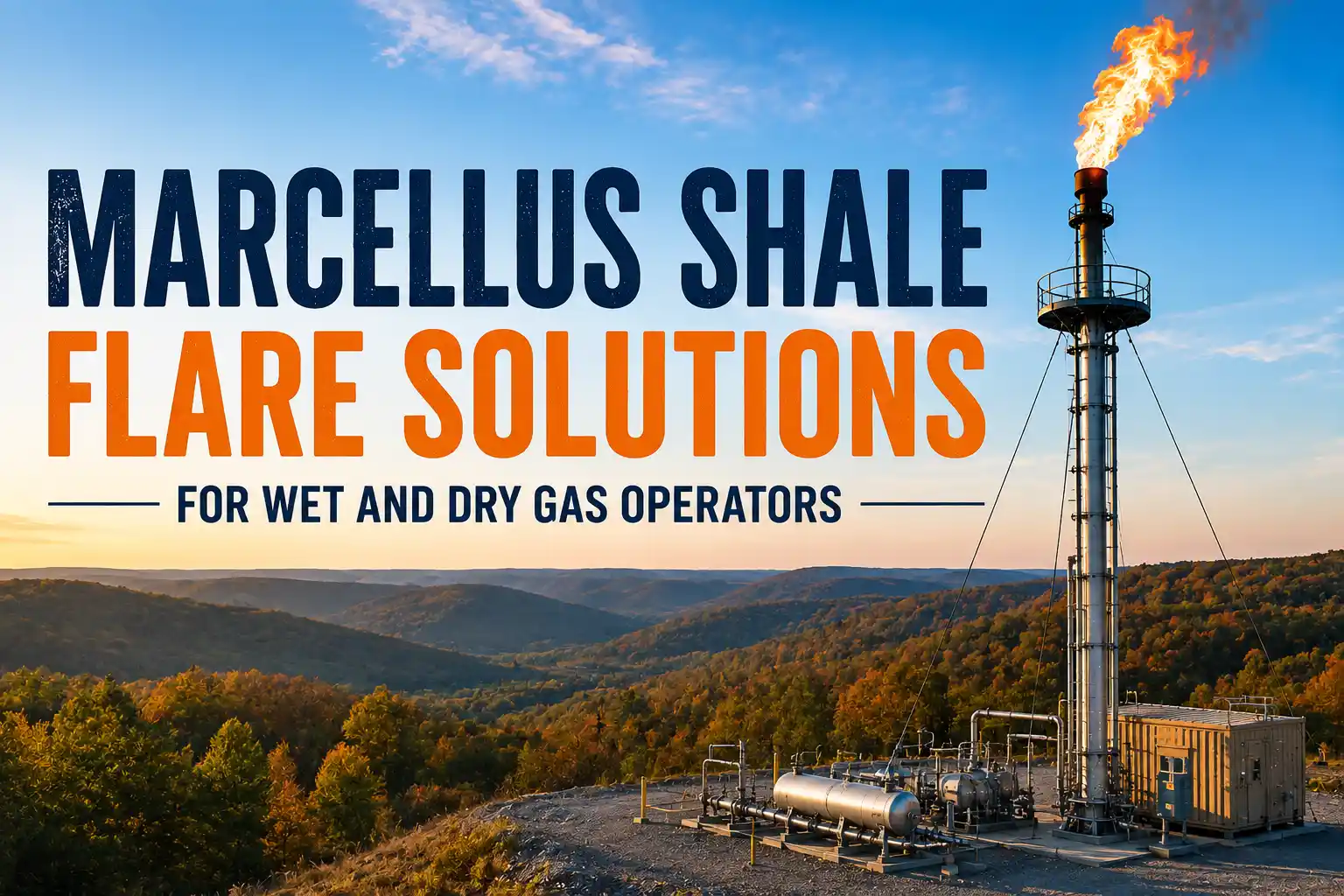
A Marcellus shale flare is a combustion device installed at Appalachian Basin production sites, compressor stations, and midstream facilities to destroy associated gas or emergency relief gas that cannot be captured and sold. Marcellus shale flares must be designed for the specific gas composition at the project location: dry gas from the northeastern dry window requires a different tip design and pilot specification than wet NGL-rich gas from the southwestern wet window. State regulatory requirements under Pennsylvania DEP and West Virginia DEP apply alongside EPA 40 CFR 60 Subpart OOOOb for affected facilities. Combustion efficiency of 98% is the standard federal performance requirement for Marcellus shale flares at OOOOb-affected production sites.
1. Wet vs. Dry Marcellus Gas: How Composition Drives Flare Selection
The Marcellus Shale play spans Pennsylvania, West Virginia, and parts of New York and Ohio. The gas window divide runs roughly northwest-to-southeast across Pennsylvania: northeastern counties (Bradford, Susquehanna, Sullivan, Lycoming) produce primarily dry gas, while southwestern counties (Washington, Greene, Westmoreland, Butler) and much of northern West Virginia produce wet gas with significant NGL content.
Dry Marcellus gas (northeastern PA, north-central WV). Dry Marcellus gas is predominantly methane with minimal ethane, propane, and condensate. It combusts cleanly in an open flare tip without significant smoke, which simplifies the smokeless capacity requirement. However, the low NGL content means the gas heating value may drop toward 950-1,000 BTU/scf, which is still adequate for reliable combustion in a well-designed pilot system. The primary design concern for dry Marcellus flares is pilot stability in the cold, wet, and sometimes icy conditions of northeastern Pennsylvania winters. Pilot systems for dry Marcellus applications must be specified for sustained operation at sub-zero ambient temperatures.
Wet Marcellus gas (southwestern PA, northern WV). Wet Marcellus gas contains significant ethane (10-20%), propane (3-8%), and butane fractions that increase the heating value and create smoke when burned without assist. Air-assist or steam-assist flare tips are required to achieve smokeless combustion at design flow rates for wet Marcellus gas. The NGL content also means that liquid dropout in the flare header is a more significant concern than for dry gas, requiring knockout drum sizing that accounts for condensate accumulation at the header liquid collection point.
2. Pennsylvania DEP Permit Requirements for Marcellus Shale Flares
Pennsylvania DEP regulates air emissions from Marcellus shale production sites under Pennsylvania’s Air Pollution Control Act and the associated regulations in 25 Pa. Code Chapter 127. The applicable permit pathway depends on facility emission levels:
GP-5A (Natural Gas Compression, Processing, and Transmission). Most Marcellus shale production sites in Pennsylvania use the GP-5A general permit, which sets operational standards for flares including combustion efficiency requirements and pilot monitoring provisions. GP-5A flares must maintain a lit pilot at all times when gas is flowing and must meet emissions limits expressed as pounds per hour of VOC and HAPs.
Plan Approval (PA). Facilities above GP-5A emission thresholds require a facility-specific Plan Approval from DEP. Plan Approval conditions for flares typically include more detailed combustion efficiency requirements, performance testing obligations, and continuous monitoring specifications than GP-5A.
Pennsylvania has also adopted state-specific methane regulations that align with and in some provisions exceed EPA OOOOb requirements, particularly for storage vessel emissions at tank batteries and compressor station blowdowns.
3. West Virginia DEP Permit Requirements
West Virginia DEP Air Quality Bureau regulates Marcellus shale production sites under WV Code 22-5 and the associated air quality regulations in WV CSR 45. Flares at WV Marcellus production sites are typically authorized under the Minor Source Air Quality Registration or, for facilities above threshold emission levels, a WV DEP Air Quality Permit to Operate.
West Virginia’s regulations for oil and gas production site air emissions were updated to address OOOOb alignment, and WV DEP flare permit conditions now commonly include pilot monitoring requirements and combustion efficiency provisions consistent with federal OOOOb standards. For facilities in West Virginia that are also subject to federal OOOOb because they meet the affected facility definition, both sets of requirements apply and the more stringent governs.
4. EPA OOOOb at Marcellus Shale Production Sites
EPA 40 CFR 60 Subpart OOOOb applies to new, modified, and reconstructed production sites across the Marcellus play. The 98% combustion efficiency requirement under OOOOb governs flares used as control devices for storage vessel and separator vent emissions at affected facilities.
Continuous pilot flame monitoring is required for all flares at OOOOb-affected Marcellus shale production sites. For Marcellus applications in remote northeastern Pennsylvania and West Virginia locations with limited cellular or satellite connectivity, thermocouple-based monitoring with local data logging is the minimum implementation. Facilities with data historian systems can integrate pilot monitoring outputs into SCADA for real-time compliance visibility.
The OOOOb compliance resources at Hero Process Solutions cover the monitoring, documentation, and flare design requirements for Marcellus shale affected facilities. Contact sales@hero-ps.com or (918) 941-2166 to discuss OOOOb compliance for a specific Marcellus shale project.
5. Cold Weather Pilot Design for Marcellus Shale Applications
Northeastern Marcellus shale production areas experience severe winters with sustained cold temperatures, ice accumulation on flare stacks, and precipitation that challenges standard pilot designs. Several pilot system considerations are specific to Marcellus winter operations.
KEY INSIGHT
Ice accumulation on flare stacks and pilot tips is a documented cause of pilot flame failures at northeastern Pennsylvania Marcellus shale production sites. Water from precipitation or condensation can freeze in the pilot gas supply line or at the pilot tip orifice during prolonged cold spells. Pilot gas supply lines for Marcellus shale flares should include a methanol injection point or trace heat for cold-climate applications. Pilot tip designs with larger orifice diameters are less susceptible to ice blockage than fine-orifice designs, but require more pilot gas flow to maintain a stable flame.
Pilot gas supply pressure must be maintained at a level sufficient to overcome expected ice accumulation resistance without relying on utility gas pressure that may fluctuate during winter demand peaks. For remote pad locations in the northeastern Pennsylvania mountains, a dedicated pilot gas supply cylinder or small accumulator vessel eliminates dependence on variable utility gas pressure.
6. Marcellus Shale Flare Equipment from Hero Process Solutions
The flare equipment selection for a Marcellus shale project should start with the local gas composition (wet or dry), the applicable state permit pathway, and the site’s winter operating conditions. Hero Process Solutions manufactures flare systems for both wet and dry Marcellus service.
For dry Marcellus gas applications in northeastern Pennsylvania and north-central West Virginia, utility flare or low-flow flare designs with cold-climate pilot systems are the standard configuration. The utility flares product line is available in configurations with enlarged pilot orifices and methanol injection provisions for cold-climate service.
For wet Marcellus gas applications in southwestern Pennsylvania and northern West Virginia, air-assist flare designs provide smokeless combustion capacity for NGL-rich gas. The air-assist flares product line includes configurations with variable-speed blower control for handling the flow variability typical of Marcellus shale multi-well pad production.
For midstream vapor combustor applications at Marcellus compressor stations and processing facilities, enclosed combustor designs provide controlled combustion performance across wide BTU and flow ranges. Field services from Hero Process Solutions include commissioning and performance testing for new Marcellus shale flare installations in Pennsylvania and West Virginia.
Article Summary
- Marcellus shale gas composition varies significantly between the dry northeastern window (Bradford, Susquehanna, Lycoming counties) and the wet southwestern window (Washington, Greene, Westmoreland counties and northern WV), and flare specification must be based on the actual local gas composition.
- Dry Marcellus gas requires flares designed for cold-climate pilot reliability. Wet Marcellus gas requires air-assist or steam-assist flare tips capable of smokeless combustion of NGL-rich gas streams.
- Pennsylvania DEP GP-5A general permit and WV DEP Minor Source Registration are the standard permit pathways for Marcellus shale production site flares. Facilities above emission thresholds require facility-specific Plan Approvals or Permits to Operate.
- EPA 40 CFR 60 Subpart OOOOb’s 98% combustion efficiency requirement applies to flares at affected Marcellus shale production sites in both Pennsylvania and West Virginia.
- Ice accumulation on pilot tips and pilot gas supply lines is a documented failure mode for Marcellus shale flares in northeastern Pennsylvania winters. Pilot systems must be specified with cold-climate provisions including methanol injection or trace heat.
- Hero Process Solutions manufactures flare systems for both wet and dry Marcellus shale applications, with field commissioning services available for Pennsylvania and West Virginia installations.
Frequently Asked Questions
What type of flare is required for Marcellus shale production sites?
The required flare type depends on the local gas composition. Dry Marcellus gas from northeastern Pennsylvania and north-central West Virginia combusts cleanly in open utility flare tips and does not require air or steam assist for smokeless operation. Wet Marcellus gas from southwestern Pennsylvania and northern West Virginia contains enough NGL to require air-assist or steam-assist flare tips to achieve smokeless combustion at design flow rates. Both types must meet EPA OOOOb’s 98% combustion efficiency requirement at affected facilities and must comply with Pennsylvania DEP or West Virginia DEP permit conditions as applicable.
What Pennsylvania DEP permits apply to Marcellus shale flares?
Most Marcellus shale production site flares in Pennsylvania are authorized under GP-5A (General Permit for Natural Gas Compression, Processing, and Transmission), which sets operational standards for combustion efficiency and pilot monitoring. Facilities with emission levels above GP-5A thresholds require a facility-specific Plan Approval from Pennsylvania DEP. Permit conditions under both pathways align with EPA OOOOb requirements for pilot monitoring and combustion efficiency.
How do cold winters affect Marcellus shale flare design?
Cold winters in northeastern Pennsylvania and West Virginia create two specific flare design challenges: ice accumulation in small-bore pilot gas supply lines can block pilot gas flow, and ice on pilot tips can obstruct the pilot orifice. Both failure modes result in pilot flame loss and OOOOb compliance events. Pilot systems for Marcellus shale applications should include methanol injection points or trace heat on pilot gas supply lines, and pilot tip designs with larger orifice diameters that are less susceptible to ice blockage.
Does EPA OOOOb apply to Marcellus shale production sites?
Yes. EPA 40 CFR 60 Subpart OOOOb applies to new, modified, and reconstructed production sites across the Marcellus Shale play in Pennsylvania, West Virginia, and other states. OOOOb requires 98% combustion efficiency for flares used as control devices at affected facilities, plus continuous pilot flame monitoring and operational record-keeping. State DEP requirements under Pennsylvania and West Virginia regulations apply in addition to federal OOOOb.
What is the difference between wet and dry Marcellus shale gas for flare purposes?
Dry Marcellus gas (northeastern PA, north-central WV) is predominantly methane with minimal NGL content, heating value near 1,000 BTU/scf, and relatively clean combustion in open flare tips. Wet Marcellus gas (southwestern PA, northern WV) contains significant ethane, propane, and butane fractions that raise the heating value to 1,100-1,300 BTU/scf and produce visible smoke when burned without combustion assist. The practical consequence is that wet Marcellus gas requires air-assist or steam-assist flare tips for permit-required smokeless operation, while dry Marcellus gas typically does not.
Does Hero Process Solutions supply flares for Marcellus shale projects?
Yes. Hero Process Solutions manufactures combustion equipment for Appalachian Basin upstream and midstream applications, including both dry and wet Marcellus shale service. Equipment options include cold-climate utility flare configurations for dry gas applications and air-assist flares for wet gas service. Field commissioning support is available for new installations in Pennsylvania and West Virginia. Contact sales@hero-ps.com or (918) 941-2166 to discuss a specific Marcellus shale project.