
FLARE ENGINEERING STANDARDS | Updated August 2026 | 9 min read
WHAT YOU’LL LEARN IN THIS GUIDE
- What ISO 25457 covers and how it differs from API 537
- Which facility types and service classes fall under ISO 25457
- How the 2023 revision updated flare system design requirements
- Flare tip selection, sizing, and combustion efficiency requirements under the standard
- How ISO 25457 addresses pilot system design and flame monitoring
- Where ISO 25457 and EPA 40 CFR 60 Subpart OOOOb requirements intersect
- Applying ISO 25457 when specifying flare equipment for international refinery and petrochemical projects
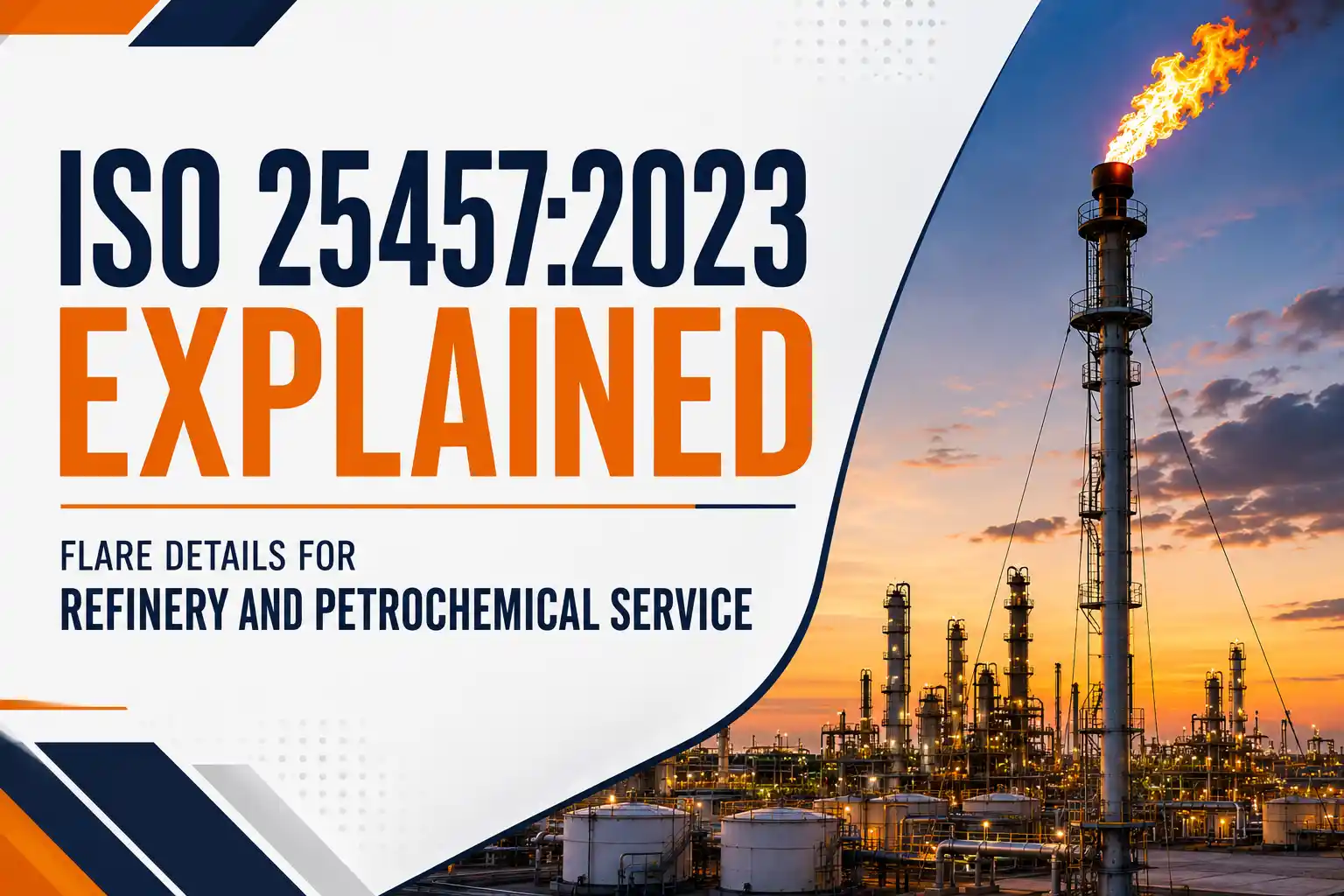
ISO 25457 is the international standard governing flare systems for the petroleum, petrochemical, and natural gas industries, and it is the document that engineers at international projects, European refineries, and facilities operating under ISO-based engineering specifications reference for flare system design details. For facilities in regions where API standards are not the default engineering basis, ISO 25457 is the primary technical authority on flare tip design, pilot systems, and assist medium selection.
Hero Process Solutions, founded in 2011 and headquartered in Kellyville, Oklahoma with operations in Midland, Texas, manufactures combustion equipment for domestic and international service. This guide explains what ISO 25457 requires, how it compares to API 537, and what it means for flare system specification at refinery and petrochemical facilities.
DIRECT ANSWER: ISO 25457
ISO 25457, “Petroleum, Petrochemical and Natural Gas Industries — Flare Details for General Production and Process Service,” is the International Organization for Standardization standard for flare system design in the petroleum and petrochemical industries. The 2023 edition (ISO 25457:2023) is the current version. It covers flare tip types, sizing, combustion efficiency, pilot systems, assist medium design, and environmental considerations. ISO 25457 is broadly equivalent in scope to API 537 but is the preferred reference standard for international projects and facilities operating under ISO-based engineering documentation requirements.
1. What ISO 25457 Covers
ISO 25457 establishes requirements and recommendations for the design, selection, and operation of flare systems in petroleum, petrochemical, and natural gas production and processing service. The scope of the standard covers the complete flare system from the flare tip inlet to the flame, including:
- Flare tip types: open pipe, air-assist, steam-assist, gas-assist, staged, and enclosed ground flares
- Flare tip exit velocity limits and turndown requirements
- Smokeless capacity design and assist medium selection
- Pilot system design: pilot tip configuration, pilot gas supply, and ignition systems
- Pilot flame monitoring and instrumentation
- Noise, radiation, and environmental impact considerations
- Flare system materials requirements
- Installation and commissioning requirements
ISO 25457 does not cover the design of pressure relief systems, relief headers, or knockout drum sizing, which fall under ISO 4126 (safety devices for protection against excessive pressure) and ISO 23251 (pressure-relieving and depressurizing systems). The parallel here is the same division of scope between API 537 and API 521 in the US market.
2. ISO 25457:2023 — What Changed in the Latest Edition
The 2023 revision of ISO 25457 updated several areas relative to the prior edition, reflecting advances in combustion technology, tightened environmental regulations globally, and lessons from flare system incidents documented in the previous decade.
Enhanced combustion efficiency requirements. The 2023 edition strengthened the combustion efficiency framework, aligning it more closely with performance-based regulatory requirements in major markets including the US, EU, and Asia-Pacific. The standard now provides more explicit guidance on demonstrating combustion efficiency at both design and turndown conditions.
Updated pilot monitoring requirements. Pilot flame monitoring specifications were revised in ISO 25457:2023 to address modern thermocouple and UV sensor technologies, and to provide clearer requirements for multi-pilot monitoring systems on large-diameter flare tips where individual pilot failure can go undetected with older single-sensor designs.
Ground-level and enclosed flare provisions. The 2023 revision expanded coverage of enclosed ground flares and multi-point ground flares, reflecting the increased use of these technologies at refineries and chemical plants where elevated flares face restrictions on visible flame, noise, or radiation.
Environmental considerations section. ISO 25457:2023 added a more structured treatment of noise, thermal radiation, visible emissions, and SO₂ dispersion from sour gas service, providing design guidance in each area.
KEY INSIGHT
ISO 25457:2023 and API 537 3rd edition (2017) are not identical, but they are substantially harmonized for the core flare tip design requirements. A flare system designed to meet API 537 will generally meet ISO 25457 requirements, and vice versa, but specific numerical limits and documentation requirements differ between the two standards. For international projects where the engineering specification calls for ISO compliance, use ISO 25457 as the primary reference, not API 537, even if the design outcome is similar.
3. Flare Tip Types and Selection Under ISO 25457
ISO 25457 classifies flare tips by their combustion mechanism and operating characteristics. The standard provides selection criteria for each type based on waste gas composition, flow rate, smokeless operation requirements, and site constraints.
Open pipe flare tips. The simplest design, used for clean gas service where smokeless operation is not required. ISO 25457 limits the exit velocity for open pipe tips to prevent flameout and blowout, and sets minimum tip height requirements based on radiation and dispersion calculations.
Steam-assist tips. Used where a steam supply is available and smokeless operation is required at moderate to high flow rates. ISO 25457 provides steam injection ratio guidance by gas type and flow rate, similar to API 537’s approach. The standard requires that steam injection be controlled to avoid over-steaming, which reduces combustion efficiency by cooling the flame.
Air-assist tips. Designed for smokeless operation using blower-forced air. ISO 25457 addresses blower sizing, air-to-gas ratios, and backup provisions in the event of blower failure. The air-assist flares from Hero Process Solutions are available for international projects requiring ISO 25457 documentation support.
Gas-assist tips. Used when neither steam nor air is practical, or when the waste gas heating value is too low to support stable combustion without supplemental fuel. ISO 25457 addresses supplemental gas injection rates and flame stability requirements for gas-assist designs.
Enclosed ground flares and multi-point ground flares. ISO 25457:2023 provides expanded coverage of these technologies, including combustion chamber sizing, thermal radiation limits at the facility boundary, and noise emission requirements.
4. Exit Velocity Limits and Pressure Drop
ISO 25457 specifies maximum allowable exit velocities at the flare tip to prevent flameout at low flow and blowout at maximum flow. The velocity limits in ISO 25457 are expressed in terms of molecular weight-corrected Mach number for high-pressure tips and in meters per second for lower-pressure utility designs.
The pressure drop methodology in ISO 25457 follows compressible flow principles for high-velocity tips and incompressible approximations for low-pressure utility designs. Engineers specifying flare tips for high-pressure relief service must use the compressible flow equations in ISO 25457 Annex B to correctly calculate tip pressure drop and verify that the available pressure at the tip inlet is sufficient for the design relief case.
For international projects where the regulatory authority requires demonstration of ISO 25457 compliance, tip sizing calculations must use the ISO 25457 methodology and be documented in the project engineering file. Hero Process Solutions provides engineering documentation support for ISO 25457 compliance projects on request. Contact sales@hero-ps.com or (918) 941-2166 to discuss documentation requirements for a specific project.
5. Pilot System Requirements in ISO 25457
ISO 25457 requirements for pilot systems parallel those in API 537 but include several provisions that differ in specifics. Key requirements include:
Pilot tip materials. ISO 25457 requires high-temperature alloys for pilot tips in continuous service. The standard references specific alloy classifications with minimum temperature ratings appropriate for the expected flare flame environment.
Pilot flame monitoring. ISO 25457:2023 requires continuous pilot flame monitoring for all flares in regulated service. Thermocouple-based monitoring must meet response time and alarm setpoint requirements defined in the standard. UV sensor systems must be installed with shield purge provisions to prevent fouling by combustion products.
Ignition system redundancy. For major facility flares where a failed start represents an unacceptable safety or environmental risk, ISO 25457 recommends redundant ignition systems. Electronic ignition is the standard approach, with manually operable backup ignition specified for critical service. The ignition systems from Hero Process Solutions include configurations designed to meet ISO 25457 ignition reliability requirements.
6. ISO 25457 vs. API 537: When to Use Each Standard
| Criterion | Use ISO 25457 | Use API 537 |
|---|---|---|
| Project location | International, Europe, Middle East, Asia-Pacific | North America, US domestic projects |
| Engineering specification basis | ISO-based engineering documents required by owner or EPC | API-based engineering documents per owner specification |
| Regulatory authority | Regulatory body cites ISO standards | Regulatory body cites API standards (e.g., US EPA) |
| Owner preference | International oil company (IOC) with ISO documentation requirements | US refiner or domestic upstream operator |
| Design outcome difference | Minor differences in numerical limits and documentation format | Minor differences in numerical limits and documentation format |
7. ISO 25457 and EPA 40 CFR 60 Subpart OOOOb
For US facilities subject to EPA 40 CFR 60 Subpart OOOOb, the primary regulatory reference for combustion efficiency and pilot monitoring requirements is the OOOOb rule itself, not ISO 25457 or API 537. However, ISO 25457:2023’s combustion efficiency framework and pilot monitoring requirements are consistent with OOOOb performance standards, meaning that a flare designed to ISO 25457 will generally meet OOOOb’s technical requirements.
For international facilities where both local environmental regulations and ISO 25457 apply, the more stringent requirement governs. In practice, ISO 25457:2023’s combustion efficiency provisions meet or exceed most national regulatory requirements in major oil and gas producing regions outside North America.
Hero Process Solutions provides OOOOb compliance documentation for US facilities and engineering support for international projects requiring ISO 25457 compliance. The flares product line includes configurations documented to either API 537 or ISO 25457 depending on project requirements.
Article Summary
- ISO 25457:2023, “Petroleum, Petrochemical and Natural Gas Industries — Flare Details for General Production and Process Service,” is the current international standard for flare system design in refinery and petrochemical service.
- ISO 25457 covers flare tip types, exit velocity limits, smokeless capacity, pilot systems, pilot monitoring, ignition, and environmental considerations including noise, radiation, and SO₂ dispersion.
- The 2023 edition strengthened combustion efficiency requirements, updated pilot monitoring specifications, expanded coverage of enclosed ground flares, and added a structured environmental considerations section.
- ISO 25457 and API 537 are substantially harmonized for core flare tip design requirements but are not identical. International projects and those with ISO-based engineering documentation requirements should reference ISO 25457, not API 537.
- Pilot monitoring requirements in ISO 25457:2023 require continuous flame detection with specific response time and alarm setpoint requirements for thermocouple and UV sensor systems.
- For US facilities subject to EPA 40 CFR 60 Subpart OOOOb, a flare designed to ISO 25457 will generally meet OOOOb technical requirements, but OOOOb, not ISO 25457, is the governing regulatory document.
- Hero Process Solutions manufactures flare systems documented to API 537 or ISO 25457 depending on project requirements, from its Kellyville, Oklahoma facility.
Frequently Asked Questions
What is ISO 25457 and what does it cover?
ISO 25457 is the International Organization for Standardization standard for flare systems in the petroleum, petrochemical, and natural gas industries. The current edition, ISO 25457:2023, covers flare tip types and selection, exit velocity limits, smokeless capacity design, pilot system requirements, pilot flame monitoring, ignition systems, and environmental impact considerations including noise, thermal radiation, and SO₂ dispersion. It is the international counterpart to API 537 and is the primary flare design standard for international projects and facilities operating under ISO-based engineering documentation requirements.
What changed in ISO 25457:2023 compared to the previous edition?
ISO 25457:2023 strengthened combustion efficiency requirements, updated pilot flame monitoring specifications for modern thermocouple and UV sensor technologies, expanded coverage of enclosed ground flares and multi-point ground flares, and added a more structured environmental considerations section covering noise, thermal radiation, visible emissions, and SO₂ dispersion from sour service. The 2023 revision also improved alignment with performance-based regulatory requirements in major international markets.
What is the difference between ISO 25457 and API 537?
ISO 25457 and API 537 cover the same scope: flare tip design, pilot systems, and assist medium requirements. ISO 25457 is the ISO standard used on international projects and by facilities with ISO-based engineering documentation requirements. API 537 is the American Petroleum Institute standard used on North American projects and by facilities with API-based engineering documentation requirements. The two standards are substantially harmonized in their core technical requirements, but differ in specific numerical limits, documentation format, and annex content. For any project, the engineering specification establishes which standard governs; using the wrong one creates documentation compliance issues even if the design outcome is similar.
Does a flare designed to ISO 25457 meet US EPA OOOOb requirements?
A flare designed to ISO 25457:2023 will generally meet the technical requirements of EPA 40 CFR 60 Subpart OOOOb for combustion efficiency and pilot flame monitoring. However, for US facilities subject to OOOOb, the governing regulatory document is OOOOb itself, not ISO 25457. Permit applications and compliance demonstrations must reference OOOOb requirements directly, even if the underlying flare design was specified to ISO 25457.
When should I specify ISO 25457 rather than API 537?
Use ISO 25457 when the project is located outside North America, when the owner or EPC contractor requires ISO-based engineering documentation, when the regulatory authority in the project jurisdiction cites ISO standards, or when the project specification explicitly calls for ISO 25457 compliance. For domestic US projects at refineries or petrochemical facilities, API 537 is the standard reference unless the owner specification says otherwise.
Does Hero Process Solutions supply flares for ISO 25457 projects?
Yes. Hero Process Solutions manufactures combustion equipment for domestic and international service. For international projects requiring ISO 25457 documentation, Hero Process Solutions can provide engineering documentation referencing ISO 25457 requirements alongside equipment built to the equivalent design standards. Contact sales@hero-ps.com or (918) 941-2166 to discuss documentation and design requirements for a specific international project.