OIL & GAS EQUIPMENT | Updated May 2025 | 8 min read
• What makes a flare system genuinely “mobile” vs. a standard skid-mounted unit
• Which well site conditions require mobile flaring vs. fixed installation
• Key mechanical features to evaluate before renting or buying a mobile flare system
• How mobile flare systems meet EPA 40 CFR 60 Subpart OOOOb combustion efficiency rules
• Deployment steps for remote locations with limited infrastructure
• Trailer configuration options and tow requirements for field mobilization
• When to transition from a mobile unit to a permanent flare installation
Mobile flare systems give oil and gas operators the ability to combust waste gas at locations where permanent flare infrastructure is not yet in place, and under EPA 40 CFR 60 Subpart OOOOb, that distinction matters because the combustion efficiency requirement of 98% applies regardless of whether your flare is fixed or temporary. Unplanned flaring, venting, and stranded gas situations at remote well pads, pipeline tie-ins, and short-cycle production sites all create both compliance exposure and operational waste.
Hero Process Solutions, founded in 2011 and headquartered in Kellyville, OK with field operations out of Midland, TX, manufactures and rents mobile flare systems designed specifically for upstream oil and gas environments. The product line spans trailer-mounted low-flow flares for wellsite venting applications through high-capacity air-assist units capable of handling multi-well pad gas volumes, all built to be deployed, operated, and relocated by a small field crew.
A mobile flare system is a trailer-mounted or skid-mounted combustion unit designed to safely destroy waste gas at remote or temporary locations without permanent infrastructure. Under EPA 40 CFR 60 Subpart OOOOb, mobile flares must achieve the same 98% combustion efficiency as fixed flares, and must include a continuously burning pilot flame verified by a thermocouple or equivalent device. Hero Process Solutions mobile flare systems are engineered to meet these requirements in well pad, pipeline, and gathering station environments.
1. What Defines a Mobile Flare System in Oil & Gas
Not every portable combustion unit qualifies as a true mobile flare system. The term covers equipment that meets three criteria: it is mounted on a road-legal trailer or self-contained skid, it can be commissioned at a new location without civil construction, and it meets the combustion efficiency and pilot reliability standards required for the waste gas stream being processed.
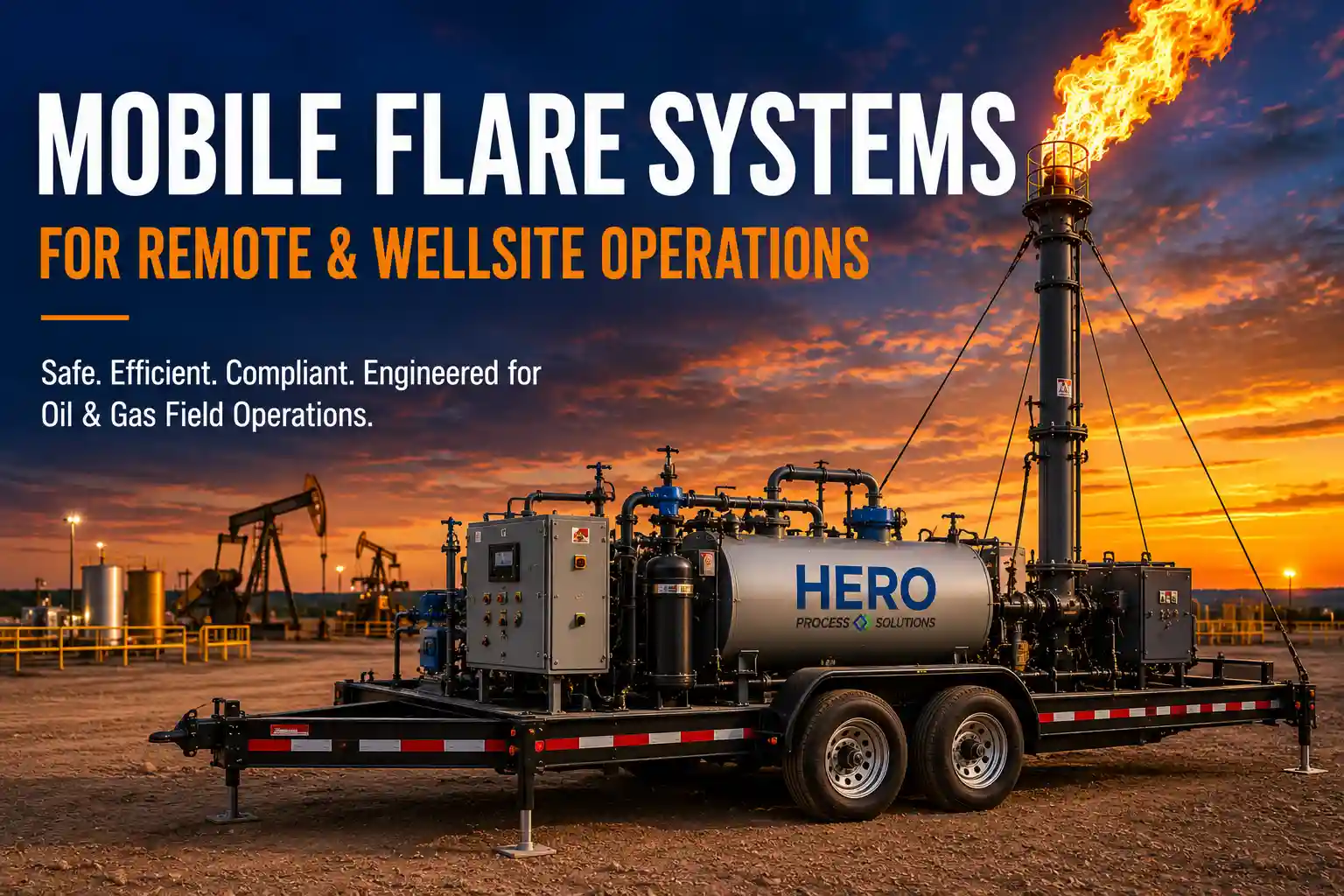
Trailer-mounted flare systems typically use a single-axle or tandem-axle gooseneck or bumper-pull trailer rated for the stack and skid weight. The flare stack itself is mounted in a folded or lowered transport position, then raised at the site using a mechanical or hydraulic mast system. Some units telescope; others hinge. Either design requires a secure base that can be leveled on unprepared ground.
Skid-mounted mobile flares are lifted rather than towed. They move by flatbed truck or crane set. This configuration suits locations with rough access roads where a trailer would be difficult to maneuver, or where the unit will remain in place for an extended period before its next move.
Distinguishing Mobile from Portable
The industry uses “portable” and “mobile” interchangeably, but there is a practical distinction. A portable flare is generally a lower-capacity unit, often handling flows under 1 MMscfd, suited for single-well venting or completion flowback. A mobile flare system implies a higher-capacity unit with more complete combustion controls, ignition monitoring, and the ability to handle variable gas compositions, including sour gas streams, at remote sites where a technician may not be on-site full-time.
2. Applications That Drive Mobile Flare Deployment
Mobile flare systems are not a niche product. Several common upstream O&G scenarios make them a practical requirement.
Well Completion and Flowback Operations
During well completion, produced gas volumes are high and variable. Before the sales line connection is made, that gas must go somewhere. A mobile flare system stages at the well pad before flowback begins, handles the peak rates of the cleanup phase, then demobilizes once the well is tied in. Completion flowback flares need to handle high liquid carryover and wide swings in gas flow, which drives the selection toward air-assist designs with liquid knockout upstream.
Remote or Stranded Production
In areas without gathering infrastructure, a producing well may send gas to a mobile flare while the operator negotiates pipeline access or evaluates whether the reserve volume justifies a permanent gathering line. These deployments can run for months. The flare system in this scenario needs auto-reignition, remote monitoring capability, and fuel efficiency for extended unattended operation.
Turnaround and Maintenance Flaring
When a processing facility goes down for maintenance, gas that normally feeds the facility requires alternative disposal. A mobile flare system can be staged at an inlet point to handle the diverted flow during the outage period. The short notice nature of maintenance events makes a rental flare the standard solution, and Hero Process Solutions’ rental fleet is available for rapid deployment from Kellyville and Midland.
Pipeline Pigging and Tie-In Operations
Pipeline operators purge sections of line with nitrogen or natural gas during pigging or tie-in work. A mobile flare provides a safe disposal point for the purge gas at the blowdown point, eliminating uncontrolled atmospheric venting that would otherwise violate Subpart OOOOb venting restrictions.
3. Key Features to Evaluate in a Mobile Flare System
Feature selection is not about preference. Each feature either solves a problem your site presents or it is unnecessary cost and weight. Evaluate these in order.
Stack Height and Radiation Clearance
Stack height determines the thermal radiation zone around the flare base. For wellsite applications, the standard reference is API RP 521, which establishes allowable radiation heat flux levels for unprotected personnel (typically 1,500 BTU/hr·ft² for 8 hours daily exposure). A correctly sized mobile flare stack places the thermal exclusion zone within your well pad boundary at your peak design flow rate.
Pilot System and Auto-Reignition
A continuously burning pilot flame is mandatory under 40 CFR 60.18 for smokeless flare compliance. For remote wellsite applications where an operator may not be on-site at all times, the pilot must include auto-reignition: a system that detects pilot flame out via thermocouple or UV scanner and re-fires the pilot automatically without manual intervention. Flares without auto-reignition require constant attended operation, which is not practical at remote locations.
Liquid Knockout
Liquid carryover from the gas stream is the most common cause of flare tip damage and incomplete combustion at wellsite flares. A mobile flare system should include an upstream liquid knockout drum sized for the anticipated liquid loading of your gas stream. For completion flowback applications, the liquid loading can be substantial; the knockout drum needs to be larger than you think.
Wind Deflector and Crosswind Performance
Crosswind conditions at remote well pads can destabilize the flare flame, particularly at low flow rates. A wind deflector shroud around the flare tip stabilizes combustion by creating a zone of reduced crosswind velocity at the burner. For locations in windy basins (Permian, Bakken, DJ), specify a flare tip with a wind deflector as standard equipment, not an option.
Auto-reignition is not optional for remote wellsite flares under continuous operation. 40 CFR 60.18(c)(6) requires that a flare have a “continuously burning” pilot. Without auto-reignition, a pilot outage during an unattended period constitutes a compliance violation, not just an operational inconvenience.
4. Mobile Flare System Configurations Compared
| Configuration | Typical Capacity | Transport Method | Best Application |
|---|---|---|---|
| Trailer-mounted low-flow | Up to 0.5 MMscfd | Bumper-pull or gooseneck trailer | Single-well venting, remote production |
| Trailer-mounted mid-range | 0.5 to 5 MMscfd | Gooseneck trailer | Multi-well pads, completion flowback |
| Air-assist trailer flare | 1 to 15+ MMscfd | Gooseneck with blower skid | High-volume flowback, pipeline maintenance |
| Skid-mounted mobile unit | Variable | Flatbed crane-set | Extended deployments, rough access sites |
| Rental unit (Hero fleet) | Multiple options | Dispatched from Midland/Kellyville | Short-notice needs, turnaround events |
5. EPA Compliance Requirements for Mobile Flare Systems
Mobile flare systems are subject to the same federal combustion efficiency standards as permanent flares. This is one of the most misunderstood aspects of temporary flaring.
40 CFR 60 Subpart OOOOb Requirements
Under EPA 40 CFR 60 Subpart OOOOb (effective for affected facilities after December 2022), flares used for gas control at oil and natural gas production sites must achieve a minimum 98% combustion efficiency. The standard requires:
- A continuously burning pilot flame monitored by thermocouple or equivalent
- No visible emissions (opacity less than 5%) except during startup or malfunction
- A net heating value of the gas stream at the flare tip that maintains flame stability
- Compliance monitoring records available for inspection
The key practical implication: if your mobile flare handles gas from an OOOOb-affected source, it must be engineered to meet these parameters, not just sized to pass the flow rate. Hero Process Solutions engineers mobile flare systems with gas composition and heating value verification as part of the selection process. Learn more at our OOOOb compliance page.
A mobile flare system handling gas from an EPA Subpart OOOOb-affected source must meet 98% combustion efficiency. “Temporary” does not create an exemption from this standard. The classification of the source, not the duration of the flare deployment, determines compliance obligations.
6. Deployment Best Practices for Remote Wellsite Operations
Proper mobilization and commissioning determine whether a mobile flare performs as designed or becomes a compliance and safety problem.
Commissioning Sequence
- Position and level the trailer; deploy outriggers or stabilizer jacks if equipped
- Raise the stack mast to operating height; verify guy wire connections if required
- Connect the gas inlet line through the liquid knockout drum
- Commission the ignition control panel: verify pressure settings, confirm thermocouple continuity
- Light the pilot and confirm stable flame before opening the main gas valve
- Bring the gas flow up gradually; verify combustion stability across the expected flow range
- Document the commissioning date, pilot confirmation, and inlet gas pressure for permit records
7. When to Transition from Mobile to Permanent Flare Infrastructure
A mobile flare solves a temporary problem. At some point, the economics and operational demands of a site justify a permanent installation. As a general rule, if a site requires continuous flaring for more than 12 to 18 months and gathering infrastructure is not on a near-term horizon, a permanent flare system with a fixed foundation and full utility connections delivers better total cost of ownership.
Common Mistakes to Avoid
| Mistake | Why It Hurts | Fix |
|---|---|---|
| Undersizing the liquid knockout drum | Liquid carryover damages flare tip and causes visible emissions violations | Size the KO drum for peak liquid-to-gas ratio during completion flowback |
| Selecting a flare without auto-reignition for remote use | Pilot outage during unattended operation = compliance violation | Specify auto-reignition as mandatory for any unattended deployment |
| Ignoring gas composition variability | Heating value swings cause unstable combustion below 98% | Obtain full gas analysis before sizing |
| Skipping site access assessment | Trailer cannot reach the pad; mobilization delay | Walk the access road with trailer specs before scheduling delivery |
| Assuming temporary flaring is exempt from OOOOb | Permit violations and enforcement action | Confirm affected source classification before mobilizing |
Article Summary
- Mobile flare systems are trailer-mounted or skid-mounted combustion units that meet the same EPA combustion efficiency standards as permanent installations.
- The 98% combustion efficiency requirement under EPA 40 CFR 60 Subpart OOOOb applies to mobile flares handling gas from affected sources.
- Auto-reignition is a non-negotiable feature for remote wellsite flares that operate without continuous attended monitoring.
- Applications include well completion flowback, stranded production, pipeline pigging, and facility maintenance events.
- A liquid knockout drum upstream of the flare tip is essential for any gas stream with liquid carryover potential.
- Stack height selection must account for API RP 521 radiation heat flux limits at the maximum design flow rate.
- State permit requirements (TCEQ in Texas, DEQ in Oklahoma) apply in addition to federal OOOOb rules.
- When mobile flaring at a site exceeds 12 to 18 months, permanent installation economics typically favor a fixed flare system.
Frequently Asked Questions
What is the difference between a mobile flare system and a portable flare?
The terms are often used interchangeably, but in oil and gas operations, a mobile flare system typically refers to a higher-capacity trailer-mounted unit with full combustion controls, auto-reignition, and liquid knockout equipment designed for extended field operation. A portable flare is more often a compact, lower-capacity unit for single-well venting or short-duration completion work. Both must comply with EPA 40 CFR 60 Subpart OOOOb combustion efficiency requirements if handling gas from affected sources.
Do mobile flare systems need to meet EPA combustion efficiency standards?
Yes. The 40 CFR 60 Subpart OOOOb requirement for 98% combustion efficiency applies to flares based on the classification of the source the flare serves, not the duration or permanence of the flare installation. If your mobile flare is handling gas from an OOOOb-affected production site, it must be engineered and operated to achieve and document 98% combustion efficiency.
How long does it take to deploy a mobile flare system?
From the decision to deploy, a standard trailer-mounted mobile flare system can be on location and commissioned within 24 to 72 hours depending on distance from the supply point and site readiness. Hero Process Solutions operates rental units out of Kellyville, OK and Midland, TX and can dispatch on short notice for urgent wellsite and pipeline events.
What size mobile flare do I need for a completion flowback operation?
Sizing depends on the expected peak flowback rate, gas composition, and heating value. For a single-well horizontal completion in a tight oil play, a unit capable of handling 1 to 5 MMscfd is a common starting point, but multi-well pad completions may require larger capacity. Consult Hero Process Solutions engineering with your well completion program before confirming equipment size.
Can a mobile flare system handle sour gas with H2S?
Yes, with proper material selection and safety provisions. H2S in the gas stream requires special attention to combustion products (sulfur dioxide), materials compatibility in the knockout drum and gas train, and personnel safety protocols. Hero Process Solutions can engineer and specify mobile flare systems for sour gas applications with the appropriate alloy materials and safety controls.