
OIL & GAS EQUIPMENT | Updated November 2026 | 12 min read
WHAT YOU’LL LEARN IN THIS GUIDE
- Capital cost ranges for recuperative, regenerative, catalytic, and direct-fired thermal oxidizers in O&G service
- How fuel gas consumption and electrical demand drive operating costs over a 10-year period
- Total cost of ownership (TCO) framework comparing thermal oxidizer vs flare for upstream applications
- How EPA 40 CFR 60 Subpart OOOOb compliance requirements affect vendor selection and equipment cost
- Key sizing parameters: waste gas volume, BTU content, halogenated compounds, and 98% DRE targets
- Operating cost reduction strategies including heat recovery, VFD controls, and combustion tuning
- Common cost estimation mistakes that inflate or underestimate thermal oxidizer project budgets
- How Hero Process Solutions structures thermal oxidizer costs for Permian Basin and mid-continent O&G operators
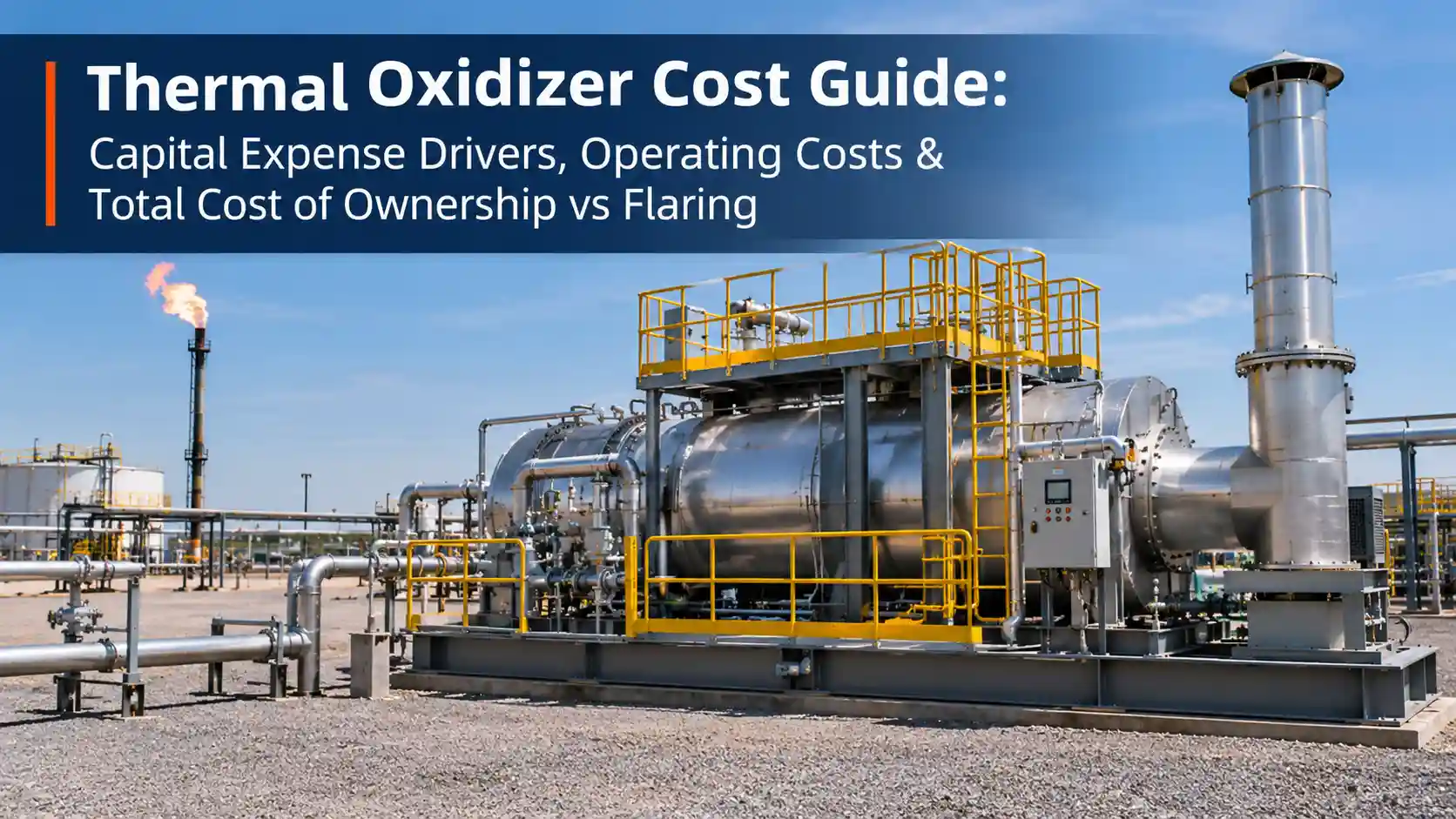
Thermal oxidizer cost is the first question most O&G procurement teams ask when evaluating combustion treatment for VOC and HAP control, and it is frequently the wrong first question. A thermal oxidizer that costs $120,000 installed but consumes 1.2 MMBtu/hr in supplemental fuel will cost more over five years than a $200,000 unit with 85% heat recovery operating on the same waste gas stream. The real number that matters is total cost of ownership, and that requires understanding every cost category before the first purchase order is issued. For upstream O&G operators in the Permian Basin facing EPA 40 CFR 60 Subpart OOOOb compliance deadlines, getting the cost analysis wrong has consequences beyond the project budget.
Hero Process Solutions, founded in 2011 and headquartered in Kellyville, OK, with operations in Midland, TX, designs and manufactures thermal oxidizers, industrial flare systems, vapor combustors, and vapor recovery units for the global oil and gas industry. The company’s combustion engineering team regularly advises operators on thermal oxidizer vs flare cost comparisons, and the analysis below reflects current equipment pricing, fuel cost assumptions, and regulatory compliance requirements as of 2026.
DIRECT ANSWER: Thermal Oxidizer Cost
Thermal oxidizer cost ranges from $80,000 to $400,000+ for capital equipment depending on type, capacity, and heat recovery configuration. Recuperative units for small-to-mid-volume streams start at $80,000-$180,000 installed; regenerative thermal oxidizers (RTOs) for high-volume applications typically cost $200,000-$400,000+. Operating costs add $15,000-$80,000+ per year in fuel, power, and maintenance depending on stream BTU content and destruction efficiency requirements. For EPA 40 CFR 60 Subpart OOOOb compliance, thermal oxidizers must achieve 95% or 98% destruction removal efficiency (DRE) depending on the regulated compound category, which directly affects combustion temperature, residence time, and equipment cost.
1. How Thermal Oxidizer Cost Is Structured: CapEx, OpEx, and Total Cost of Ownership
Breaking thermal oxidizer cost into three buckets prevents the most common budget error: comparing equipment purchase price without accounting for the annual operating expense that runs for the life of the asset.
Capital Expenditure (CapEx)
CapEx covers the combustion chamber, burner, heat exchanger (if recuperative or regenerative), instrumentation, control panel, structural skid, and outlet stack. Installed CapEx includes freight, foundation, electrical connections, and commissioning. Excluding these from the initial quote routinely adds 15-25% to the delivered equipment cost.
Operating Expenditure (OpEx)
OpEx for thermal oxidizers includes supplemental fuel gas (the largest variable for low-BTU waste streams), electrical power for blowers and controls, burner maintenance, thermocouple and sensor replacement, catalyst replacement (catalytic oxidizers only), and regulatory compliance testing (Method 25A stack testing under 40 CFR 60 Appendix A). Annual OpEx for a mid-size recuperative unit processing 500 SCFM of 50 BTU/SCF waste gas typically runs $25,000-$45,000 per year at $3.00/MMBtu natural gas pricing.
Total Cost of Ownership (TCO)
TCO = CapEx + (Annual OpEx x expected operating years) + major overhaul reserves. For a 10-year operating period, the OpEx component frequently exceeds the original capital cost for units operating on lean waste gas streams. This is why high-BTU waste streams from condensate stabilizers, glycol dehydrators, and tank vents reduce thermal oxidizer TCO significantly: the waste gas itself provides most of the combustion energy, reducing supplemental fuel to near zero.
2. Capital Cost Ranges by Thermal Oxidizer Type
Not all thermal oxidizers are priced the same. The four primary configurations differ substantially in capital cost, heat recovery capability, and application fit for O&G service.
| Type | Typical Capital Cost Range | Heat Recovery | Best Application | Key Limitation |
|---|---|---|---|---|
| Recuperative TO | $80,000-$180,000 | 50-70% | 500-5,000 SCFM, moderate BTU content | Lower efficiency at very lean streams |
| Regenerative TO (RTO) | $200,000-$400,000+ | 85-95% | 5,000+ SCFM, continuous high-volume streams | High maintenance, not suitable for variable flow |
| Catalytic TO (CTO) | $100,000-$250,000 | 50-80% | Clean streams, low-halogen content, 300-1,400°F operating range | Catalyst deactivation from sulfur/silicones |
| Direct-Fired TO (DFTO) | $70,000-$150,000 | None to minimal | High-BTU streams, intermittent service | High fuel cost on lean streams |
Hero Process Solutions’ thermal oxidizer line covers recuperative and direct-fired configurations. For operators weighing capital cost against long-term fuel savings, the company’s applications engineers calculate fuel offset projections for each site-specific waste gas analysis. Aftermarket parts and service contracts extend equipment life and protect the capital investment, particularly for recuperative heat exchangers that require periodic inspection at the 3-5 year mark.
KEY INSIGHT
RTO capital costs are front-loaded but fuel costs are substantially lower over a 10-year horizon. For streams above 5,000 SCFM with consistent BTU content, an RTO’s $150,000-$200,000 premium over a recuperative unit typically pays back in fuel savings within 3-4 years at $3.00/MMBtu natural gas pricing. Below 2,000 SCFM, the payback period extends past 10 years, making recuperative units the lower-TCO choice for most upstream O&G applications.
3. Operating Cost Drivers: Fuel Gas, Power, and Maintenance
Operating costs for thermal oxidizers depend on three primary variables: waste gas heat content, flow rate variability, and required operating temperature for the target destruction removal efficiency.
Fuel Gas Consumption
Supplemental fuel gas is typically the largest component of thermal oxidizer OpEx. For a recuperative TO operating at 1,600°F with 60% heat recovery, treating a 1,000 SCFM waste gas stream at 100 BTU/SCF content, supplemental fuel consumption is approximately 0.4-0.6 MMBtu/hr. At $3.00/MMBtu, that runs $10,500-$15,700 per year for 24/7 continuous operation. For the same unit treating a 500 BTU/SCF stream, supplemental fuel drops to near zero as the waste gas self-sustains combustion.
Electrical Power
Blower and fan power for a mid-size recuperative thermal oxidizer typically runs 7-20 kW continuous depending on pressure drop and flow rate. At $0.10/kWh in continuous operation, that equates to $6,100-$17,500 per year in electrical cost. Variable frequency drives (VFDs) on the combustion air fan can reduce power consumption by 20-40% when waste gas flows vary substantially from design.
Maintenance and Inspection
Annual maintenance for a recuperative thermal oxidizer includes burner tip cleaning and inspection ($500-$1,500), thermocouple and UV scanner replacement ($1,000-$2,500), refractory inspection ($1,000-$3,000), and control panel calibration ($500-$1,500). Annualized, routine maintenance runs $3,000-$8,500 per year for a properly sized unit on a well-conditioned waste gas stream.
4. Thermal Oxidizer vs Flare: Total Cost Comparison for Oil and Gas Applications
The thermal oxidizer vs flare cost comparison is application-dependent and cannot be answered generically. The decision hinges on waste gas volume, composition, regulatory requirements, and site location.
| Cost Factor | Thermal Oxidizer (Recuperative) | Air-Assist Flare | Notes |
|---|---|---|---|
| Capital cost (installed) | $80,000-$400,000+ | $30,000-$150,000 | TO cost scales with heat recovery selection |
| Supplemental fuel (annual) | $0-$50,000+ | Minimal to zero | Flares use waste gas directly; TO may require supplement for lean streams |
| Visible flame / opacity | No visible flame | Visible flame | TO preferred for urban or sensitive receptor sites |
| Destruction efficiency | 95-99.9% DRE | 96.5%+ (smokeless) | Both meet OOOOb with proper sizing |
| Annual maintenance | $3,000-$12,000 | $2,000-$8,000 | Flares simpler mechanically; TO has more instrumentation |
| Permit complexity | Moderate to high | Lower in most states | Varies by state agency and air quality district |
For low-BTU streams below 200 BTU/SCF where supplemental fuel costs are high, an air-assist flare frequently delivers lower 10-year TCO while still meeting EPA 40 CFR 60 Subpart OOOOb destruction efficiency requirements. For high-BTU streams, streams requiring zero visible emissions (urban locations, pipeline compressor stations near populated areas), or operations targeting carbon credit programs, thermal oxidizers provide advantages that justify higher capital cost.
KEY INSIGHT
The break-even point where thermal oxidizer TCO equals flare TCO depends primarily on waste gas heat content. At typical Permian Basin tank vapor BTU values (350-700 BTU/SCF), a thermal oxidizer operating on self-sustaining combustion with no supplemental fuel reaches TCO parity with a comparably sized flare within 4-7 years, primarily driven by lower permitting complexity and no visible emissions violations.
5. EPA 40 CFR 60 Subpart OOOOb Compliance and Its Effect on Thermal Oxidizer Cost
EPA 40 CFR 60 Subpart OOOOb (Standards of Performance for New, Reconstructed, and Modified Sources in the Oil and Natural Gas Sector) establishes the performance standards that determine thermal oxidizer specification for most onshore production, gathering, and processing operations built or modified after December 6, 2022.
The regulation requires at minimum:
- 95% destruction removal efficiency (DRE) for VOC-containing streams from storage vessels in certain categories
- 98% DRE for streams containing benzene above specific thresholds
- Continuous monitoring of combustion zone temperature and operating parameter compliance
- Method 25A or Method 25C performance testing at specified intervals
These requirements drive thermal oxidizer cost in two ways. First, achieving 98% DRE requires a combustion temperature of at least 1,600°F at 0.5-second residence time for most VOC streams, which sets a floor on combustion chamber size and refractory specification. Second, continuous temperature monitoring and data retention require a data acquisition system (DAS) that adds $5,000-$15,000 to equipment cost compared to a basic unit without compliance monitoring. Hero Process Solutions’ OOOOb compliance solutions are pre-engineered to meet these performance thresholds without requiring field modification after installation.
CRITICAL RULE
EPA 40 CFR 60 Subpart OOOOb requires compliance monitoring documentation for all control devices including thermal oxidizers. A thermal oxidizer without a compliant DAS and parametric monitoring plan cannot satisfy the compliance demonstration requirements of Section 60.5415b, regardless of its stated destruction efficiency. Never specify a thermal oxidizer for Subpart OOOOb sites without confirming the control panel includes the required continuous monitoring outputs.
6. Sizing Parameters That Drive Thermal Oxidizer Cost
Thermal oxidizer cost scales with four primary sizing inputs. Getting any of these wrong in the initial specification increases either capital cost (over-sizing) or operating cost (under-sizing for DRE targets).
- Waste gas flow rate (SCFM or MMscfd): Combustion chamber volume, blower sizing, and heat exchanger area all scale directly with flow rate. A unit specified for 500 SCFM costs roughly 30-40% less than the same design at 1,000 SCFM.
- Waste gas heat content (BTU/SCF): Higher BTU content reduces supplemental fuel cost and can eliminate it entirely on rich streams. It also sets the minimum combustion air ratio to avoid overtemperature on the heat exchanger.
- Halogenated compound content: Streams containing chlorinated VOCs, fluorinated compounds, or high sulfur require acid gas scrubbing systems downstream of the combustion chamber. This adds $20,000-$80,000 to system cost and significantly increases operating complexity.
- Required DRE: Moving from 95% to 99.99% DRE typically adds 100-200°F to the required operating temperature and 20-40% to combustion chamber refractory cost. For streams where 95% satisfies the permit, over-specifying DRE increases both capital and operating cost unnecessarily.
For operators managing multiple small-volume streams, vapor recovery systems that capture and redirect high-BTU vapors to a central thermal oxidizer can reduce per-unit capital cost by consolidating several low-volume streams into a single compliant treatment device.
7. Reducing Long-Term Thermal Oxidizer Cost: Efficiency Strategies
Once a thermal oxidizer is installed, several operational practices significantly reduce annual OpEx without requiring capital upgrades.
Combustion Tuning
Excess air ratio has an outsized effect on fuel consumption. Running excess air at 150% of stoichiometric is common at startup but adds 15-25% to fuel cost compared to operating at 110-120% excess air within the DRE compliance window. Annual combustion tuning by qualified technicians typically returns $3,000-$12,000 per year in fuel savings on units treating consistent waste gas compositions.
Waste Gas Stream Conditioning
Liquid knockout upstream of the thermal oxidizer prevents both combustion instability and heat exchanger fouling. A properly maintained liquid knockout drum reduces maintenance intervals and prevents the unplanned shutdowns that create compliance gaps under Subpart OOOOb’s deviation reporting requirements.
Planned Maintenance Scheduling
Hero Process Solutions’ field services team offers planned maintenance programs for combustion equipment across the mid-continent and Permian Basin. Planned maintenance programs for thermal oxidizers typically cost 40-60% less than reactive maintenance calls on the same equipment, while extending mean time between major overhauls from 7 years to 10+ years on properly maintained units.
8. Recommended Schema Markup
| Schema Type | Best Used For | Key Properties |
|---|---|---|
| TechArticle | Technical cost guides, comparison articles | headline, author, datePublished, proficiencyLevel, about |
| FAQPage | FAQ section at the bottom of the page | mainEntity, Question, acceptedAnswer |
| Product | Specific thermal oxidizer product references | name, description, brand, offers, url |
CRITICAL RULE
All thermal oxidizer cost figures cited in this article should be reflected in FAQPage schema’s acceptedAnswer properties, so that AI search and featured snippet systems can extract the structured cost data directly. Never implement schema that contradicts the published article copy.
9. Internal Linking Plan
| # | Anchor Text | Target URL | Placement Section |
|---|---|---|---|
| 1 | thermal oxidizer | https://heroprocesssolutions.com/thermal-oxidizers/ | Opening paragraph |
| 2 | industrial flare systems | https://heroprocesssolutions.com/flares/ | Second paragraph |
| 3 | Aftermarket parts and service contracts | https://heroprocesssolutions.com/aftermarket/ | Section 2: Capital Cost Ranges |
| 4 | air-assist flare | https://heroprocesssolutions.com/air-assist-flares/ | Section 4: Thermal Oxidizer vs Flare |
| 5 | OOOOb compliance | https://heroprocesssolutions.com/oooob-c/ | Section 5: EPA OOOOb Compliance |
| 6 | vapor recovery systems | https://heroprocesssolutions.com/vapor-recovery-systems/ | Section 6: Sizing Parameters |
| 7 | field services team | https://heroprocesssolutions.com/field-services/ | Section 7: Reducing Long-Term Cost |
10. External Linking Plan
| # | Anchor Text | Target URL | Placement Section |
|---|---|---|---|
| 1 | EPA 40 CFR 60 Subpart OOOOb | https://www.ecfr.gov/current/title-40/chapter-I/subchapter-C/part-60/subpart-OOOOb | Section 5: EPA OOOOb Compliance |
| 2 | EPA oil and gas air pollution control guidance | https://www.epa.gov/controlling-air-pollution-oil-and-natural-gas-industry | FAQ: thermal oxidizer vs flare |
| 3 | EIA natural gas market data | https://www.eia.gov/naturalgas/ | FAQ: operating costs |
11. Common Thermal Oxidizer Cost Mistakes
| Mistake | Why It Hurts Operations / Compliance | Fix |
|---|---|---|
| Specifying capital cost without supplemental fuel analysis | A $90K unit with high fuel draw can exceed $200K TCO in 5 years versus a $160K heat-recovery unit | Always run a 10-year TCO model using site-specific BTU content and fuel cost projections before vendor selection |
| Under-sizing for peak flow rates | DRE drops below compliance threshold during upset conditions, creating Subpart OOOOb deviation events | Size for 125% of maximum expected flow rate, not average operating flow rate |
| Ignoring halogenated compound content | Halogenated VOCs require acid scrubbing; operating without it corrodes the combustion chamber and fails compliance testing | Submit a full waste gas composition analysis (not just BTU and flow) before specifying a thermal oxidizer |
| Specifying without DAS compliance monitoring | Subpart OOOOb requires parametric monitoring documentation; units without compliant DAS cannot satisfy the compliance demonstration | Confirm the control panel includes temperature data logging, alarm outputs, and downloadable compliance records |
| Ignoring maintenance intervals in OpEx budget | Skipping annual combustion tuning adds 15-25% to fuel cost and shortens refractory life by 2-3 years | Include $3,000-$8,500/year in planned maintenance budget from project inception |
Article Summary
- Thermal oxidizer cost ranges from $80,000 to $400,000+ capital depending on type (recuperative, regenerative, catalytic, or direct-fired) and heat recovery configuration.
- Regenerative thermal oxidizers (RTOs) have the highest capital cost ($200K-$400K+) but lowest long-term fuel cost; direct-fired units have the lowest capital cost but highest fuel draw on lean streams.
- Annual operating costs run $15,000-$80,000 per year depending on waste gas BTU content, supplemental fuel requirements, and maintenance practices.
- Total cost of ownership (TCO) over 10 years frequently exceeds capital cost on lean waste gas streams; TCO analysis before purchase is essential for projects treating sub-200 BTU/SCF streams.
- Thermal oxidizers and air-assist flares can both satisfy EPA 40 CFR 60 Subpart OOOOb when properly sized; the lower-TCO choice depends primarily on waste gas heat content and site location constraints.
- EPA 40 CFR 60 Subpart OOOOb requires 95-98% DRE, continuous temperature monitoring, and compliance data retention, adding $5,000-$15,000 to equipment specification compared to a basic non-compliant unit.
- Combustion tuning, VFD controls, and planned maintenance programs reduce annual OpEx by 20-40% over the life of the asset with minimal capital investment.
- Key sizing inputs that drive thermal oxidizer cost: waste gas flow rate, BTU content, halogenated compound presence, and required destruction removal efficiency.
- Hero Process Solutions manufactures thermal oxidizers for the O&G industry from its Oklahoma facility, with applications engineering support for Subpart OOOOb compliance sizing and TCO analysis.
Frequently Asked Questions
How much does a thermal oxidizer cost for an oil and gas application?
Thermal oxidizer cost for oil and gas applications ranges from $80,000 to $400,000+ for capital equipment depending on type and capacity. Recuperative units for 500-2,000 SCFM streams typically cost $80,000-$180,000 installed. Regenerative thermal oxidizers (RTOs) for high-volume continuous streams cost $200,000-$400,000+. The largest cost variable after capital is supplemental fuel gas, which can add $15,000-$50,000 per year for units treating lean waste gas streams below 200 BTU/SCF. Total cost of ownership over 10 years should always be calculated before final vendor selection. For current pricing on Hero Process Solutions’ thermal oxidizer configurations, contact the company’s applications engineering team in Kellyville, OK.
What is the difference in cost between a thermal oxidizer and a flare?
Flares generally have lower capital cost ($30,000-$150,000 for air-assist units) compared to thermal oxidizers ($80,000-$400,000+), but the total cost comparison depends on operating conditions. For high-BTU waste streams where the thermal oxidizer operates without supplemental fuel, TCO parity is typically reached within 4-7 years due to lower permitting complexity and no visible emissions issues. For lean streams below 200 BTU/SCF, flares generally deliver lower 10-year TCO while still meeting EPA 40 CFR 60 Subpart OOOOb destruction efficiency requirements. See EPA’s oil and gas air pollution control guidance for the regulatory framework governing both control device types.
What operating costs should I budget for a thermal oxidizer?
Annual operating costs for a mid-size recuperative thermal oxidizer (500-1,000 SCFM) typically run $20,000-$55,000 per year, broken down as: supplemental fuel gas $10,000-$35,000 (highly variable with BTU content), electrical power $6,000-$12,000, and annual maintenance $3,000-$8,500. Units treating high-BTU streams near self-sustaining combustion can operate at $8,000-$18,000 per year total OpEx. EIA natural gas market data provides current and forecast fuel cost inputs for OpEx modeling. Use these ranges as a starting point and calculate site-specific costs using your actual waste gas analysis and local fuel pricing.
Does EPA Subpart OOOOb require a thermal oxidizer specifically?
EPA 40 CFR 60 Subpart OOOOb does not mandate thermal oxidizers specifically. The regulation establishes performance standards (DRE, combustion efficiency, continuous monitoring) that multiple control device types can satisfy, including thermal oxidizers, flares, vapor combustors, and vapor recovery units. The key requirements are 95-98% destruction removal efficiency (depending on the regulated compound), continuous combustion zone temperature monitoring, and compliance demonstration through stack testing at specified intervals. A properly designed and sized flare or vapor combustor can satisfy Subpart OOOOb for many upstream production applications. The choice of control device should be based on site conditions, operating costs, and total cost of ownership rather than a default assumption that thermal oxidizers are required.
What factors increase thermal oxidizer cost the most?
The five factors that most significantly increase thermal oxidizer cost are: (1) High required DRE (98-99.99%) requiring larger combustion chambers and higher operating temperatures; (2) Halogenated compound content requiring acid gas scrubbing systems adding $20,000-$80,000 to system cost; (3) High flow rates above 2,000 SCFM requiring larger blowers, combustion chambers, and heat exchangers; (4) Remote installation requiring self-contained power, automated operation, and extended maintenance intervals; and (5) Lean waste gas streams below 100 BTU/SCF with high supplemental fuel requirements that drive up 10-year TCO significantly above capital cost. For operators with lean streams, evaluating vapor combustors as an alternative for sub-200 SCFM applications can reduce both capital and operating cost while maintaining Subpart OOOOb compliance.
How often does a thermal oxidizer need maintenance?
Standard thermal oxidizer maintenance intervals include: monthly visual inspection of burner, thermocouple, and UV scanner; quarterly burner tip cleaning and combustion performance check; annual refractory inspection, full combustion analysis, and control calibration; and 3-5 year recuperative heat exchanger inspection for tube fouling and wall thickness measurement. Total annual maintenance cost for a properly operated unit runs $3,000-$8,500 per year. Planned maintenance programs through equipment vendors or specialized field service contractors reduce total maintenance cost by 40-60% compared to reactive repairs, primarily by preventing unplanned shutdowns that trigger Subpart OOOOb deviation notifications. Hero Process Solutions provides field maintenance services across Oklahoma and Texas for its installed combustion equipment base.