
OIL & GAS EQUIPMENT | Updated May 2025 | 10 min read
- What industrial flare systems are and why they are essential to safe process operations
- The full range of flare technologies available for different industrial applications
- Which industries and applications drive the demand for industrial flare systems
- EPA and international regulatory requirements governing industrial flare operation
- How modern flare designs achieve smokeless combustion and environmental compliance
- The difference between elevated and ground-level (enclosed) flare designs
- What to evaluate when selecting an industrial flare system manufacturer
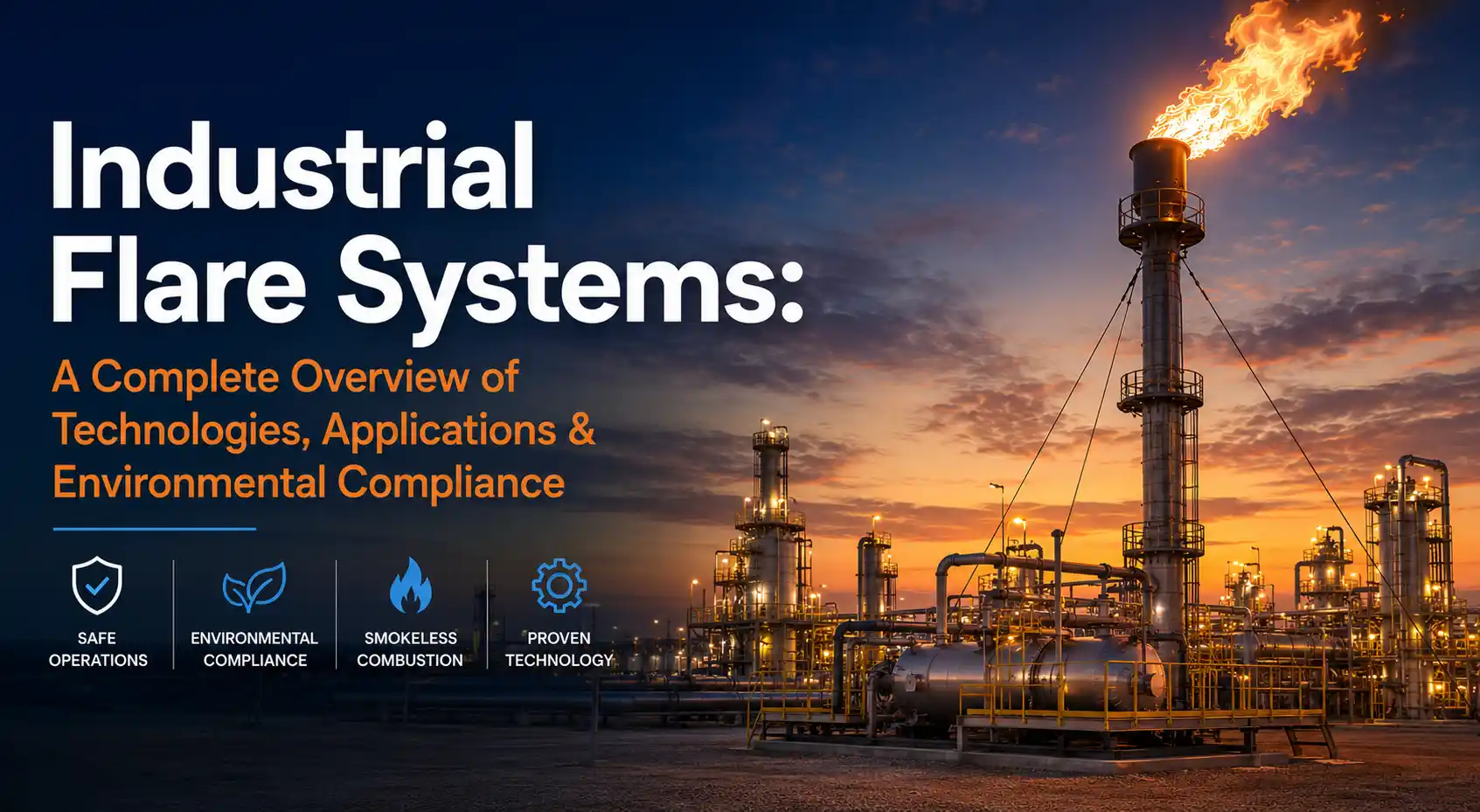
Industrial flare systems are combustion devices that safely destroy waste gas streams that cannot be recovered, sold, or routed to other beneficial use, and in oil and gas production, refinery operations, and chemical manufacturing, the flare is the last line of defense against uncontrolled release of hydrocarbons and toxic gases that would otherwise be vented to the atmosphere in violation of EPA 40 CFR 60 Subpart OOOOb and other environmental regulations. A properly designed industrial flare system operates continuously, reliably, and within the combustion efficiency standards that permit conditions require.
Hero Process Solutions, based in Kellyville, OK with operations in Midland, TX, has manufactured industrial flare systems since 2011 for upstream oil and gas production, midstream gas gathering and processing, and other industrial applications requiring combustion solutions. The product line spans air-assist, gas-assist, sonic, emergency utility, portable, and low-flow flare configurations, all engineered and fabricated at the Kellyville facility with direct field service support from both locations.
An industrial flare system is a combustion device used to safely destroy waste hydrocarbon gas streams through high-temperature combustion. In the oil and gas industry, industrial flare systems must achieve 98% combustion efficiency under EPA 40 CFR 60 Subpart OOOOb and must include a continuously burning pilot flame per 40 CFR 60.18. Flare systems range from simple utility-type units for low-flow production sites to large multi-tip elevated flares and enclosed ground-level flares at refineries and chemical plants.
[IMAGE SUGGESTION 1: Wide-angle photograph of a large industrial flare system at night with visible flame, showing an elevated multi-point air-assist flare at a midstream gas processing facility, with the liquid knockout drum and header piping visible in the foreground.]
1. What Industrial Flare Systems Do and Why They Exist
Industrial flare systems serve two fundamental purposes: safety and regulatory compliance.
The Safety Function
In process facilities, pressure relief devices (safety valves and rupture disks) discharge gas during overpressure events. This gas must go somewhere safe. Venting it directly to atmosphere creates a cloud of flammable and potentially toxic gas near the facility. Routing it to an industrial flare system burns it as it is released, eliminating the atmospheric vapor cloud hazard. Every refinery, petrochemical plant, gas processing facility, and upstream production site has some combination of pressure relief loads that must be safely routed to a flare system or other combustion device. The flare system is not optional at any of these facilities — it is a required safety component.
The Environmental Compliance Function
Beyond safety, industrial flare systems are environmental control devices. They prevent hydrocarbons, VOCs, and HAPs from being discharged to the atmosphere. In the United States, EPA regulations (primarily 40 CFR 60 Subpart OOOOb for oil and gas) require that waste gas from affected sources be destroyed at a minimum efficiency, with the flare being the most common destruction device.
The Continuous Operation Requirement
An industrial flare system must operate continuously and reliably. Unlike a backup generator or emergency system that activates infrequently, the flare is always standing by and must light and hold combustion any time gas is introduced — at 2 AM on a cold winter night, during a facility emergency, and at any point in between. The pilot system and auto-reignition design directly determine whether the flare delivers on this reliability requirement.
2. Industrial Flare Technology Categories
Industrial flare systems are classified along two primary dimensions: the assist mechanism used to achieve smokeless combustion, and the physical configuration (elevated vs. enclosed ground-level).
Assist Mechanism Technologies
- Air-assist: Forced-air blower injects combustion air at the tip base; most common for upstream O&G and midstream applications with rich gas
- Steam-assist: High-pressure steam injection provides turbulence and additional oxygen; standard at refineries and chemical plants with steam infrastructure
- Gas-assist: High-velocity fuel gas or waste gas jets entrain air through the Coanda effect; suitable for applications with adequate gas pressure and limited external utilities
- Natural draft (utility): No external assist; relies on natural air entrainment; suitable for lean gas or emergency-only applications
- Sonic/Coanda: High-velocity gas at the tip creates stable high-efficiency combustion through fluid dynamics; used at high-pressure gas facilities
Elevated vs. Ground-Level (Enclosed) Flares
An elevated flare burns at the top of a stack, which places the flame above the facility and dissipates heat and combustion products at elevation. This is the standard design for most upstream and midstream oil and gas applications. An enclosed ground-level flare burns waste gas inside an insulated enclosure at grade level. These designs are used when: the facility cannot accommodate a tall elevated stack, zero visible flame is required for visual impact reasons (residential proximity), or the waste gas volume and heating value favor a ground-level combustion design.
3. Applications Across the Oil and Gas Value Chain
Industrial flare systems appear at virtually every point in the oil and gas value chain. The application determines the design requirements.
Upstream Production (Well Pads, Tank Batteries)
At upstream production sites, flare systems handle separator gas that cannot be gathered or sold, tank battery vapor recovery overflow, completion flowback gas during well cleanup, and emergency pressure relief from wellhead and separator systems. Upstream flares are often mobile or trailer-mounted for flexibility across a well pad program. The gas stream is typically rich associated gas with high heating value. The primary regulatory driver is OOOOb.
Midstream (Gathering Systems, Processing Plants)
At midstream gathering stations and gas processing plants, flare systems handle inlet separator gas during plant startup and shutdown, compressor blow-down gas during maintenance, pressure relief from gas processing equipment, and emergency relief during facility upsets. Midstream flares are typically fixed elevated units with larger capacity ratings than upstream units.
Downstream (Refineries, Petrochemical)
Refinery and petrochemical flare systems are the largest and most complex in the industry. They handle a wide range of gas streams with varying compositions, heating values, and flow rates from an extensive network of pressure relief devices and blowdown systems. These applications use steam-assist designs and often require elevated stacks of 100 to 200 feet or more.
Other Industrial Applications
Hero Process Solutions flare systems also serve biogas facilities (landfill gas, agricultural anaerobic digesters), mining operations with combustible waste gas, and marine and offshore applications where compact and reliable flare designs are required.
The oil and gas industry accounts for the largest portion of industrial flare system demand in the United States, driven by EPA Subpart OOOOb methane and VOC controls and the large volume of associated gas produced from tight oil plays like the Permian Basin and Bakken. As OOOOb enforcement expands and gathering infrastructure builds out, the mix of permanent and mobile flare system deployments continues to shift toward permanent installations at producing sites with multi-year production horizons.
4. Environmental Compliance Requirements for Industrial Flare Systems
Federal Requirements
The primary federal standards governing industrial flare systems in oil and gas are:
- 40 CFR 60.18: General performance standards for flares subject to any NSPS. Requires continuous pilot, no visible emissions, minimum heating value.
- 40 CFR 60 Subpart OOOOb: New source performance standards for oil and natural gas facilities. Requires 98% combustion efficiency from flares at affected facilities under OOOOb compliance.
- 40 CFR Part 63 NESHAP: Various subparts applying to specific industry segments with additional HAP destruction efficiency and monitoring requirements.
State Requirements
Texas (TCEQ) and Oklahoma (DEQ) each administer state implementation plans that in some respects exceed federal requirements. Texas TCEQ administers a strict flaring reporting and curtailment program for production sites, requiring permits for extended or high-volume flaring events. Oklahoma DEQ manages similar requirements under Oklahoma Administrative Code Title 252.
International Standards
Outside the United States, industrial flare systems must comply with applicable national and regional regulations. In Canada, the Alberta Energy Regulator (AER) and similar provincial bodies regulate flaring with efficiency and opacity requirements. The World Bank Global Gas Flaring Reduction Partnership (GGFR) has established global benchmark standards that many international operators use as reference design requirements even in jurisdictions with weaker local enforcement.
A flare system that is operating but not achieving 98% combustion efficiency is not compliant with EPA OOOOb — even if the pilot flame is lit and the flare is burning. Compliance is defined by combustion efficiency, not by whether the flare is operating. Verify that your flare system is achieving the required efficiency at actual operating conditions, not just at the design point.
5. Modern Smokeless Flare Design
Why Visible Smoke Occurs
Visible black smoke from a flare indicates incomplete combustion of heavy hydrocarbons. The aromatic and aliphatic C4+ compounds in rich gas streams require more combustion air and mixing energy to burn cleanly than methane or ethane. When the flare tip does not provide sufficient air and mixing for the heavy fraction, those compounds partially combust and produce soot particles visible as black smoke.
How Modern Designs Eliminate Smoke
- Forced air injection (air-assist): Blower provides assured oxygen supply and turbulence at the tip
- Multi-point tip staging: Distributing the gas across multiple smaller tip nozzles increases gas-air contact area vs. a single large orifice tip
- High-momentum injection: High-velocity gas jets entrain ambient air through momentum exchange, providing combustion air without external fans
- Sonic tip operation: At sonic velocity, gas exits the tip and entrains large volumes of ambient air through aerodynamic effects
Noise Considerations
Some smokeless flare designs (particularly sonic and high-momentum designs) produce elevated combustion noise levels. For facilities near residential areas or with noise permit conditions, the flare tip selection must balance smokeless performance against noise output. Multi-point air-assist designs generally offer lower noise than sonic designs at comparable flow rates.
6. Hero Process Solutions Industrial Flare Product Line
Hero Process Solutions manufactures industrial flare systems across the following product categories:
- Air-Assist Flares — Forced-air blower designs for smokeless combustion of rich gas streams at upstream production and midstream facilities. Available in a range of capacities with single and multi-blower configurations.
- Sonic Flares — High-efficiency sonic tip designs for high-pressure gas streams at gathering stations and processing plants where maximum smokeless performance is required.
- Gas-Assist Flares — Fuel gas-driven designs for applications with adequate gas pressure and limited power availability.
- Emergency Utility Flares — Simple reliable utility designs for emergency relief applications where smokeless performance is a secondary consideration to operational simplicity.
- Portable/Trailer-Mounted Flares — Mobile flare systems for completion flowback, temporary production, and pipeline maintenance events.
- Low-Flow Flares — Small-capacity designs for continuous low-volume production site venting.
| Hero PS Flare Product | Primary Application | Smokeless | Assist Type |
|---|---|---|---|
| Air-Assist Flares | Rich gas upstream/midstream | Yes | Electric blower |
| Sonic Flares | High-pressure gathering/processing | Yes | Pressure-driven |
| Gas-Assist Flares | Remote/low-power sites | Yes | Fuel gas pressure |
| Emergency Utility Flares | Emergency relief, lean gas | Partial | None |
| Portable/Trailer Flares | Completion flowback, temp production | Configurable | Configurable |
| Low-Flow Flares | Continuous low-volume venting | Configurable | None or minimal |
[IMAGE SUGGESTION 2: Hero Process Solutions product line display showing side-by-side specifications of air-assist, sonic, and low-flow flare types with key performance parameters listed for each.]
Common Design Mistakes to Avoid
| Mistake | Why It Hurts Operations/Compliance | Fix |
|---|---|---|
| Using a utility flare for rich gas streams | Visible black smoke; opacity violation; OOOOb non-compliance | Select air-assist or gas-assist for rich associated gas streams with C4+ content |
| Flare operating without verifying combustion efficiency | OOOOb compliance is efficiency-based; a burning flare is not automatically compliant | Conduct combustion efficiency verification per EPA methodology or engineering calculation |
| No backup pilot or auto-reignition | Pilot outage creates uncontrolled venting; OOOOb violation | Specify auto-reignition with thermocouple monitoring for all industrial flare systems |
| Sizing flare capacity for normal production only | Cannot handle emergency relief load; may require venting during pressure events | Size for the maximum combined normal + emergency relief flow rate |
| Operating without a purge gas system | Air enters the flare header; explosion risk inside the system | Install and maintain a continuous low-flow purge gas connection on all industrial flare headers |
| No noise assessment for facilities near communities | Community noise complaints; permit violations | Include flare tip noise evaluation in the design phase for any facility within 0.5 miles of occupied buildings |
How Flare Systems Reduce Emissions: The GHG Math
Flare systems reduce greenhouse gas emissions by combusting waste gas that would otherwise be vented to atmosphere, converting methane and volatile organic compounds into carbon dioxide and water vapor through thermal oxidation. The emissions reduction is quantifiable and substantial.
Methane carries a Global Warming Potential (GWP) of 84 times that of carbon dioxide over a 20-year horizon, according to the IPCC Sixth Assessment Report (AR6). A production site venting 500 Mcf/day of gas at 90% methane content releases approximately 19,080 lbs/day of methane, equivalent to 1,602,720 lbs/day of CO2-equivalent. A compliant flare operating at 98% Destruction and Removal Efficiency combusts 98% of that methane, reducing the residual to approximately 382 lbs/day of CO2-equivalent — a reduction of more than 99.97% in climate impact from that emission source.
| Disposition Method | Methane Emitted | VOC Emitted | Regulatory Status (OOOOb) |
|---|---|---|---|
| Venting | 100% of waste gas | 100% of VOC content | Prohibited above thresholds |
| Flaring (open, 98% DRE) | ~2% of methane content | ~2% of VOC content | Compliant when permitted |
| Enclosed combustor / VCU | ~2% or less | ~2% or less | Compliant, no visible flame |
| Vapor Recovery Unit | Near 0% | Near 0% (gas captured) | Compliant, gas sold or reused |
The DRE formula that governs this calculation is: DRE = [(Mass In – Mass Out) / Mass In] x 100%. EPA 40 CFR 60 Subpart OOOOb sets the required minimum at 98% DRE for covered production site equipment. For a detailed breakdown of the combustion math and a comparison of all three control options, see our guide: How Flare Systems Reduce Emissions: Methane GWP, DRE Math, and Combustion Efficiency Explained.
Top US Flare System Manufacturers
When selecting a flare system for a production, midstream, or refinery application, manufacturer engineering capability and post-sale field support determine long-term Destruction and Removal Efficiency compliance as much as the initial equipment specification.
Hero Process Solutions — Kellyville, Oklahoma and Midland, Texas. Manufactures air-assist, sonic, gas-assist, low-flow, and portable flares; vapor combustors; BTEX control systems; and vapor recovery units for production, gas processing, pipeline, and industrial markets. Direct field service operation. Rental fleet available for temporary or short-duration compliance. Phone: (918) 941-2166.
Zeeco — Tulsa, Oklahoma. Large product range spanning utility and air-assist flares to complex enclosed ground flares and OEM burner systems. Serves refining, petrochemical, and LNG markets globally.
John Zink Hamworthy Combustion — Tulsa, Oklahoma (Koch Industries subsidiary). Broad portfolio including steam-assisted flares, enclosed ground flares, and combustion control systems for major refinery and chemical plant applications.
AEREON — Fort Worth, Texas. Focused on combustion control for the upstream E&P market. Known for low-flow combustors and vapor recovery equipment for tank battery and wellsite applications.
Honeywell UOP Callidus — Industrial and refinery flare systems with a focus on smokeless combustion and high-efficiency tip designs at large-scale processing facilities.
For production sites requiring rapid mobilization, Hero Process Solutions’ equipment rental program provides deployable flare systems and vapor combustor units without capital purchase requirements. Contact Hero Process Solutions at (918) 941-2166 or sales@hero-ps.com for equipment specifications and availability.
Article Summary
- Industrial flare systems are combustion devices that safely destroy waste hydrocarbon gas at oil and gas, refinery, and chemical plant facilities through high-temperature combustion.
- Flares serve both a safety function (disposing of pressure relief gas) and an environmental compliance function (meeting EPA OOOOb and NESHAP combustion efficiency requirements).
- Flare technologies include air-assist, steam-assist, gas-assist, natural draft utility, and sonic designs, each suited to different gas compositions and operating conditions.
- Elevated flares are standard for most oil and gas applications; enclosed ground-level flares are used where visible flame restrictions apply.
- EPA 40 CFR 60 Subpart OOOOb requires 98% combustion efficiency from industrial flares at affected oil and gas production facilities.
- A burning flare is not automatically compliant — combustion efficiency must be verified against the 98% standard at actual operating conditions.
- Modern smokeless flare designs use air-assist, multi-point staging, high-momentum injection, or sonic operation to prevent visible emissions.
- Hero Process Solutions manufactures industrial flare systems across the full product range: air-assist, sonic, gas-assist, emergency utility, portable, and low-flow configurations.
Frequently Asked Questions
What is an industrial flare system used for?
An industrial flare system burns waste hydrocarbon gas streams that cannot be recovered or sold. In oil and gas production, flares handle associated gas from wells that lacks pipeline access, completion flowback gas, pressure relief gas from separators and processing equipment, and emergency blowdown gas during facility upsets. The flare provides a safe, controlled combustion point that eliminates the atmospheric release hazard and meets EPA emissions control requirements.
What combustion efficiency do industrial flare systems need to achieve?
Industrial flare systems at EPA 40 CFR 60 Subpart OOOOb-affected oil and gas facilities must achieve a minimum 98% combustion efficiency. This efficiency requirement applies across the expected range of operating flow rates and gas compositions, not just at the design flow rate. Additionally, flares must maintain a continuously burning pilot flame and operate with no visible emissions (opacity below 5%) under 40 CFR 60.18.
What is the difference between elevated and enclosed ground-level industrial flares?
An elevated flare burns waste gas at the top of a stack, typically 30 to 200 feet in height, dispersing combustion products at elevation. An enclosed ground-level flare burns gas inside an insulated enclosure at grade level, producing no visible flame from outside the enclosure. Enclosed flares are used where visible flame or thermal radiation from an elevated stack creates concerns related to proximity to communities, zero-visible-emission permit conditions, or facility aesthetics. Elevated flares are standard for most upstream and midstream oil and gas applications.
Which industries use industrial flare systems beyond oil and gas?
In addition to upstream, midstream, and downstream oil and gas, industrial flare systems are used at: chemical and petrochemical manufacturing plants, landfill gas facilities (biogas flaring), agricultural anaerobic digestion operations, mining facilities with combustible waste gas (coal mine methane), and marine/offshore platforms. Hero Process Solutions serves multiple market segments beyond oil and gas, including biofuels, mining, and pipeline operations.
How do I choose between an air-assist and a gas-assist industrial flare?
The choice depends primarily on power availability, gas pressure, and gas composition. Air-assist flares require a motor-driven blower (typically 3-phase power), offer precise air control, and work well for variable-composition gas streams. Gas-assist flares use high-pressure fuel gas to entrain combustion air without a blower, making them well-suited for remote sites with limited power but adequate gas pressure. For upstream Permian Basin applications where power may be limited, gas-assist is often the practical choice; for facilities with reliable power and variable-composition gas, air-assist provides more operating flexibility.