
OIL & GAS EQUIPMENT | Updated May 2026 | 8 min read
What You’ll Learn in This Guide
- What “custom engineering” actually means in flare system manufacturing
- When off-the-shelf standard flare designs are the right choice
- When custom-engineered flares deliver value worth the additional cost and lead time
- How site-specific design changes during execution differ between the two approaches
- How OOOOb compliance documentation differs between custom and off-the-shelf designs
- What lead times to expect for each path
- Common selection mistakes between custom and off-the-shelf flares
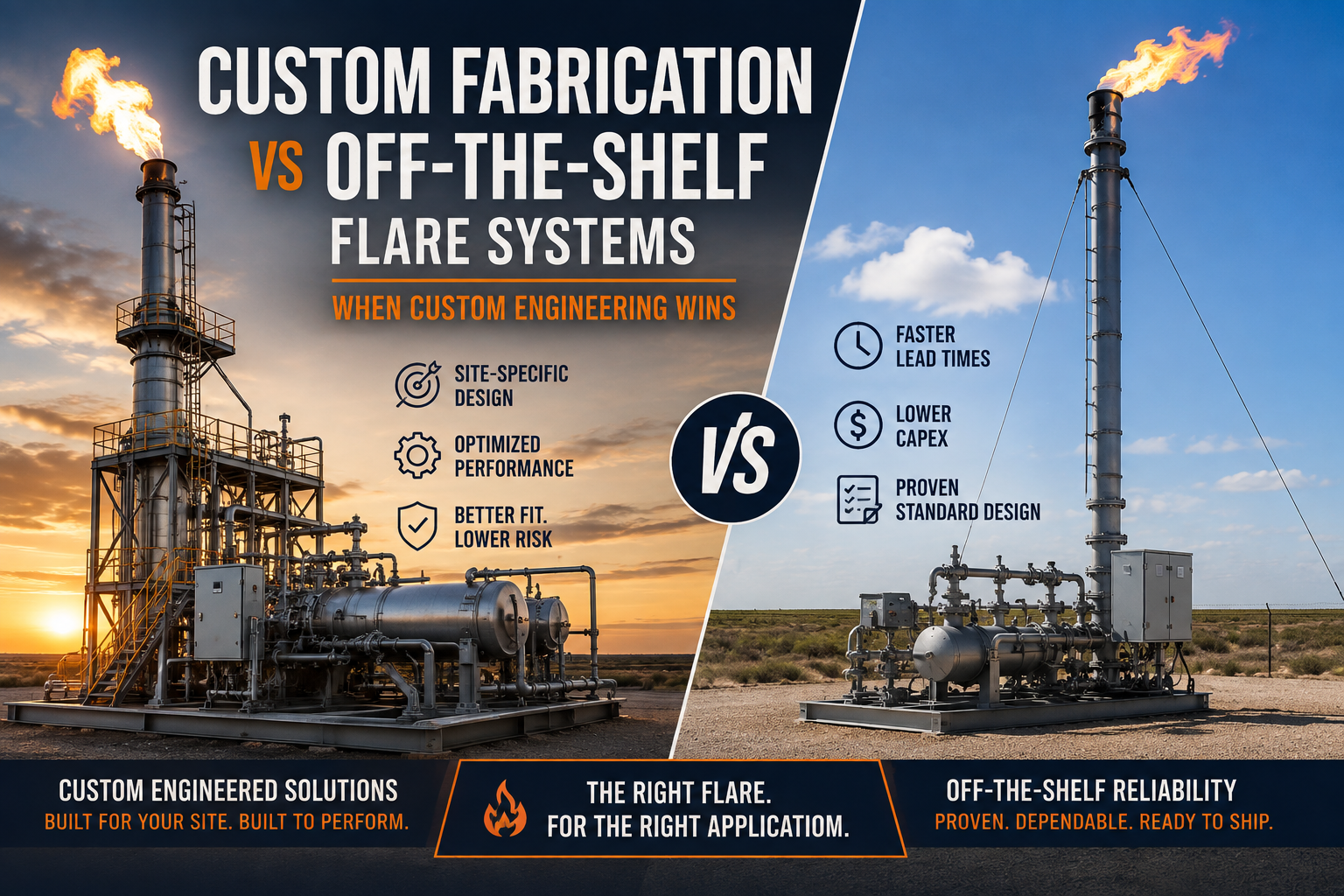
“Custom” and “off-the-shelf” are two ends of a continuum in flare system manufacturing. At one end, a pre-engineered catalog flare ships with specifications matched to a typical service profile and standard installation drawings. At the other end, a custom-engineered flare is designed specifically for one site’s relief loads, layout constraints, fuel gas profile, and integration requirements. Most projects fall somewhere between, with operators choosing the level of customization based on project complexity and cost tolerance. This guide walks through when each approach wins.
Hero Process Solutions, founded in 2011 and headquartered in Kellyville, Oklahoma with operations in Midland, Texas, manufactures industrial flare systems across the full range from pre-engineered catalog units to fully custom engineered configurations. Custom engineering responsiveness is one of Hero’s competitive differentiators against larger global suppliers.
DIRECT ANSWER: Off-the-shelf flares are pre-engineered to a standard service profile with catalog sizing, fixed materials, and standard installation drawings — shorter lead time (8 to 16 weeks typical) and lower CAPEX make them the right answer for straightforward projects that fit the catalog envelope. Custom-engineered flares are designed specifically for one site’s relief loads, layout, fuel gas profile, and integration requirements — longer lead time (16 to 32 weeks typical) and higher engineering cost are justified by better fit, lower installation cost, and reduced field rework on complex projects. The right choice depends on project complexity, site constraints, OOOOb compliance certainty, and the operator’s tolerance for design changes during execution.
1. What “Custom Engineering” Actually Means
Custom engineering in flare system manufacturing covers four levels of customization. Each level adds engineering value and engineering cost.
Catalog selection with field modifications is the lowest level. The supplier picks a pre-engineered catalog model and ships with minor field changes (mounting orientation, connection sizes, ladder location). Most “custom” projects at large global suppliers are actually catalog selection with field modifications.
Custom sizing within a standard product platform involves taking a standard product family (e.g., A+ Series air-assist flares) and sizing the specific tip, stack height, blower horsepower, and instrumentation for the actual site conditions. The engineering scope covers sizing and integration but not fundamental design changes to the product platform.
Site-specific custom engineering includes everything in custom sizing plus site-specific changes to integration with existing equipment, control system interfaces, OOOOb monitoring instrumentation routing, and unusual site constraints (height limits, footprint constraints, weather/seismic, sour service metallurgy).
Full custom design develops new equipment configurations for service that does not fit any existing product platform. This level is reserved for unusual service profiles where no off-the-shelf or platform-customized option works.
2. When Off-the-Shelf Catalog Flares Win
Off-the-shelf catalog flares win on five application categories.
Straightforward projects fit the catalog envelope. A standard upstream tank battery vent gas application with typical produced gas composition, standard tank battery layout, and routine OOOOb compliance requirements is well served by a catalog low flow flare. Hero’s low flow flare catalog covers these applications directly.
Short lead time projects. Catalog flares ship in 8 to 16 weeks typically, compared to 16 to 32 weeks for custom-engineered units. For projects with construction schedules driving equipment delivery, the shorter lead time often wins.
Lower CAPEX projects. Catalog flares carry standard engineering and supply chain costs without the project-specific engineering premium of custom designs. For tight project budgets, the CAPEX difference matters.
Repeated installations across a basin or fleet. When an operator is installing many similar units (e.g., low flow flares across a Permian basin upstream development), standardizing on catalog models simplifies inspection, maintenance, parts inventory, and training.
Service environments where catalog certification documentation suffices. For OOOOb-affected service where catalog OOOOb compliance documentation (Quad O Certified Enclosed Combustor designs, for example) eliminates the need for site-specific compliance engineering.
3. When Custom Engineering Wins
Custom engineering wins on five application categories.
Site-specific constraints that catalog flares cannot accommodate. Height limits, footprint constraints, unusual relief header pressure profiles, integration with existing equipment retrofitting, sour service metallurgy, cold-climate winterization — all require custom engineering for proper fit.
Complex relief load profiles. A refinery with combined routine vent gas and emergency relief from multiple PSVs across a complex network benefits from custom-engineered relief header integration. Catalog flares often miss the integration details that determine field installation success.
Unusual stream composition. Variable composition, high olefin content, sour service, or other composition characteristics that fall outside catalog certification envelopes require custom engineering to ensure smokeless operation and OOOOb compliance.
Retrofit applications. Existing stacks, foundations, and integration constraints make catalog flare drop-in installation difficult. Custom engineering matches new equipment to existing site conditions.
Project complexity that demands engineering responsiveness during execution. Complex projects encounter site-specific issues during construction (foundation surprises, pipeline routing changes, regulatory clarification). Custom engineering relationships deliver faster, more substantive responses than catalog supplier customer service typically can.
KEY INSIGHT: The deciding factor is usually project complexity, not project size. A simple 50,000 lb/hr air-assist flare on a standard midstream gas plant is well served by catalog selection. A complex 10,000 lb/hr air-assist flare retrofit on a 30-year-old refinery FCC unit needs custom engineering. Project size and project complexity are not the same dimension.
4. Lead Time and CAPEX Comparison
| Approach | Typical Lead Time | CAPEX Range | Engineering Hours |
|---|---|---|---|
| Catalog selection with field modifications | 8 to 12 weeks | Baseline | 20 to 80 hours |
| Custom sizing within standard product platform | 10 to 16 weeks | 5% to 15% premium | 80 to 200 hours |
| Site-specific custom engineering | 16 to 24 weeks | 15% to 30% premium | 200 to 500 hours |
| Full custom design | 24 to 36 weeks | 30%+ premium | 500+ hours |
The premium for custom engineering is real but often paid back through reduced installation cost, faster commissioning, lower field rework, and OOOOb compliance certainty. The decision should be made on total installed cost and project risk, not equipment CAPEX alone.
5. OOOOb Compliance Documentation
OOOOb compliance documentation differs between custom and off-the-shelf designs.
Off-the-shelf designs with certification (Quad O Certified Enclosed Combustor designs are the typical example) carry the certification with the equipment. The operator’s compliance documentation references the certification at the installed envelope, dramatically simplifying the OOOOb compliance file.
Custom-engineered designs typically require site-specific OOOOb performance testing to demonstrate 98% DRE at the installed configuration. The testing is more rigorous and the documentation more substantial than certified catalog units. See our EPA OOOOb compliance resource for the complete framework.
For OOOOb-affected service where catalog certification covers the application, off-the-shelf is the simpler compliance path. For applications outside catalog certification envelopes, custom engineering is required regardless of preference.
6. The Hybrid Approach: Custom Sizing of Standard Products
The middle ground — custom sizing within a standard product platform — combines the speed and reliability of platform-based products with site-specific fit. This approach handles most real-world projects.
The A+ Series air-assist flare platform, for example, ships with the same basic blower architecture, VFD control system, monitoring instrumentation, and OOOOb-compliant documentation regardless of size. The specific tip throat area, stack height, blower horsepower, and pilot specification are sized for the actual project. Lead time is shorter than fully custom engineering, CAPEX is between catalog and custom, and site-specific fit is much better than pure catalog selection.
For most projects, the hybrid approach is the right answer. Custom sizing of standard products is what Hero delivers as the default for medium-complexity projects.
7. Selection Decision Framework
Five questions help operators choose the right approach for a specific project.
Does the project fit a standard catalog envelope? If yes, catalog selection or custom sizing wins on lead time and CAPEX. If no, custom engineering is required.
Are there site-specific constraints (height, footprint, sour service, retrofit)? If yes, custom engineering matches new equipment to site conditions. If no, off-the-shelf or platform-customized works.
Is the project schedule driving equipment delivery? If yes, catalog or platform-customized wins on lead time. If schedule is flexible, custom can deliver better long-term value.
Is OOOOb compliance documentation simpler with certified catalog units? If the catalog certification covers the application, off-the-shelf wins. If custom service profile, custom engineering is required.
Will the project encounter site-specific issues during construction? If yes, custom engineering relationships deliver better execution responsiveness. If no, catalog supplier customer service is adequate.
8. Common Custom vs Off-the-Shelf Selection Mistakes
| Mistake | Why It Hurts | Fix |
|---|---|---|
| Specifying full custom engineering when standard product platform fits | Lead time and CAPEX premium without value | Use custom sizing of standard products for medium-complexity projects |
| Specifying catalog flare for complex retrofit project | Site-specific issues create field rework cost | Specify site-specific custom engineering for complex retrofits |
| Comparing only equipment CAPEX without installation cost | Custom engineering often reduces total installed cost despite higher equipment CAPEX | Run total installed cost comparison including field rework probability |
| Ignoring OOOOb certification simplification on standard products | Site-specific OOOOb testing burden on operator | Use Quad O Certified catalog designs where applicable |
| Selecting catalog supplier for project requiring execution responsiveness | Large supplier customer service slower than custom engineering relationships | Choose custom engineering supplier for execution-complex projects |
| Custom engineering without confirming standard product platform inadequacy | Premium without value if standard would have worked | Run catalog/platform fit check before committing to custom engineering |
Article Summary
- Custom engineering covers four levels: catalog with field modifications, custom sizing within standard product platform, site-specific custom engineering, and full custom design.
- Off-the-shelf catalog flares win on straightforward projects, short lead time, lower CAPEX, repeated installations, and catalog-certified OOOOb service.
- Custom engineering wins on site-specific constraints, complex relief loads, unusual composition, retrofits, and execution-complex projects.
- Lead times range from 8-12 weeks (catalog) to 24-36 weeks (full custom); CAPEX premiums range from baseline to 30%+ over baseline.
- OOOOb compliance is simpler with certified catalog units; custom designs require site-specific performance testing.
- The hybrid approach (custom sizing of standard products) handles most projects with reasonable lead time, CAPEX, and site-specific fit.
- Project complexity, not project size, is the deciding factor in the selection.
- Hero Process Solutions delivers the full range from catalog selection through full custom design from Kellyville, Oklahoma.
Frequently Asked Questions
What does “custom engineering” actually mean in flare manufacturing?
Custom engineering covers four levels: catalog selection with minor field modifications, custom sizing within a standard product platform, site-specific custom engineering including integration and site constraint accommodations, and full custom design for unusual service profiles. Most “custom” projects at large global suppliers are actually catalog selection with field modifications.
When are off-the-shelf catalog flares the right choice?
Choose catalog flares when the project fits the standard envelope (no unusual site constraints), the schedule benefits from shorter lead time (8-16 weeks vs 16-32 for custom), the budget tolerates the CAPEX baseline (no engineering premium), the operator is installing many similar units across a fleet, or catalog certification documentation (Quad O Certified, OOOOb-ready) covers the OOOOb compliance pathway.
When is custom engineering worth the cost and lead time?
Choose custom engineering when site-specific constraints (height, footprint, retrofit) require accommodation, the relief load profile is complex (multiple PSVs, variable pressure, unusual composition), the project is a retrofit on existing infrastructure, or the project complexity demands engineering responsiveness during execution. The premium is paid back through reduced installation cost, faster commissioning, and OOOOb compliance certainty.
What is the “hybrid approach” between custom and off-the-shelf?
The hybrid approach is custom sizing within a standard product platform. The product family (e.g., A+ Series air-assist flares) ships with the same basic architecture but the specific tip throat, stack height, blower horsepower, and pilot specification are sized for the actual project. Lead time is shorter than fully custom, CAPEX is between catalog and custom, and site-specific fit is much better than pure catalog selection. This handles most real-world projects.
How does OOOOb compliance differ between custom and off-the-shelf flares?
Off-the-shelf designs with certification (Quad O Certified Enclosed Combustor designs) carry the certification with the equipment, dramatically simplifying the OOOOb compliance file. Custom-engineered designs typically require site-specific OOOOb performance testing to demonstrate 98% DRE at the installed configuration. The testing is more rigorous and the documentation more substantial than certified catalog units.
Can Hero Process Solutions deliver both catalog and custom engineering?
Yes. Hero delivers the full range from catalog selection through custom sizing within standard product platforms (the default for most projects) to full custom engineering for unusual service profiles. The selection between approaches is supported by Hero’s engineering team during project assessment based on site constraints, schedule, CAPEX target, and OOOOb compliance pathway.