

OIL & GAS EQUIPMENT | Updated May 2026 | 8 min read
What You’ll Learn in This Guide
- What flare tip erosion actually looks like and what causes it
- How thermal cycling, combustion zone exposure, and waste-gas composition drive wear rate
- How to detect erosion before it affects OOOOb 98% DRE compliance
- Inspection schedule, instrumentation trends, and physical indicators that signal replacement
- Typical tip replacement intervals across air-assist, sonic, gas-assist, utility, and low flow flares
- How aftermarket service contracts manage tip lifecycle for OOOOb-affected facilities
- Common tip erosion management mistakes and how to avoid them
A flare tip is consumable equipment. No matter how well it is designed, the combustion zone it operates in exceeds 1,800°F, the metallurgy is exposed to thermal cycling between idle and active service, and the gas composition often includes corrosive components that accelerate wear. Even on the best-designed flares, the tip eventually erodes to the point where smokeless performance degrades, exit velocity falls outside design, and OOOOb 98% DRE compliance is at risk. The question for every operator is when to replace — early enough to prevent compliance issues, late enough to capture the full service life of the existing tip.
Hero Process Solutions, founded in 2011 and headquartered in Kellyville, Oklahoma with operations in Midland, Texas, provides aftermarket support for installed flare tips including inspection, replacement, and lifecycle management across the full range of flare configurations.
DIRECT ANSWER: Flare tip erosion is the gradual wear of the tip’s combustion zone, throat, and Coanda profile (where applicable) caused by thermal cycling, oxidation, hot-spot exposure, and corrosive constituents in the waste gas. Erosion is detected through visual inspection (combustion zone metal loss, edge rounding, refractory damage), thermocouple trend data (downward drift indicating wider effective throat area), and DRE testing during OOOOb annual recertification. Typical tip replacement intervals are 5 to 10 years for air-assist and sonic flares in continuous service, 7 to 15 years for utility flares in emergency-only service, and 10+ years for low flow flares with short cumulative operating time. Hero’s aftermarket service manages tip lifecycle on installed A+ Series flares with scheduled inspection, predictive replacement timing, and on-site service.
1. What Flare Tip Erosion Looks Like
Flare tip erosion appears as four distinct wear patterns, often combined on installed tips.
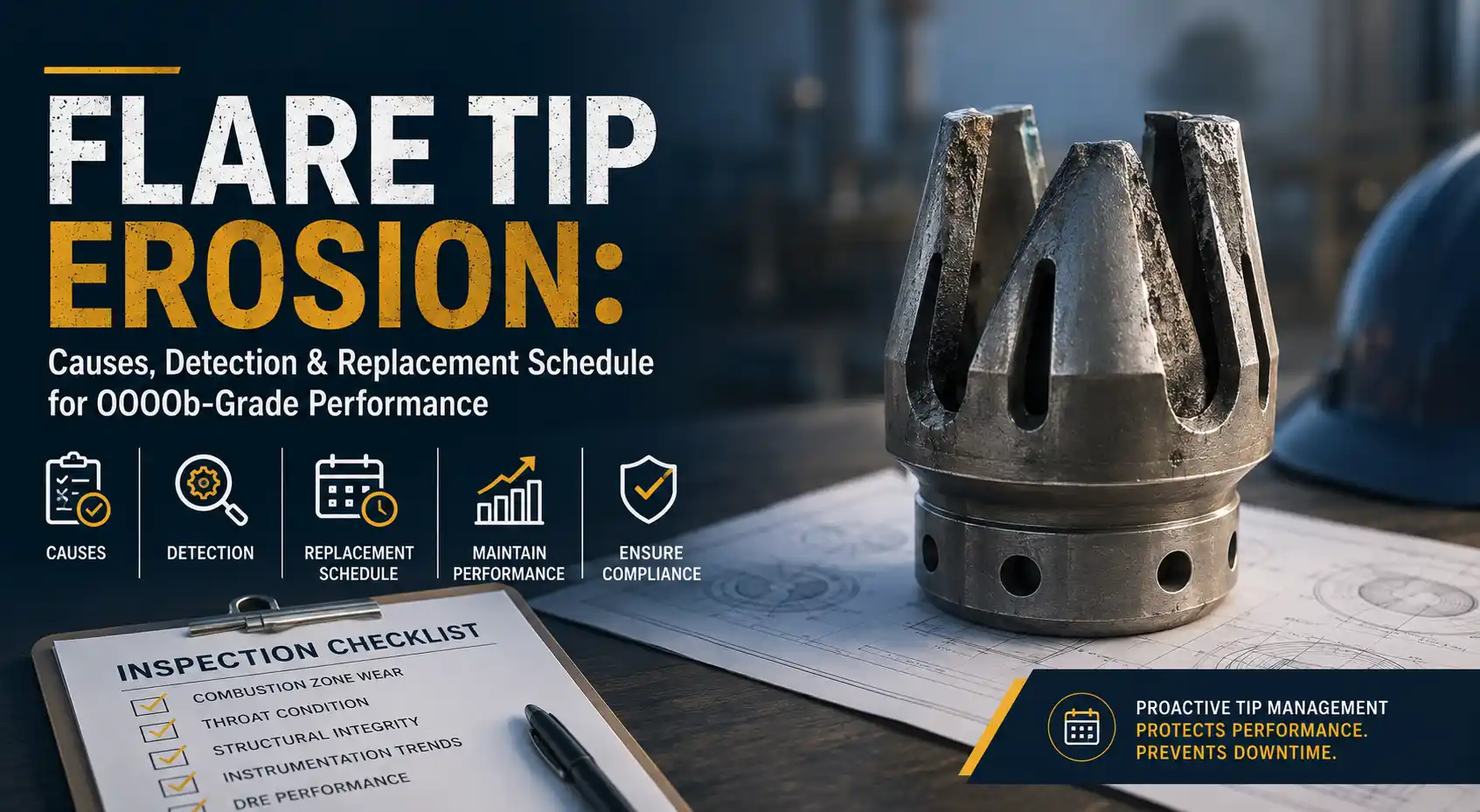
Combustion zone metal loss appears as thinning and rounding of the metal edges at the tip exit. The flame anchor point on a sonic flare’s Coanda profile, the swirler or radial-injection structure on an air-assist tip, and the inner throat on a gas-assist tip all show metal loss over time. The wear is not uniform — flame stability variations, hot-spot recirculation, and oxide scale spalling concentrate wear in specific areas.
Thermal cracking appears as small fissures in high-stress areas. Thermal cycling between idle and active service, especially on utility flares that see infrequent large relief events, drives crack initiation and propagation. Cracks that reach the gas flow path enlarge the effective throat area.
Refractory damage on enclosed combustor tips and flares with internal refractory liners includes spalling, erosion of high-velocity flow paths, and chemical attack from H₂S, ammonia, or other corrosive components.
Bolt and weld degradation at tip-to-stack connections progresses with thermal cycling. Loose bolts, weld cracks, and gasket degradation create small leakage paths that affect flame stability before they become structural concerns.
2. What Drives Tip Erosion Rate
Five operating factors set the erosion rate on any given tip.
Cumulative operating hours at full flame is the dominant variable. A utility flare that sees one major relief event per year shows much less erosion than an air-assisted flare in 24/7 continuous service.
Thermal cycling between idle and active states drives crack initiation. Utility flares with infrequent large events actually see disproportionate thermal stress per operating hour because the thermal swing is more severe.
Waste-gas composition affects both flame temperature and chemical attack on the tip. Sour gas streams accelerate erosion through sulfide stress cracking and metal dusting. Olefin-rich streams produce harder soot deposits that abrade the tip during periodic dislodgement.
Composition variability affects flame stability. Tips operating in tightly controlled steady composition experience less hot-spot variability than tips on streams with significant composition swings.
Metallurgy matters across the service life. Hero’s A+ Series tips use stainless steel construction sized for the design service profile. Cast tips, carbon steel tips, and other metallurgical choices have different erosion behavior.
KEY INSIGHT: Cumulative operating hours alone do not predict erosion. A utility flare with one major event per year often shows worse erosion at the bolts and welds than an air-assisted flare in continuous service, because the thermal cycling per event is more severe. Match inspection schedule to the actual operating profile, not just calendar age.
3. How to Detect Erosion Before OOOOb Compliance Is at Risk
Erosion that reaches the point of affecting 98% DRE typically progresses through identifiable stages, each detectable before compliance is at risk.
Combustion-zone thermocouple temperature drift is the earliest leading indicator. The thermocouple sits in the combustion zone and reads a flame temperature characteristic of the tip’s specific geometry. As the tip wears and effective throat area expands, exit velocity drops at constant mass flow, mixing efficiency degrades, and combustion zone temperature declines. The change is gradual but trends downward over weeks to months. Set a rolling-average trend alarm rather than instantaneous threshold.
Combustion-zone flame ionization detector signal strength similarly declines as the flame envelope weakens. Compare current readings against commissioning baseline.
Annual OOOOb performance test results provide direct DRE measurement. A test that passes 98% by a comfortable margin year over year and then narrows to barely passing is signaling tip degradation that should be addressed at the next scheduled outage.
Visual inspection during scheduled outages provides direct observation of erosion patterns. The combination of trend data and visual inspection gives operators 6 to 18 months of advance notice on tip replacement.
4. Inspection Schedule by Flare Type
| Flare Type | Inspection Interval | What to Look For |
|---|---|---|
| Air-Assist (continuous) | Annual external; 3-year detailed inspection; 5-year tip evaluation | Combustion zone metal loss, Coanda profile rounding, bolt condition |
| Sonic (continuous) | Annual external; 5-year detailed inspection | Coanda profile geometry, throat area dimensional check |
| Gas-Assist (continuous) | Annual external; 3-year detailed inspection | Assist gas injection points, throat erosion, refractory if present |
| Utility (emergency-only) | Annual external; 5-year detailed inspection; post-major-event inspection | Thermal cracking, bolt and weld integrity, refractory damage |
| Low Flow (intermittent) | Annual external; 5-year detailed inspection | Tip exit erosion, spark electrode integrity |
| Portable/Mobile (temporary) | Pre-deployment and post-event inspection | Transport damage, tip erosion from previous deployments |
The detailed inspection at 3- to 5-year intervals includes dimensional measurement of the throat and Coanda profile, metallurgical sampling on suspect areas, and visual documentation of all combustion-zone surfaces. Hero’s aftermarket inspection service handles these activities on installed A+ Series flares.
5. Typical Tip Replacement Intervals
| Flare Type | Typical Tip Replacement Interval | Notes |
|---|---|---|
| Air-Assist (continuous service) | 5 to 10 years | Tip wear from continuous high-velocity flow |
| Sonic (continuous service) | 7 to 12 years | Coanda profile erosion gradual |
| Gas-Assist (continuous service) | 5 to 10 years | Assist gas injection points wear faster than main throat |
| Utility (emergency-only) | 7 to 15 years | Thermal cycling drives wear despite low cumulative hours |
| Low Flow (intermittent) | 10+ years | Low cumulative hours; spark ignition simpler tip |
The intervals are typical for properly designed and operated tips on streams that match the design envelope. Off-design operation, sour service, olefin-rich composition, or frequent excursions can shorten the interval significantly.
6. Aftermarket Service Contracts for Tip Lifecycle
Aftermarket service contracts manage tip lifecycle through structured inspection, predictive replacement timing, and on-site service when replacement is required. Hero’s aftermarket program for installed A+ Series flares includes annual inspection, trend monitoring data review, parts and labor for scheduled replacement, and emergency response capability if unscheduled replacement becomes necessary.
The aftermarket relationship is particularly valuable for OOOOb-affected facilities because tip replacement timing must be coordinated with OOOOb annual performance testing and CEDRI reporting. Visit our EPA OOOOb compliance resource for how aftermarket service integrates with OOOOb documentation.
7. Replacement vs Reconditioning
In some cases, tip reconditioning (weld repair, profile restoration, refractory re-lining) extends service life without full tip replacement. Reconditioning is typically applicable when erosion is limited to specific localized areas and the underlying tip geometry remains within original design tolerances.
Full tip replacement is required when erosion has progressed to affect overall throat dimensions, when Coanda profile geometry has changed beyond the original design envelope, when refractory damage cannot be repaired in place, or when bolt and weld condition prevents reliable re-installation of the existing tip.
The replacement-vs-reconditioning decision is made during detailed inspection by Hero’s engineering team based on the specific tip condition.
8. Common Tip Erosion Management Mistakes
| Mistake | Why It Hurts | Fix |
|---|---|---|
| Replacing on calendar interval without trend data | Either replaces too early (waste) or too late (compliance risk) | Use trend data plus visual inspection to time replacement |
| Ignoring combustion-zone thermocouple trend drift | Misses earliest warning indicator of tip degradation | Set rolling-average trend alarm on combustion-zone temperature |
| Skipping post-major-event inspection on utility flares | Thermal cycling damage from event goes undetected | Run inspection after every major relief event |
| Assuming sour service tips wear at standard rate | Sulfide stress cracking and metal dusting accelerate erosion | Shorten inspection interval on sour service installations |
| Not coordinating tip replacement with OOOOb performance testing | Compliance documentation gaps | Schedule replacement before annual performance test window |
| Full replacement when reconditioning is adequate | Higher CAPEX than necessary | Run reconditioning vs replacement evaluation at detailed inspection |
Article Summary
- Flare tip erosion is the gradual wear of combustion zone, throat, and Coanda profile from thermal cycling, oxidation, hot-spot exposure, and corrosive gas components.
- Four wear patterns appear: combustion zone metal loss, thermal cracking, refractory damage, and bolt/weld degradation.
- Five operating factors drive erosion rate: cumulative hours, thermal cycling, gas composition, composition variability, and tip metallurgy.
- Detection through combustion-zone thermocouple trend drift, flame ionization signal decline, annual OOOOb performance test results, and visual inspection.
- Inspection schedule varies by flare type with annual external plus 3- to 5-year detailed inspections standard.
- Typical tip replacement intervals are 5-10 years for air-assist and sonic continuous service, 7-15 years for utility emergency-only, 10+ years for low flow intermittent.
- Aftermarket service contracts manage tip lifecycle through structured inspection, predictive replacement, and OOOOb coordination.
- Hero Process Solutions provides aftermarket inspection, replacement, and reconditioning service for installed A+ Series flares from Kellyville, Oklahoma.
Frequently Asked Questions
What causes flare tip erosion?
Five operating factors drive erosion: cumulative operating hours at full flame, thermal cycling between idle and active states, waste-gas composition (especially sour and olefin-rich streams), composition variability that affects flame stability, and tip metallurgy. The combination of high combustion zone temperature, thermal cycling, and chemical attack from waste-gas components progressively wears the tip’s combustion zone, throat, and Coanda profile.
How can I detect flare tip erosion before it affects OOOOb compliance?
Combustion-zone thermocouple temperature drift is the earliest leading indicator. As the tip wears and effective throat area expands, exit velocity drops at constant mass flow and combustion zone temperature declines over weeks to months. Set a rolling-average trend alarm rather than instantaneous threshold. Annual OOOOb performance test results provide direct DRE measurement; narrowing pass margins year-over-year signal tip degradation.
How often should flare tips be replaced?
Typical replacement intervals are 5-10 years for air-assist and sonic flares in continuous service, 7-15 years for utility flares in emergency-only service (thermal cycling drives wear despite low cumulative hours), 5-10 years for gas-assist flares, and 10+ years for low flow flares in intermittent service. The intervals apply to properly designed tips on streams that match the design envelope; off-design operation can shorten significantly.
Can flare tips be reconditioned instead of replaced?
Sometimes. Reconditioning (weld repair, profile restoration, refractory re-lining) extends service life when erosion is localized and underlying tip geometry remains within original design tolerances. Full replacement is required when erosion affects overall throat dimensions, Coanda profile geometry has changed, refractory damage cannot be repaired in place, or bolt and weld condition prevents reliable re-installation. The decision is made during detailed inspection.
What inspection schedule should I follow for installed flare tips?
Annual external inspection is standard for all flare types. Detailed inspection (dimensional measurement, metallurgical evaluation, visual documentation) at 3- to 5-year intervals depending on flare type. Post-major-event inspection on utility flares after any large relief event. Pre- and post-deployment inspection on portable flares. Hero’s aftermarket inspection service handles these activities on installed A+ Series flares.
Does Hero Process Solutions provide flare tip replacement service?
Yes. Hero’s aftermarket service includes annual inspection, trend monitoring review, parts and labor for scheduled tip replacement, emergency response for unscheduled replacement, and replacement-vs-reconditioning evaluation. The aftermarket program coordinates with OOOOb annual performance testing and CEDRI reporting to manage tip lifecycle on installed A+ Series flares.