OIL & GAS EQUIPMENT | Updated May 2025 | 9 min read
- The 7 criteria that consistently separate capable flare system manufacturers from catalog vendors
- Why engineering capability matters more than brand name in flare system selection
- How to evaluate a manufacturer’s experience with your specific gas composition and regulatory environment
- What questions to ask about a manufacturer’s field service support capabilities
- How rental fleet availability affects your risk profile when buying or renting flares
- What documentation a qualified manufacturer should deliver with every flare system
- Why manufacturing location and fabrication capacity matter for lead times and quality
Flare system manufacturer selection is not a catalog exercise. The waste gas composition, flow rate variability, regulatory classification of your site, and the operational environment of your field each narrow the viable options considerably, and selecting a manufacturer that cannot engineer specifically to your conditions — rather than adapting a catalog design — creates compliance and reliability risk that surfaces after commissioning, not before. The criteria below reflect what experienced procurement managers and process engineers evaluate when selecting a flare system manufacturer for oil and gas applications.
Hero Process Solutions, founded in 2011 and headquartered in Kellyville, OK with manufacturing and field operations in Midland, TX, is a flare system manufacturer that designs and fabricates across the full product range: air-assist, sonic, gas-assist, emergency utility, portable, and low-flow flare systems. The criteria in this guide reflect the questions operators should ask of Hero PS and any other manufacturer they evaluate.
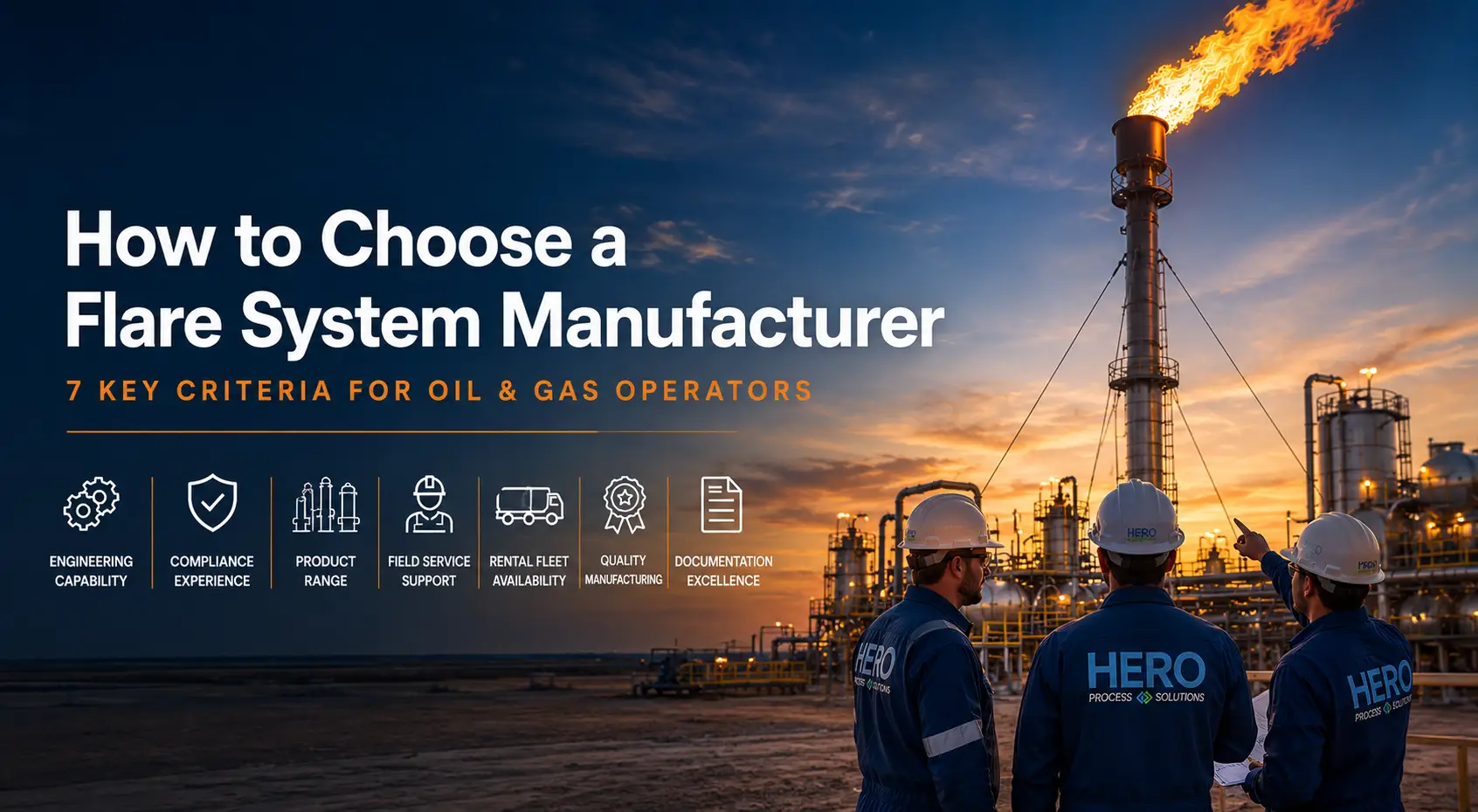
The 7 key criteria for selecting a flare system manufacturer are: (1) engineering capability for your specific gas conditions, (2) proven experience with EPA OOOOb compliance designs, (3) full product range coverage, (4) field service and commissioning support, (5) rental fleet availability for urgent deployments, (6) manufacturing quality and certifications, and (7) documentation and regulatory package quality. Each criterion addresses a specific operational or compliance risk that surfaces when a manufacturer does not meet it.
[IMAGE SUGGESTION 1: Photo of Hero Process Solutions’ Kellyville, OK manufacturing facility showing a flare stack under fabrication, with welding operations and quality inspection activity visible.]
Criterion 1: Engineering Capability for Your Specific Gas Conditions
The most fundamental differentiator between capable and incapable flare system manufacturers is whether they engineer for your specific gas conditions or adapt a catalog design to fit.
What Engineering Capability Means
A manufacturer with genuine engineering capability will request a full gas composition analysis (heating value, H2S content, hydrocarbon breakdown, inert fractions) before proposing a system, provide design calculations that demonstrate combustion efficiency across your expected flow rate range, size the liquid knockout drum based on your gas stream’s actual liquid loading, and select the flare tip geometry based on your gas composition and smokeless requirement. A manufacturer without this capability will provide a quote based on maximum flow rate and a standard tip selection, without demonstrating that the system will meet 98% combustion efficiency at your minimum flow rate or with your specific gas composition variability.
Red Flags
A vendor who proposes a flare system without requesting a gas analysis, or who cannot provide the design basis for their tip selection when asked, is not a manufacturer with engineering depth. They are a distributor with a catalog. For EPA OOOOb compliance purposes, you need a manufacturer who can document that the design meets the standard, not one who assumes it does.
Criterion 2: Proven Experience with EPA OOOOb Compliance Designs
The regulatory environment for oil and gas flare systems changed materially when EPA finalized the OOOOb rule. Flare systems manufactured and designed before December 2022 may not be engineered to the 98% combustion efficiency standard with the monitoring and documentation that OOOOb requires.
What to Ask
Ask the manufacturer directly: “Have you designed flare systems specifically for OOOOb compliance?” A capable manufacturer will be able to describe the design features that address OOOOb requirements — auto-reignition, thermocouple monitoring, heating value verification, combustion efficiency documentation methodology — and will provide examples of OOOOb-compliant designs delivered to other operators.
State Compliance Knowledge
Beyond federal OOOOb, ask about the manufacturer’s experience with TCEQ (Texas) and DEQ (Oklahoma) permit requirements. A manufacturer who works primarily in one regulatory environment may not be current on the permit conditions that apply to your site in another state.
Criterion 3: Full Product Range Coverage
A flare system manufacturer with a complete product range is more valuable to an O&G operator than one who specializes in only a single flare type. Operations change. A well that starts with a small low-flow flare during early production may require a large air-assist unit during completion on a nearby pad. An operator who has a relationship with a manufacturer that covers the full range can expand and reconfigure equipment without switching vendors.
Hero PS covers the complete flare product range for upstream and midstream oil and gas: Air-Assist Flares for rich gas streams requiring smokeless combustion, Sonic Flares for high-pressure gathering and processing applications, Gas-Assist Flares for remote or low-power-availability sites, Emergency Utility Flares for emergency relief applications, Portable/Trailer-Mounted Flares for completion flowback and temporary production, and Low-Flow Flares for continuous low-volume venting at producing wells.
| Product Type | Needed For | Should Manufacturer Offer? |
|---|---|---|
| Air-assist flares | Rich gas, smokeless required | Yes |
| Gas-assist flares | Remote, low power | Yes |
| Utility/emergency flares | Lean gas, emergency relief | Yes |
| Low-flow flares | Low-volume continuous venting | Yes |
| Portable/trailer flares | Completion flowback, temp use | Yes |
| Sonic flares | High-pressure gathering | For midstream-capable manufacturers |
Criterion 4: Field Service and Commissioning Support
A flare system that is designed and fabricated correctly but commissioned incorrectly will underperform or fail compliance from day one. Field service and commissioning support are not add-on services — they are part of what a capable manufacturer delivers.
Commissioning Support
The manufacturer’s field team should commission the flare system at the site, which includes confirming the flare is installed per the design (correct elevation, orientation, setbacks), verifying the pilot system ignites and holds flame reliably, setting pressure regulators and control system parameters, and documenting the initial commissioning date and pilot confirmation for permit records.
Ongoing Field Service
After commissioning, field service support covers scheduled inspections of the flare tip, pilot, and control system; troubleshooting when the flare underperforms or the pilot fails to hold; replacement of worn tip components and pilot hardware; and emergency response when the flare system is down during a production event.
Geographic Coverage
For Permian Basin and Mid-Continent operators, Hero Process Solutions provides field service from Midland, TX and Kellyville, OK respectively. The proximity of field service personnel to operating sites determines response time during an emergency. A manufacturer headquartered in another region may not be able to respond to a field issue within 24 hours.
A flare system that fails the pilot and cannot be relit during a production event creates an immediate OOOOb compliance gap — uncontrolled venting of gas that should be combusted. The manufacturer’s ability to dispatch a field technician within hours, not days, determines whether that compliance gap extends into a permit violation report. Geographic proximity of field service matters.
Criterion 5: Rental Fleet Availability for Urgent Deployments
Not every flare deployment can wait 8 to 16 weeks for a new fabrication. Well completion programs, pipeline maintenance events, and unplanned production upsets all create immediate flare needs. A manufacturer with an active rental fleet is a more flexible partner than one who only sells new equipment.
What to Evaluate in a Rental Fleet
When assessing a manufacturer’s rental fleet, ask: What sizes and configurations are available for immediate dispatch? What is the geographic coverage area for rental dispatch? Are rental units maintained to the same compliance standards as purchased units? What is the typical rental mobilization timeline?
Hero Process Solutions maintains a rental fleet dispatched from Kellyville, OK and Midland, TX. Rental units are maintained to the same OOOOb compliance standards as purchased units, with current pilot certifications and complete commissioning documentation provided with each rental deployment.
Rental vs. Purchase Decision Support
A capable manufacturer should be able to help you evaluate whether to rent or purchase based on your deployment duration, frequency of use, and capital situation — not push you toward the transaction that benefits them most. If a manufacturer only offers rental, they cannot help you transition to a permanent installation when it makes economic sense. If they only sell, they cannot support your urgent short-term needs.
Criterion 6: Manufacturing Quality and Certifications
ASME and API Certifications
For pressure-containing components (knockout drums, vessel connections), ASME Section VIII, Division 1 certification is the industry standard. API RP 521 and API Standard 537 should be referenced in the manufacturer’s design standards. Ask the manufacturer directly: do your designs reference API 537 for flare tip selection and API RP 521 for knockout drum sizing?
Material Traceability
A quality manufacturer maintains material traceability for all components — the ability to trace the material of each component back to its mill certificate. This is required for ASME pressure vessels and is a general marker of fabrication quality control. Manufacturers who cannot provide mill certs for their pressure-containing components are not operating to the standards that O&G operators’ purchasing requirements typically mandate.
Weld Quality and Inspection
Flare stack welds are structural and must meet the applicable structural weld quality standards. Ask whether the manufacturer performs non-destructive testing (NDT) on structural welds and what their rejection criteria are. For ASME pressure vessels, radiographic or ultrasonic testing of pressure-containing welds is specified by the code.
Hero Process Solutions Manufacturing
Hero PS fabricates all flare systems at the Kellyville, OK facility. The manufacturing team works to the same specifications for both standard and custom orders, with quality inspection at the fabrication stage rather than at delivery. The Kellyville facility allows Hero PS to control fabrication quality directly rather than relying on third-party manufacturing.
Criterion 7: Documentation and Regulatory Package Quality
What a Complete Documentation Package Includes
A capable flare system manufacturer delivers: design basis document (gas analysis inputs, combustion efficiency calculation, tip sizing basis, radiation analysis), ASME Form U-1 and mill certs for all pressure-containing components, pilot system specification (thermocouple type, auto-reignition description, control panel wiring diagram), commissioning record (date, pilot confirmation, initial pressure settings), compliance statement or OOOOb applicability assessment, and operation and maintenance manual specific to the delivered configuration.
Why Documentation Quality Is a Manufacturer Differentiator
If TCEQ or EPA requests records demonstrating OOOOb compliance from your flare system, your documentation package is the evidence. A poorly documented system — or one where the manufacturer cannot provide the design calculations when requested — creates a compliance defense problem that you cannot solve after the fact. Ask the manufacturer for an example documentation package from a comparable project. The quality and completeness of that package tells you exactly what you will receive.
[IMAGE SUGGESTION 2: Sample documentation package layout for a Hero Process Solutions flare system, showing organized binder sections: design calculations, ASME data sheet, pilot specification, commissioning record, and O&M manual.]
Common Mistakes to Avoid When Choosing a Flare System Manufacturer
| Mistake | Why It Hurts Operations/Compliance | Fix |
|---|---|---|
| Selecting a manufacturer based on price alone | Cheapest option rarely designs to your gas conditions; compliance gaps surface after installation | Evaluate design capability first; compare pricing only between manufacturers who meet technical criteria |
| Not requesting design calculations with the quote | Cannot verify the system will meet OOOOb 98% efficiency at your actual conditions | Require a design basis document with every flare system proposal |
| Ignoring field service geography | Remote or delayed field service creates extended compliance gaps when problems occur | Confirm the manufacturer has field personnel within reasonable dispatch distance of your site |
| Choosing a manufacturer without a rental fleet | No short-notice option for urgent deployments; operational risk during production events | Prefer a manufacturer who offers both sales and rental from an active fleet |
| Not verifying sour service specifications | Incorrect materials for H2S service; corrosion and SSC risk | Confirm the manufacturer’s sour service material specifications before ordering for H2S-containing applications |
| Accepting a quote without a documentation commitment | Post-purchase, manufacturer cannot or will not provide compliance documentation | Make documentation package delivery a contractual requirement in the purchase order |
Article Summary
- Flare system manufacturer selection requires evaluation against 7 criteria: engineering capability, OOOOb compliance experience, product range, field service support, rental fleet, manufacturing quality, and documentation quality.
- Engineering capability means the manufacturer requests and uses your gas analysis to design for your conditions, not adapts a catalog product.
- OOOOb compliance experience means the manufacturer can specify and document the design features (auto-reignition, thermocouple monitoring, combustion efficiency calculation) required by the standard.
- Full product range coverage from a single manufacturer allows operators to manage changing flare needs without switching vendors.
- Field service support geographic proximity determines how quickly a manufacturer can respond to a pilot failure or compliance issue at your site.
- Rental fleet availability provides a fast-response option for unplanned flare needs that cannot wait for new fabrication.
- Manufacturing quality is confirmed by ASME certifications, material traceability, and weld inspection records, not by marketing claims.
- Documentation package quality determines your regulatory defense capability when EPA or state agencies request compliance records.
- Hero Process Solutions meets all 7 criteria: engineering-driven design, OOOOb-compliant product line, full product range, field service from Kellyville and Midland, active rental fleet, ASME manufacturing, and complete compliance documentation.
Frequently Asked Questions
What is the most important criterion when selecting a flare system manufacturer?
Engineering capability is the most important criterion because it determines whether the flare system will actually perform as required at your site. A flare that does not achieve 98% combustion efficiency at your actual gas composition and flow range is not compliant, regardless of what the manufacturer’s marketing materials claim. Request design calculations that demonstrate compliance at your specific conditions before committing to any manufacturer.
How do I verify that a flare system manufacturer designs for EPA OOOOb compliance?
Ask the manufacturer directly for their OOOOb design checklist or a sample compliance documentation package from a comparable project. A manufacturer with genuine OOOOb experience will be able to show you: combustion efficiency calculation methodology, pilot design with auto-reignition specification, thermocouple monitoring description, and recordkeeping guidance. Inability to produce these elements indicates the manufacturer may not be current on OOOOb requirements.
Does the location of a flare system manufacturer matter?
Location matters for two reasons: field service response time and freight cost. A manufacturer with field personnel near your operating area can respond within hours to a commissioning issue or a pilot failure — a manufacturer 1,500 miles away cannot. For the Permian Basin, a manufacturer with Midland, TX field operations is practically advantageous. Hero Process Solutions operates from both Kellyville, OK and Midland, TX to serve Permian Basin and Mid-Continent operators.
Should I buy or rent a flare system from the manufacturer?
The rent vs. buy decision depends on deployment duration and frequency of use. For deployments under 12 to 18 months, rental is typically more economical and faster to mobilize. For continuous or recurring needs over a multi-year horizon, purchase typically provides lower total cost of ownership. A capable manufacturer offers both options and can help you make the economic comparison for your specific situation.
What documentation should a flare system manufacturer provide?
A complete flare system documentation package should include: design basis document (gas analysis, combustion efficiency calculation, tip sizing basis), ASME Form U-1 and mill certs for pressure-containing components, pilot system specification with thermocouple and auto-reignition details, commissioning record, OOOOb applicability assessment, and an operation and maintenance manual specific to the delivered configuration. Request a sample documentation package from a comparable project before committing to any manufacturer.