OIL & GAS EQUIPMENT | Updated May 2026 | 9 min read
What You’ll Learn in This Guide
- The specific upstream O&G operations that require a temporary flare stack
- How temporary flare stacks differ from permanent installations in design and permitting
- Safety requirements that apply regardless of the temporary nature of the installation
- EPA 40 CFR 60 Subpart OOOOb and state-level compliance obligations for temporary flaring
- Step-by-step mobilization process from order to operational flare
- How to coordinate with air quality agencies before deploying a temporary flare stack
- Common upstream temporary flare deployment failures and how to prevent them
- How Hero Process Solutions supports temporary flare operations from rental to field service
Temporary flare stacks are a standard tool in upstream oil and gas operations, deployed when gas must be safely combusted but permanent infrastructure is not in place, not yet operational, or temporarily unavailable. Every well test, production startup, or emergency flaring event where a permanent flare cannot serve the need requires either a temporary flare stack or an uncontrolled venting event that creates both a safety hazard and a compliance violation.
Hero Process Solutions operates a rental fleet of temporary flare stacks and manufactures portable flare systems for purchase, serving upstream and midstream operations from its base in Kellyville, OK and Midland, TX. Field commissioning and operational support are available through the company’s field services team.
DIRECT ANSWER: Temporary Flare Stacks for Upstream Operations
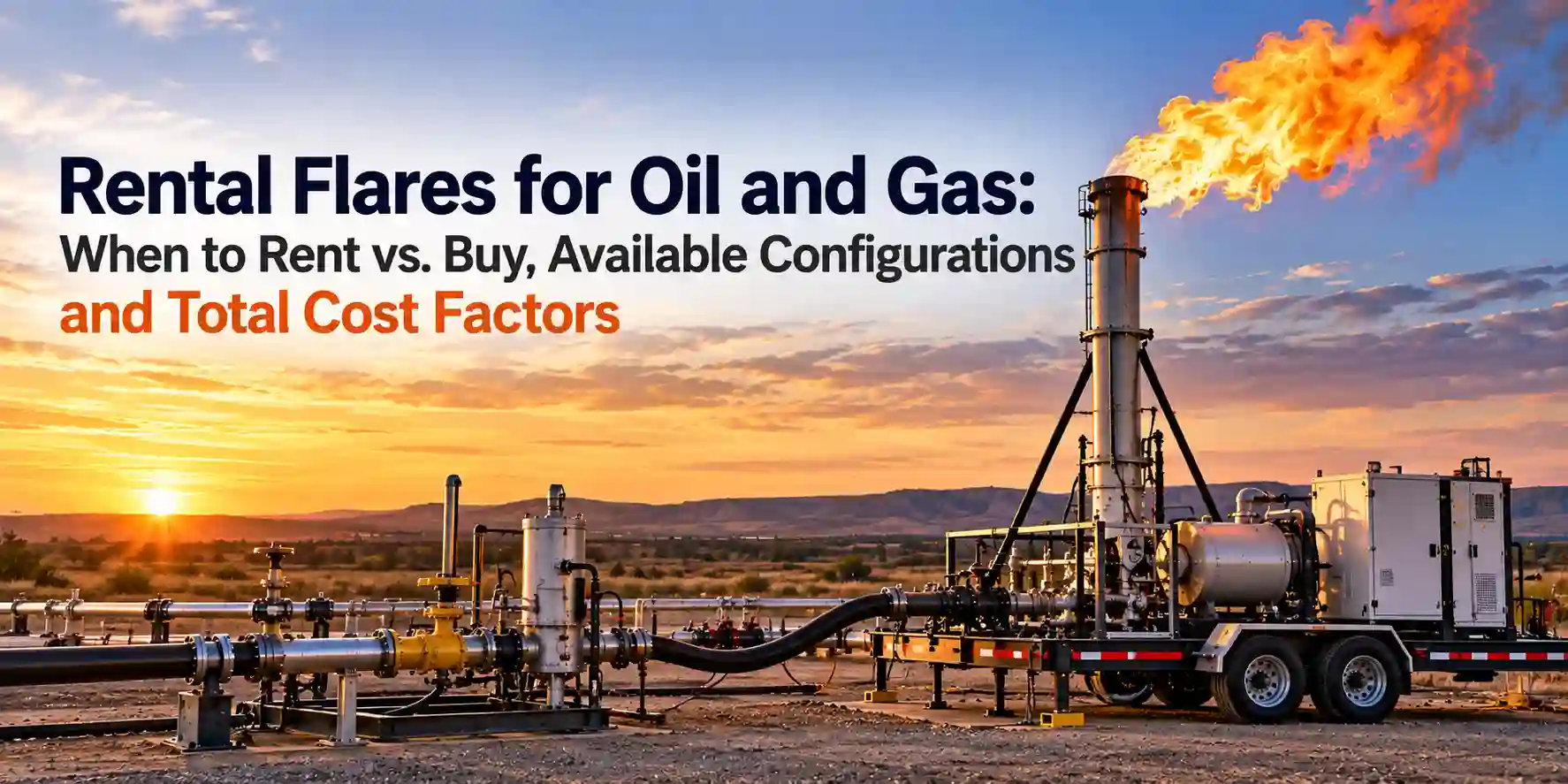
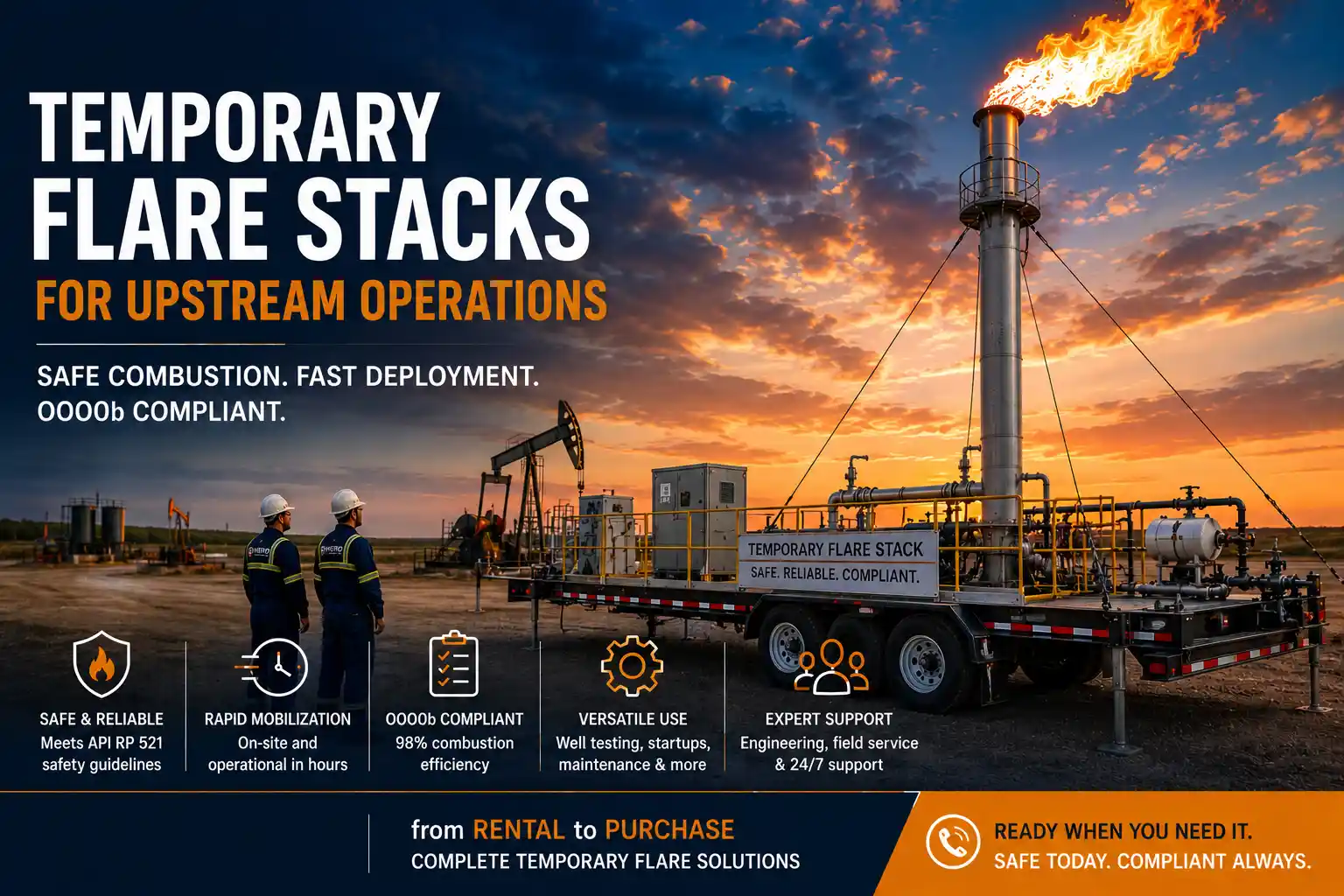
Temporary flare stacks are trailer-mounted or skid-mounted combustion devices deployed for time-limited upstream operations where permanent flare infrastructure is absent or offline. Common use cases include well testing, production startup, pipeline work, and emergency flare coverage. When used to control emissions at regulated sources, temporary flare stacks must meet EPA 40 CFR 60 Subpart OOOOb performance requirements — including 98% combustion efficiency and continuous pilot monitoring — regardless of the duration of deployment.
1. Upstream Use Cases That Require a Temporary Flare Stack
Well testing: New wells require testing to characterize reservoir performance, gas composition, and production rates before production equipment is connected. During testing, gas produced from the well must be safely disposed of. A temporary flare stack positioned near the wellhead provides the combustion point for test gas, typically for a period of days to weeks.
Production facility startup and commissioning: When a new production battery or gathering facility is commissioned, the permanent flare may not yet be operational. A temporary flare stack bridges the period between first production and full operational status of the permanent combustion system.
Permanent flare maintenance and outage coverage: When a permanent flare must be taken offline for inspection, maintenance, or repair, a temporary flare stack provides emergency combustion capacity during the maintenance period, preventing the choice between shutting down operations or venting uncontrolled gas.
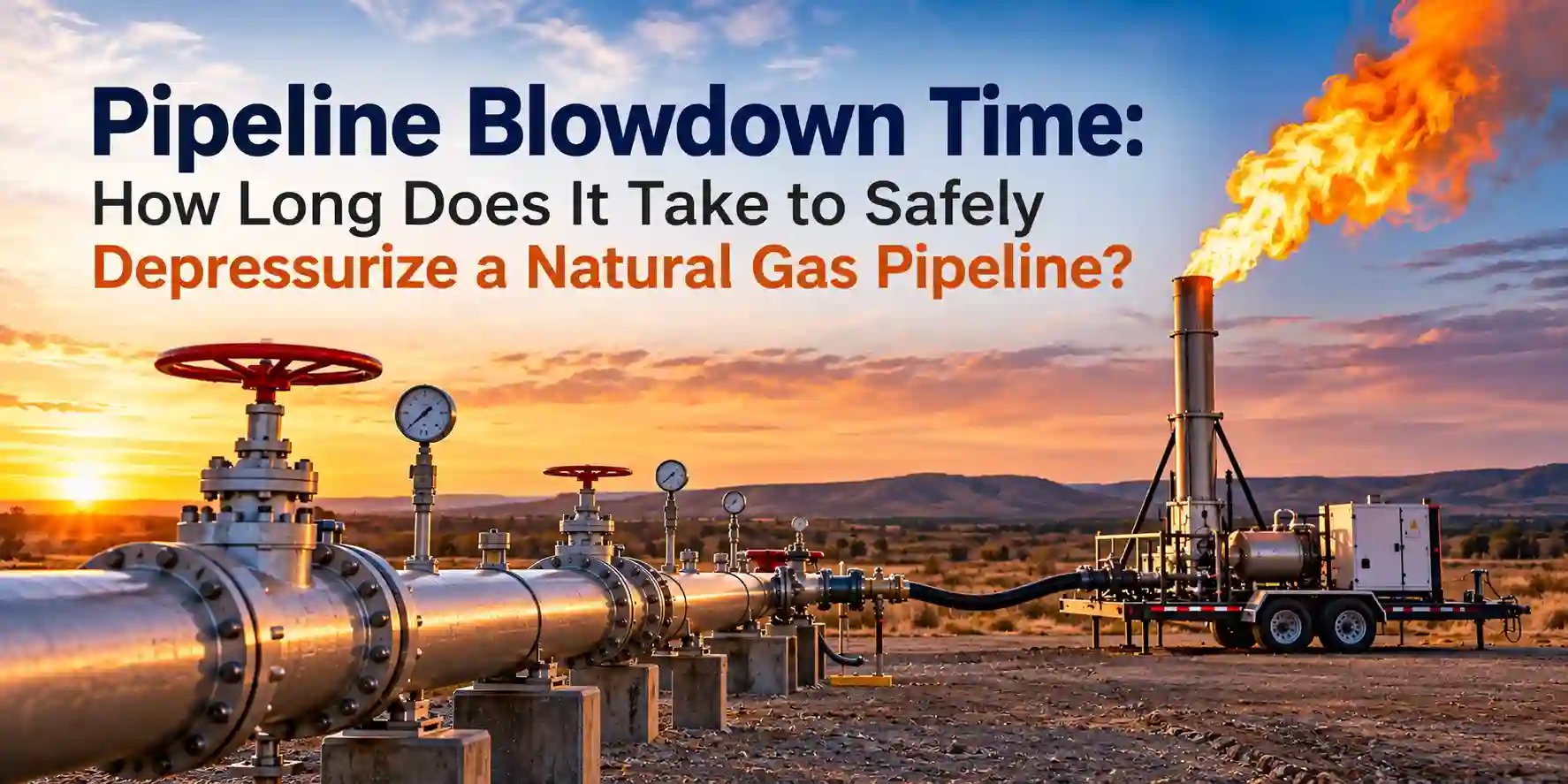
Pipeline pigging and depressurization: Pipeline sections being pigged, repaired, or modified must be depressurized before work begins. A temporary flare stack positioned at the pig receiver or blowdown point handles this gas safely.
Exploration and appraisal well operations: Exploratory wells in areas without existing infrastructure require temporary flare capability for any gas encountered during drilling or testing.
Emergency response: Blowouts, pressure relief events, or equipment failures that exceed the capacity of a permanent flare system may require emergency temporary flare supplementation. Rental fleet availability and rapid mobilization are critical in this scenario.
2. How Temporary Flare Stacks Differ from Permanent Installations
Structural differences:
- Temporary flare stacks are mounted on road-legal trailers or transportable skids; permanent installations have concrete foundations
- Connections are made via flexible hoses and quick-connect fittings rather than fixed piping
- Utility supplies are self-contained or connected via portable sources
- Can be operational within hours of arrival on site
- Demobilized without site disturbance when the application is complete
Permitting differences:
- Permanent flares are permitted as fixed emissions control devices in the facility’s air quality permit
- Temporary flare stacks may be covered under emergency authorization provisions, general authorizations, or temporary permit amendments
- Texas TCEQ and Oklahoma DEQ each have different authorization pathways for temporary flaring
- Federal facilities subject to Subpart OOOOb must demonstrate the temporary flare meets performance requirements
KEY INSIGHT
Many state air quality programs have specific authorization mechanisms for temporary flare stacks that allow deployment within 24-48 hours of notification, rather than requiring full permit amendment. However, this typically requires the unit to meet specific performance standards and operating time limits. Familiarize yourself with your state’s authorization pathway before you need a temporary flare on short notice.
3. Safety Requirements for Temporary Flare Stack Operations
Thermal radiation exclusion zone: Per API RP 521, the area around the flare must be restricted to maintain ground-level radiation below 1,600 BTU/hr-ft² at continuously manned locations and below 500 BTU/hr-ft² at areas where workers may be present without clothing protection. The exclusion zone must be physically established and communicated to all personnel on location before ignition.
Pilot flame requirement: A continuous pilot flame must be maintained throughout the flaring operation. Loss of pilot flame with active gas flowing through the flare tip is a safety hazard. Pilot monitoring systems must be functional before gas flow begins, and automatic or remote re-ignition capability should be confirmed.
Grounding and bonding: Temporary flare stack trailers must be properly grounded at the deployment location. Static buildup during gas flow through flexible hoses and connections can create ignition hazards if grounding is not established.
Pressure relief and emergency shutdown: The inlet connection must include an isolation valve operable from a safe distance. An emergency shutdown procedure must be established and communicated to the operating crew before gas flow begins.
Wind assessment: Temporary flare deployments must account for prevailing wind direction relative to personnel, equipment, and the public. If wind direction creates a hazardous condition, the operation should be paused until conditions improve or the flare position is relocated.
CRITICAL RULE
Before igniting a temporary flare stack, confirm the following: exclusion zone is established and marked; all personnel are briefed; pilot flame is confirmed; inlet isolation valve is operable; grounding is connected; and a responsible person is designated for monitoring throughout the flaring operation. These steps are not optional even for a one-day well test.
4. EPA 40 CFR 60 Subpart OOOOb Compliance for Temporary Flaring
When Subpart OOOOb applies to temporary flaring:
- The well being tested or started up is a new well subject to Subpart OOOOb as an affected facility
- The production equipment being served is an affected facility under the standard
- The operator has selected flaring as the control method for a specific Subpart OOOOb emission point
Performance requirements when applicable:
- 98% combustion efficiency for organic compounds per 40 CFR 60.18
- Continuous pilot flame monitoring with loss-of-pilot alarm
- Assist medium monitoring for air-assist units
- Visible emission compliance per EPA Method 22
- Recordkeeping of operating parameters and any monitoring deviations
KEY INSIGHT
State-level requirements in Texas and Oklahoma may impose additional permit conditions beyond Subpart OOOOb. In Texas, TCEQ requires notification for certain temporary flaring operations; in Oklahoma, DEQ may require a temporary permit amendment. Verify state-level requirements before deployment.
See the Hero Process Solutions OOOOb compliance resource for reference.
5. Step-by-Step Mobilization Process
Step 1: Application engineering (1-2 days before order)
Provide the vendor with: waste gas flow rate (maximum and normal), gas composition or best available estimate, inlet pressure, site location, access route details, power availability, and expected deployment duration. Confirm the unit specification against these parameters.
Step 2: State permit or authorization (parallel with Step 1)
Determine whether the planned temporary flare operation requires a permit amendment, temporary authorization, or notification to the state air quality agency. Submit the required notification or application. Confirm the authorization timeline against the planned operation start date.
Step 3: Logistics planning (1-3 days before mobilization)
Confirm trailer dimensions, weight, and transport requirements against the site access route. Confirm power supply availability at the flare location for air-assist units and whether the operator or vendor supplies the generator.
Step 4: Site preparation (day before mobilization)
Level and stabilize the flare pad area. Stage the inlet piping connection including isolation valve. Confirm power drop location. Establish and mark the exclusion zone. Brief all site personnel on the planned flaring operation, exclusion zone boundaries, and emergency procedures.
Step 5: Mobilization and arrival (day of)
The transport truck delivers the trailer to the staged location. Level the trailer using integrated leveling jacks or cribbing. Connect grounding cables. Connect the inlet hose to the process connection. Connect the power supply to the blower control panel.
Step 6: Commissioning (2-4 hours after arrival)
Commission the blower system: verify motor rotation, air flow, and control panel function. Ignite the pilot flame and confirm pilot monitoring system response. Open the inlet connection slowly and verify gas flow to the flare tip. Confirm pilot flame stability. Verify blower air flow at normal operating conditions. Document commissioning completion before declaring the unit operational.
Step 7: Monitoring during operation
Maintain continuous monitoring of pilot flame status. Check blower operation, inlet pressure, and knockout drum liquid level at regular intervals. Document operating parameters per the monitoring plan.
Step 8: Demobilization
Close the inlet isolation valve and allow the flare to burn down residual gas. Shut down the pilot and blower. Disconnect the inlet hose and cap the connection. Disconnect power and grounding. Remove cribbing. The transport truck retrieves the trailer. Typically requires 2-4 hours.
6. Coordinating with Air Quality Agencies for Temporary Flaring
Texas (TCEQ): TCEQ has established pathways for temporary flaring under standard exemptions and permit by rule provisions. For well testing at new wells, certain operations qualify under TCEQ’s Permit by Rule for New or Amended Air Quality Permits. Emergency flaring situations may qualify under TCEQ’s upset/maintenance/startup provisions with prompt notification.
Oklahoma (DEQ): Oklahoma DEQ issues temporary source permits for portable combustion equipment. The application process requires identification of the source location, equipment specifications, and estimated operating duration. Lead time can range from a few days for standard portable equipment to several weeks for more complex applications.
Federal (EPA) notification: For facilities subject to Subpart OOOOb, certain monitoring deviations or force majeure events require prompt notification to the EPA regional office. Understand the notification requirements before a temporary flare deployment that may involve deviations from normal permit conditions.
7. Common Temporary Flare Stack Deployment Failures and How to Prevent Them
| Failure | Root Cause | Prevention |
|---|---|---|
| Flare cannot reach the site | Access route not surveyed; trailer too large or heavy | Survey access route before mobilization; confirm trailer specs against road limits |
| Startup delayed by permit issue | Authorization process started too late | Initiate regulatory coordination simultaneously with unit procurement |
| Blower has no power at site | Generator not included in site plan | Confirm power source and specify generator if needed before mobilization |
| Visible smoke during well test | Unit undersized or wrong gas composition spec | Provide gas analysis to vendor; confirm smokeless capacity at peak test rate |
| Pilot lost during operation | No remote monitoring; loss not detected promptly | Specify remote pilot alarm; establish monitoring protocol before gas flow begins |
| Liquid ingestion damages flare tip | Knockout drum not included or undersized | Confirm knockout drum sizing against expected liquid loading |
| Exclusion zone violates site layout | Radiation calculation not performed before siting | Perform API 521 radiation check before positioning trailer |
| Late demobilization billing | Rental period not clearly defined in agreement | Define mobilization date, minimum rental period, and demobilization trigger in the rental agreement |
8. Hero Process Solutions Temporary Flare Stack Services
Hero Process Solutions supports upstream temporary flare operations through its rental fleet of trailer-mounted flare stacks, available in passive elevated and air-assist configurations. Rental units are maintained to field-ready condition with current service records.
For operations requiring field commissioning support, Hero PS Field Services provides on-site technician support for temporary flare startup, monitoring, and demobilization. This service is particularly valuable for first-time portable flare deployments or complex operations where technical oversight during startup reduces risk.
Operators with recurring temporary flare needs may find that purchasing a portable flare stack — available through the portable flares product page — is more economical over a multi-year planning horizon than continued rental. The flares product hub provides an overview of all Hero Process Solutions combustion system options.
Contact Hero Process Solutions at sales@hero-ps.com or (918) 941-2166 to discuss rental availability, unit specifications, or field service support for an upcoming temporary flare operation.
Article Summary
- Temporary flare stacks are deployed for upstream O&G operations including well testing, production startup, permanent flare maintenance coverage, pipeline depressurization, exploration, and emergency response.
- Temporary flare stacks use trailer-mounted assemblies with flexible hose connections, self-contained utilities, and rapid deployment capability without civil construction.
- Safety requirements include thermal radiation exclusion zone per API 521, continuous pilot flame monitoring, proper grounding and bonding, inlet isolation valve, and wind direction assessment.
- EPA 40 CFR 60 Subpart OOOOb applies to temporary flare stacks when the controlled source is an affected facility; 98% combustion efficiency requirements apply regardless of deployment duration.
- Compliance responsibility remains with the facility operator during temporary flare operations; rental unit performance does not transfer the operator’s regulatory obligation.
- State permit coordination must start in parallel with unit procurement; Texas TCEQ and Oklahoma DEQ each have specific authorization pathways for temporary portable combustion equipment.
- A well-executed mobilization delivers the unit from order to operational within 2-4 days for standard upstream applications, assuming site preparation and permits are completed in parallel.
- Common deployment failures include access route issues, late permit authorization, missing power supply, undersized units for the actual gas composition, and absence of knockout drum.
- Hero Process Solutions operates a rental fleet of temporary flare stacks and provides field commissioning support for upstream deployment, with permanent purchase options available for recurring temporary flare users.
Frequently Asked Questions
When does an upstream oil and gas operation need a temporary flare stack?
A temporary flare stack is needed any time gas must be safely combusted at a location where permanent flare infrastructure is not installed or not operational. The most common upstream scenarios are well testing, production facility startup and commissioning, permanent flare maintenance coverage, and pipeline depressurization. Venting gas to atmosphere is not an acceptable alternative in most regulatory environments.
Do temporary flare stacks require EPA or state permits?
Temporary flare stacks used to control emissions from regulated sources are subject to EPA 40 CFR 60 Subpart OOOOb performance requirements when the source is an affected facility. State-level authorization is also typically required. Texas TCEQ and Oklahoma DEQ each have specific permit or notification requirements for portable combustion equipment. Regulatory coordination should begin at the same time as unit procurement to avoid deployment delays.
How quickly can a temporary flare stack be mobilized to an upstream location?
A rental temporary flare stack can typically be delivered and operational within 2-4 days of order confirmation, assuming the unit is available and site preparation is complete. Sites with challenging access, long transport distances, or permit requirements with extended review timelines may require longer lead times.
What safety zone is required around a temporary flare stack during operation?
The required safety exclusion zone is determined by a heat radiation calculation per API RP 521. At continuously manned locations, ground-level radiation must not exceed 1,600 BTU/hr-ft²; at areas where workers may be present without protection, 500 BTU/hr-ft² applies. For a typical upstream well test with a standard trailer-mounted flare stack, the exclusion radius is typically 50-150 feet depending on flow rate and stack height.
Who is responsible for Subpart OOOOb compliance when using a rented temporary flare stack?
The facility operator is responsible for compliance with EPA 40 CFR 60 Subpart OOOOb when a temporary flare stack controls emissions at an affected facility. A rental agreement does not transfer the operator’s compliance obligation. The operator must verify the rental unit’s combustion efficiency basis, pilot monitoring system, and assist medium monitoring capability against permit requirements before deployment.
Can a temporary flare stack handle H2S-bearing waste gas?
Temporary flare stacks can handle H2S-bearing waste gas, but the unit must be specified for H2S service with compatible materials of construction. Personnel safety protocols for H2S monitoring and emergency response must be established before gas flow begins. Combustion products will include SO2, which must be dispersed safely. Confirm H2S concentration with the vendor during the specification process.