
OIL & GAS EQUIPMENT | Updated May 2025 | 9 min read
• What a 3-phase separator does and how it differs from a 2-phase separator
• The internal mechanisms that separate oil, gas, and water in a single vessel
• Horizontal vs. vertical separator designs and when each is the right choice
• Key sizing parameters: retention time, gas capacity, and liquid interface control
• Which upstream production scenarios require 3-phase separation vs. 2-phase
• How 3-phase separators connect with downstream vapor control and flare systems
• Common operational problems and how to avoid them with proper design and sizing
A 3-phase separator simultaneously splits produced fluids into three distinct streams — gas, oil, and water — in a single pressure vessel. For upstream oil and gas operations where produced water volumes are significant, running a 2-phase separator and handling emulsified fluids separately is both operationally inefficient and a source of the water-in-oil carryover problems that downstream processing equipment cannot tolerate. The 3-phase separator is the standard solution for wellhead and tank battery inlet separation at most oil-producing wells with meaningful water production.
Hero Process Solutions, headquartered in Kellyville, OK with operations in Midland, TX, designs and manufactures 3-phase separator vessels for upstream oil and gas production. Founded in 2011, Hero PS engineers separation equipment alongside its flare systems and vapor control product line, enabling integrated system design from the wellhead inlet through the vapor recovery and flare systems at the back end.
A 3-phase separator is a pressure vessel that separates produced fluids from an oil or gas well into three phases: hydrocarbon gas (vapor), crude oil (liquid hydrocarbon), and produced water (aqueous phase). Separation occurs through a combination of gravity, residence time, and internal flow-directing devices (baffles, coalescing elements, and weirs). 3-phase separators are required whenever produced water volumes are too high to manage through downstream oil-water treating alone.
1. How a 3-Phase Separator Works
A 3-phase separator works by giving the produced fluid stream enough space and residence time for the three phases to segregate by density under controlled conditions. Produced fluids from the wellhead enter the separator through an inlet nozzle fitted with a diverter or distributor, which breaks up the incoming turbulent stream and directs the flow to minimize re-mixing of the phases.
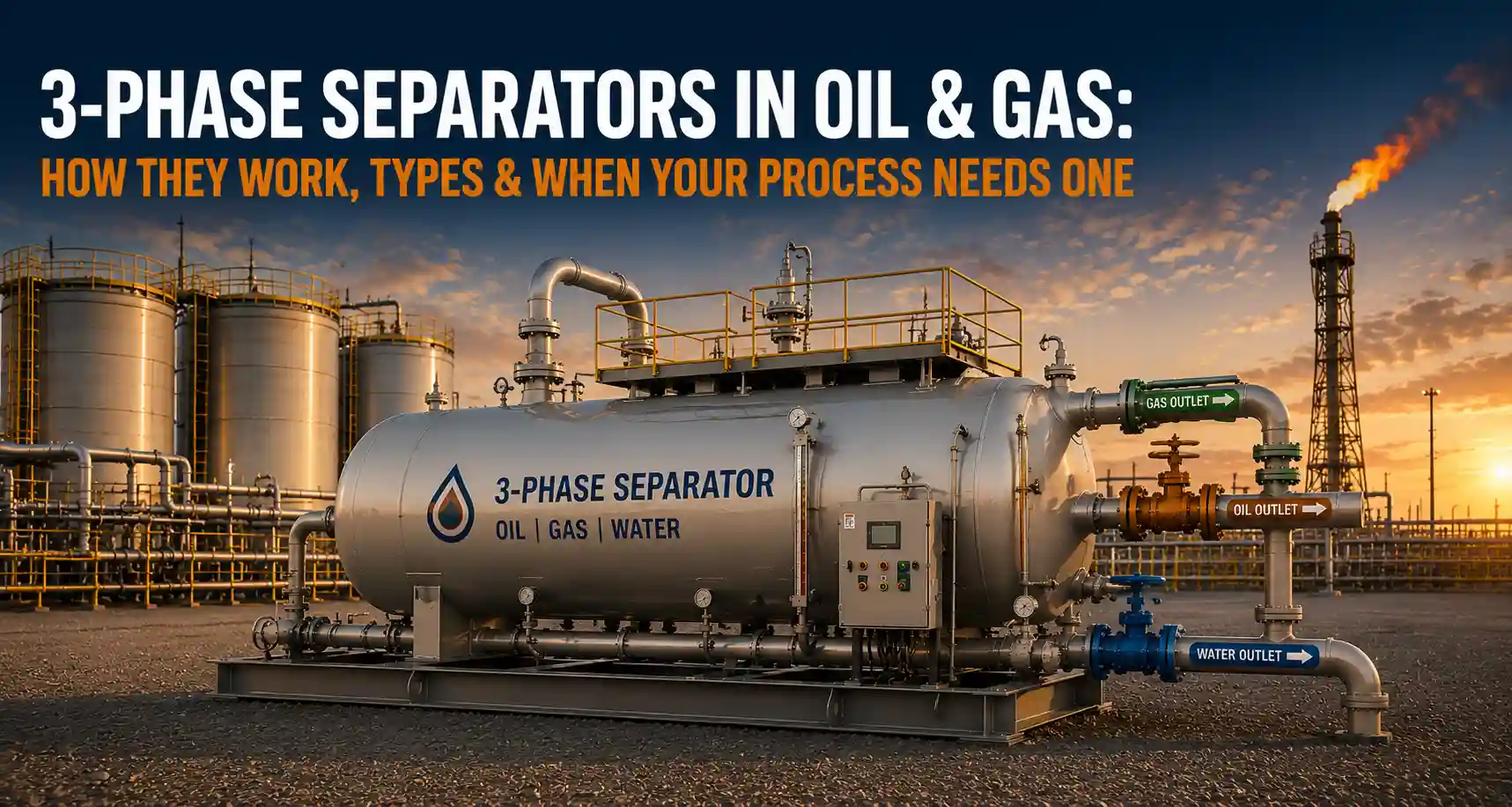
Inside a horizontal 3-phase separator, three distinct zones exist. The gas zone is the upper portion of the vessel where vapor accumulates; a mist extractor at the gas outlet removes entrained liquid droplets before the gas exits. The oil zone is where the liquid hydrocarbon phase floats above the water phase; a weir plate or interface controller separates the oil and water compartments, with oil overflowing the weir into the oil leg. The water zone is where produced water settles to the bottom; a level control valve on the water outlet manages the interface level between oil and water.
The critical design parameter for effective 3-phase separation is residence time — the time the fluid spends inside the vessel before exiting each phase outlet. Minimum residence times for oil-water separation are typically 3 to 10 minutes depending on fluid properties.
2. Horizontal vs. Vertical 3-Phase Separators
The two primary vessel orientations for 3-phase separators are horizontal and vertical. Horizontal vessels are the dominant design for 3-phase separation because the longer horizontal liquid retention zone provides more residence time per unit of vessel volume, the oil-water interface is easier to control due to larger interface area, and high gas-to-liquid ratios are accommodated more efficiently. Vertical separators are used when plot space is severely limited, when the gas-to-liquid ratio is very high with low liquid volumes, or when liquid surges from the wellhead would overwhelm the liquid handling in a horizontal unit.
| Factor | Horizontal | Vertical |
|---|---|---|
| Residence time per vessel volume | Higher | Lower |
| Oil-water interface control | Easier | More challenging |
| Footprint | Larger | Smaller |
| High GOR applications | Suitable | Better for very high GOR |
| Typical application | Tank battery inlet, high water cut | Wellhead separator, compact installations |
3. Internal Components That Enable 3-Phase Separation
The inlet diverter breaks up the incoming multiphase stream and reduces turbulence in the separation zone. The weir plate in the liquid section creates the separation between the oil compartment and water compartment; the height of the weir is set based on the oil-water interface level the design is targeting. The mist extractor at the gas outlet captures liquid droplets entrained in the gas phase — wire mesh pads are standard for most production applications, while vane-type mist extractors are used where liquid loading in the gas is high. A 3-phase separator also requires two level control systems: one for the overall liquid level and one for the oil-water interface level.
Emulsion treating chemicals (demulsifiers) are often added to the separator inlet to improve oil-water separation efficiency. The correct demulsifier type and injection rate depends on the crude oil API gravity, the produced water chemistry, and the separator operating temperature. A demulsifier program that works well in summer may not be adequate in winter when reduced fluid temperatures slow coalescence.
4. When Your Operation Needs a 3-Phase Separator
Not every production well requires 3-phase separation from day one. Early in a well’s life, water cut may be low (under 10%), and a 2-phase separator with downstream oil-water treating is adequate. As the well ages and water cut climbs — often to 50%, 70%, or higher in mature fields — the volume of produced water makes 2-phase separation increasingly inadequate. A 3-phase separator is effectively mandatory when water cut exceeds 20 to 30% at production volumes above a few hundred barrels per day, when water carryover into the oil sales pipeline would violate the pipeline operator’s BS&W specification (typically 0.5% or less), or when produced water disposal requirements demand separated water before injection or trucking.
5. Connecting the 3-Phase Separator to Downstream Vapor Control
The gas outlet from a 3-phase separator connects directly to the vapor control system at the production site. Under OOOOb, the gas separated from produced fluids at an affected facility must be routed to a compliant vapor control device — either a vapor recovery unit (VRU) that compresses the gas for sales, or a flare or combustor that destroys it. Routing separator gas directly to atmosphere from an OOOOb-affected facility is a violation, regardless of how small the gas volume appears.
The gas from a separator can carry entrained liquid mist, particularly during high-rate production events or liquid surges. A liquid knockout drum downstream of the separator gas outlet and upstream of the flare or VRU protects downstream equipment from liquid damage and ensures the flare tip receives a clean gas stream.
The gas outlet of a 3-phase separator at an OOOOb-affected production facility must be connected to a compliant vapor control device (VRU, flare, or combustor). Uncontrolled venting of separator gas, even during startup or upset conditions, triggers OOOOb compliance obligations. Design the separator gas outlet connection to route to the vapor control system from day one.
Common Mistakes to Avoid
| Mistake | Why It Hurts | Fix |
|---|---|---|
| Sizing for initial water cut rather than peak water cut | Separator overwhelmed as water cut increases; poor oil quality | Size for the expected maximum water cut over the well’s life |
| Inadequate mist extractor capacity | Liquid carryover into gas line; compressor damage; flare tip damage | Select mist extractor type and size based on maximum gas velocity and liquid loading |
| Incorrect weir height setting | Oil-water interface unstable; carryover in both directions | Calculate weir height based on expected oil-water interface target level |
| Separator gas vent to atmosphere | OOOOb violation; methane and VOC emissions | Route all separator gas outlets to VRU, flare, or combustor from initial commissioning |
| No knockout drum downstream of separator gas outlet | Liquid slugs from separator damage flare tip or VRU compressor | Install liquid knockout drum between separator gas outlet and vapor control equipment |
Article Summary
- A 3-phase separator splits produced fluids into gas, crude oil, and produced water in a single pressure vessel using gravity, residence time, and internal flow-directing components.
- Horizontal separators provide more oil-water residence time per vessel volume; vertical separators are preferred where footprint is severely limited.
- Key internal components include the inlet diverter, weir plate, mist extractor, and dual-level control systems for overall liquid and oil-water interface.
- 3-phase separation is required when water cut is high enough that oil-water treating downstream of a 2-phase separator becomes inadequate or impractical.
- The separator gas outlet must be connected to a compliant vapor control device (VRU, flare, or combustor) under EPA 40 CFR 60 Subpart OOOOb.
- A liquid knockout drum downstream of the separator gas outlet protects flare tips and VRU compressors from liquid carryover damage.
- Hero Process Solutions designs and fabricates 3-phase separator vessels for upstream oil and gas production, with integration into full-site vapor control systems.
Frequently Asked Questions
What is the difference between a 2-phase and a 3-phase separator?
A 2-phase separator separates gas from total liquid (oil + water combined). A 3-phase separator separates all three phases: gas, crude oil, and produced water, into distinct outlet streams. When water cut is low, a 2-phase separator with downstream oil-water treating is adequate. As water cut increases, a 3-phase separator becomes necessary to handle the volume and quality requirements for both the oil and water outlet streams.
How long does produced fluid need to stay in a 3-phase separator?
Minimum retention times for oil-water separation in a 3-phase separator are typically 3 to 10 minutes for the liquid phase, depending on the API gravity of the crude, the water chemistry, and whether emulsion-breaking chemicals are injected. Gas separation typically occurs much faster. Heavier crude oils (lower API) and tight emulsions require longer retention times and may require heat assistance through a heater-treater configuration.
What causes water carryover into the oil outlet of a 3-phase separator?
Water carryover into the oil outlet is typically caused by the oil-water interface level exceeding the weir height; excessive liquid throughput velocity that prevents adequate settling; level controller malfunction or drift; inadequate emulsion treatment; or a tight emulsion that does not break within the vessel retention time. Each of these has a distinct diagnostic signature and solution.
Does a 3-phase separator require regulatory permits?
The separator vessel itself typically does not require an individual air quality permit in most jurisdictions, but the gas outlet must be controlled as required by EPA 40 CFR 60 Subpart OOOOb if the facility is an affected source. The separator’s liquid outlets connect to storage tanks that may have their own permit requirements. Consult with your EHS team or regulatory consultant for the applicable requirements at your specific facility.
What downstream equipment connects to a 3-phase separator gas outlet?
The gas outlet from a 3-phase separator typically connects to a liquid knockout drum, followed by either a vapor recovery unit (VRU) compressor or a flare and combustor for gas destruction. The liquid knockout drum removes any entrained liquid droplets from the gas before they can damage the VRU compressor or flare tip. At OOOOb-affected facilities, routing the gas to a compliant vapor control device is mandatory.