OIL & GAS EQUIPMENT | Updated May 2026 | 9 min read
What You’ll Learn in This Guide
- The main types of portable flares available for upstream oil and gas operations
- Key technical specifications to evaluate before renting or purchasing
- How to decide between renting and buying a portable flare for your specific application
- EPA 40 CFR 60 Subpart OOOOb compliance requirements for portable flare operations
- What mobilization, setup, and decommission looks like for a portable flare unit
- Common specification mistakes in portable flare procurement that create safety and compliance problems
- How Hero Process Solutions’ portable flare product line and rental fleet are configured
- Cost factors that determine rent vs. buy ROI
Portable flares handle combustion requirements that permanent installations cannot — well testing, production startup, emergency relief, pipeline pigging operations, and short-term production from leases that do not yet justify permanent infrastructure. Choosing the right portable flare for an oil and gas application requires matching the unit’s smokeless capacity, flow rate rating, and assist system to the actual waste gas composition and operational timeline.
Hero Process Solutions, founded in 2011 and headquartered in Kellyville, OK with operations in Midland, TX, manufactures and rents portable flares for upstream and midstream O&G applications throughout North America.
DIRECT ANSWER: Portable Flares for Oil & Gas
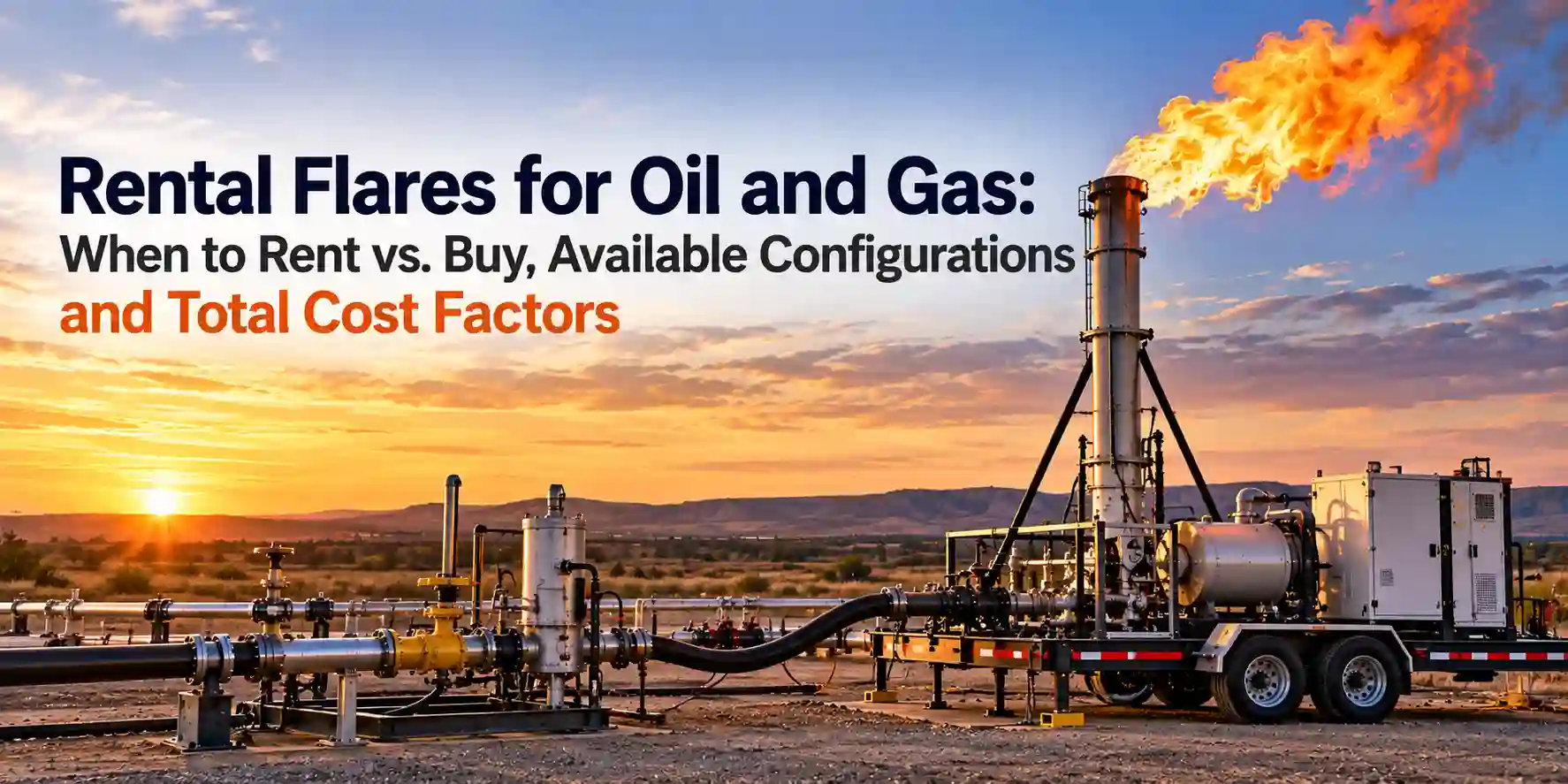
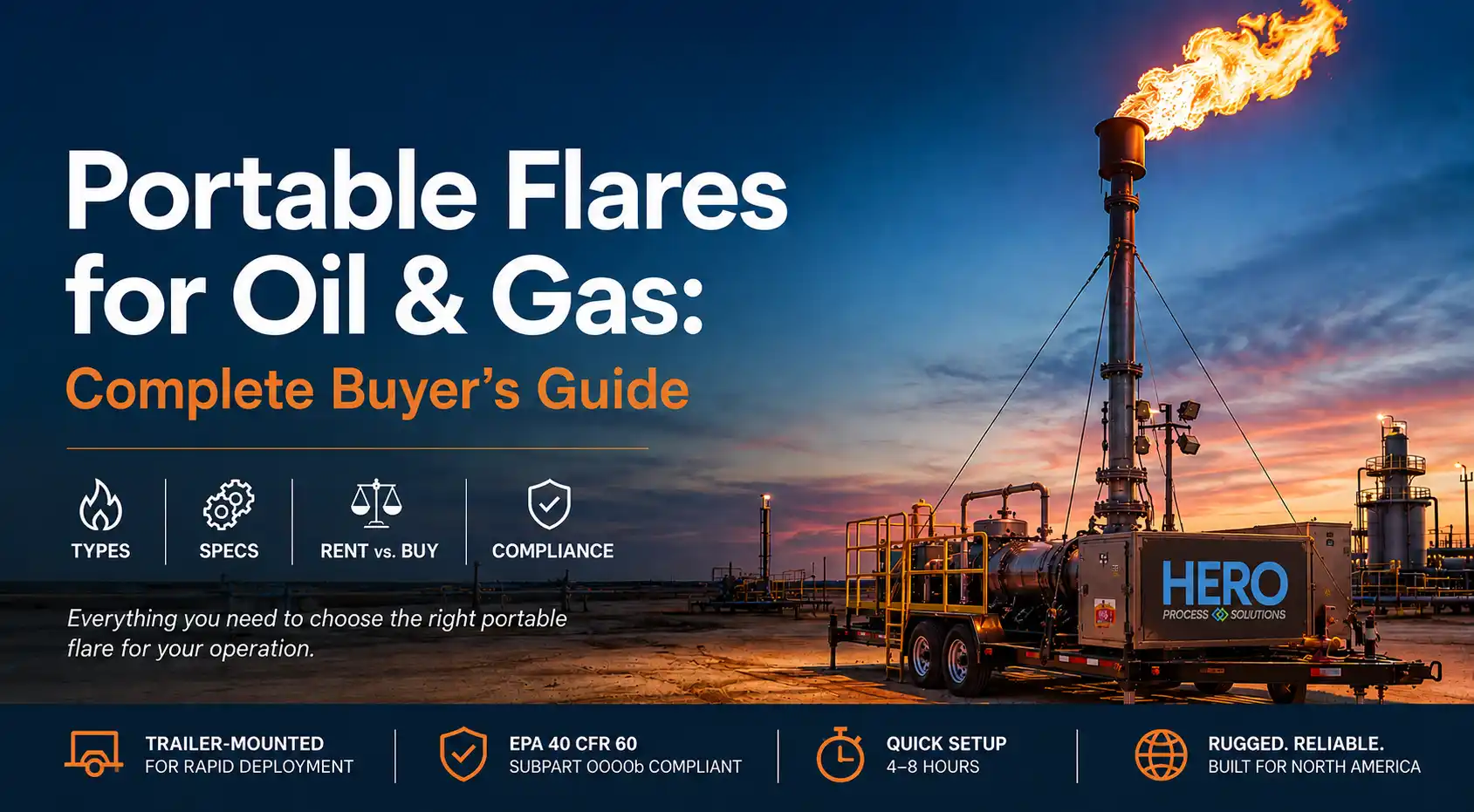
Portable flares are trailer-mounted or skid-mounted combustion devices designed for temporary flaring applications in oil and gas operations, including well testing, production startup, pipeline work, and emergency relief. They are available in passive elevated, low-flow, air-assist, and enclosed combustor configurations depending on the required flow rate, waste gas composition, and smokeless performance standard. Under EPA 40 CFR 60 Subpart OOOOb, portable flares used at affected facilities must meet the same 98% combustion efficiency requirement as permanent installations.
1. Types of Portable Flares Available for Oil & Gas Operations
Passive elevated portable flares: The simplest configuration — a vertical stack mounted on a trailer with a continuous pilot ignition system. No assist medium required. Suitable for lean natural gas (predominantly methane) at flow rates within the passive smokeless envelope.
Air-assist portable flares: A trailer-mounted unit with an integrated blower skid, air injection manifold at the flare tip, and a powered control panel. Achieves smokeless combustion for moderate to heavy hydrocarbon streams without requiring steam. The most versatile portable configuration for upstream production operations. Requires a power source at the site.
Low-flow portable flares: Designed for low-volume gas streams — pneumatic controller venting, small-volume production tank venting, and wellhead bleed applications. See Hero Process Solutions’ low flow flares product page.
Enclosed vapor combustors (portable): Portable enclosed combustors for continuous low-flow vapors from tank batteries and produced water handling. See Hero Process Solutions’ combustors page for enclosed combustion options.
2. Key Technical Specifications to Evaluate
Maximum waste gas flow rate (MMscfd or Mscfd): The most basic sizing parameter. Use the absolute maximum expected flow rate — not the average.
Smokeless capacity: The maximum flow rate at which the unit achieves smokeless combustion per EPA Method 22 criteria. Confirm this covers your peak flow scenario.
Waste gas composition rating: A unit rated for lean gas (MW 18-20) may not perform smokeless for gas with significant C3+ content (MW 25+). Get the composition spec confirmed against the unit’s design basis.
Connection size and pressure rating: Inlet connections must match your field piping size and maximum operating pressure. Confirm the MAWP against your worst-case relief or emergency pressure scenario.
Pilot ignition system: Continuous pilot with electronic ignition is the baseline. Confirm whether remote or automatic re-ignition is included — manual re-ignition requiring a technician is not acceptable for unattended remote operation.
Stack height: Confirm stack height meets API 521 radiation requirements at your site’s minimum exclusion distance.
Mobility and setup time: Most trailer-mounted air-assist portable flares can be operational within 4-8 hours of arrival on site when connections are pre-staged.
3. Rent vs. Buy: How to Make the Decision
Rent when:
- The application is genuinely temporary: well testing, startup, pipeline work, or emergency response
- The rental duration is less than 6-12 months and recurrence is uncertain
- Capital is better deployed in production assets than combustion equipment
- Rapid deployment is required and procurement lead time for a new unit is too long
Buy when:
- You have recurring portable flare needs across multiple sites or operations per year
- The application repeats on a predictable schedule (seasonal well testing, annual turnarounds)
- Long-term cost of ownership over a 3-5 year horizon is lower than cumulative rental cost
- You require a unit immediately available without rental lead time
KEY INSIGHT
For operators running 5 or more well tests or startup flaring events per year with similar gas compositions, the 3-year total cost of ownership on a purchased portable flare typically falls below the equivalent rental spend. The crossover point depends heavily on mobilization and freight costs, which vary by region and unit size.
4. EPA 40 CFR 60 Subpart OOOOb Compliance for Portable Flares
A common misconception is that temporary or portable flares are exempt from Subpart OOOOb requirements. They are not, if the source they control is an affected facility under the standard.
Under EPA 40 CFR 60 Subpart OOOOb, any flare used to control emissions from a covered source must meet the same performance requirements as a permanent installation:
- 98% combustion efficiency for organic compounds per 40 CFR 60.18
- Continuous pilot flame with monitoring and loss-of-pilot alarm
- Visible emission compliance per EPA Method 22
- Assist medium monitoring for air-assist units
CRITICAL RULE
A portable flare rented from a third party does not transfer the operator’s compliance obligation. The facility operator remains responsible for ensuring the portable flare meets all applicable Subpart OOOOb performance requirements during the period of use. Confirm unit specs against your permit conditions before deployment.
For a complete regulatory reference, see Hero Process Solutions’ OOOOb compliance page.
5. Mobilization, Setup, and Decommission: What to Expect
Pre-deployment: Confirm site access road width, weight limits, turning radius. Identify inlet connection location, size, and pressure rating. Confirm power supply availability. Review safety exclusion zones. Confirm permit status.
Mobilization: Trailer-mounted portable flares are transported by standard flatbed or lowboy trailer. Arrival to ready-to-operate condition typically requires 4-8 hours.
Operation: Continuous pilot must be maintained throughout. For unattended sites, remote monitoring of pilot status and blower operation is recommended. Daily checks of knockout drum liquid level, pilot flame status, and inlet pressure are minimum requirements.
Decommission: Purge the flare header and knockout drum before disconnecting. Knockout drum liquids must be disposed of per applicable waste handling requirements. Typically requires 2-4 hours.
6. Portable Flare Comparison Table
| Configuration | Max Flow Range | Smokeless Performance | Utility Required | Best For |
|---|---|---|---|---|
| Passive elevated | Low to moderate | Lean gas only | None | Lean methane, low-volume venting |
| Air-assist portable | Moderate to high | Lean to moderate HC | Electric power | Well testing, startup, production battery |
| Low-flow flare | Very low (Mscfd) | Lean gas | None or minimal | Pneumatics, small tank venting |
| Portable vapor combustor | Very low to low | All compositions | Electric or gas | Continuous low-flow vapor control |
7. Common Mistakes in Portable Flare Procurement and Operation
| Mistake | Why It Hurts Operations/Compliance | Fix |
|---|---|---|
| Sizing to average flow instead of peak | Smokeless capacity exceeded during well test peak or blowdown | Obtain maximum expected flow rate and size to that |
| Ignoring gas composition in unit selection | Air-assist insufficient for heavy gas; visible smoke violation | Provide gas composition to vendor; confirm smokeless spec |
| Assuming temporary = no compliance obligation | Subpart OOOOb applies regardless of installation permanence | Review permit requirements before deployment |
| Skipping pre-deployment site survey | Access, power, or connection problems discovered on arrival | Complete site survey checklist before mobilization |
| No knockout drum protection | Liquid ingestion at flare tip; flashback and tip damage | Confirm knockout drum is included in unit configuration |
| Failing to monitor pilot flame during unattended operation | Pilot out goes undetected; unburned gas vents from stack | Specify remote pilot monitoring with alarm output |
8. Hero Process Solutions Portable Flare Products and Rental Fleet
Hero Process Solutions’ portable flares product line includes trailer-mounted units in both passive and air-assist configurations. The rental fleet provides access to portable flare capacity without capital commitment, with rapid mobilization for emergency and planned operations. Hero Process Solutions field services provides commissioning, startup, and troubleshooting support at the site. Aftermarket support covers parts and maintenance for purchased portable units.
Contact Hero Process Solutions at sales@hero-ps.com or (918) 941-2166 to specify a portable flare or discuss rental availability.
Article Summary
- Portable flares are trailer-mounted or skid-mounted combustion devices for temporary oil and gas applications including well testing, production startup, pipeline work, and emergency relief.
- Main types include passive elevated, air-assist, low-flow, and enclosed portable vapor combustors, each suited to different flow rates and gas compositions.
- Key specifications to evaluate: maximum waste gas flow rate, smokeless capacity, gas composition rating, inlet pressure rating, pilot ignition system, stack height, and setup time.
- The rent-vs.-buy decision hinges on utilization frequency; operators running five or more flaring events per year typically find purchase cost-effective over a three-year horizon.
- EPA 40 CFR 60 Subpart OOOOb applies to portable flares when the source they control is an affected facility; the 98% combustion efficiency requirement applies regardless of installation permanence.
- Compliance responsibility for a rented portable flare remains with the facility operator, not the rental provider.
- Mobilization for a trailer-mounted air-assist portable flare typically requires 4-8 hours from arrival to operational.
- Knockout drum protection and continuous pilot monitoring are non-negotiable requirements for any portable flare deployment.
- Hero Process Solutions offers both a portable flare product line for purchase and a rental fleet for temporary applications.
Frequently Asked Questions
What are portable flares used for in oil and gas operations?
Portable flares are used for temporary combustion applications where permanent flare infrastructure is not installed or not yet operational. Common applications include well testing, production startup and commissioning, pipeline depressurization and pigging operations, emergency relief when a permanent flare is offline for maintenance, and short-term production from leases awaiting permanent facility construction.
Do portable flares need to comply with EPA regulations?
Yes. If the source controlled by a portable flare is subject to EPA 40 CFR 60 Subpart OOOOb or other applicable New Source Performance Standards, the portable flare must meet the same performance requirements as a permanent flare installation — including 98% combustion efficiency, continuous pilot flame monitoring, and visible emission compliance per EPA Method 22.
How long does it take to set up a portable flare on site?
Most trailer-mounted portable flares can be operational within 4-8 hours of arrival on site, assuming inlet connections are pre-staged, power is available for air-assist units, and the site is accessible. Larger or more complex units may require a full day for installation and commissioning.
What is the typical rental period for a portable flare?
Rental periods vary by application. Well testing operations may require a portable flare for as little as a few days to two weeks. Production startup can extend to several weeks or months. Most rental agreements are structured with a minimum rental period (typically 30 days) and a daily or monthly rate thereafter.
How do I determine which type of portable flare I need?
Start with two pieces of information: the maximum expected waste gas flow rate and a representative gas composition analysis. These parameters determine whether a passive elevated, air-assist, or low-flow configuration is appropriate, and establish the minimum smokeless capacity the unit must achieve. Hero Process Solutions can provide application engineering support based on your flow rate and composition data.