
- How vapor combustor units destroy tank battery vent gas at 99%+ destruction efficiency
- The technical differences between VCUs and elevated open flares
- Which tank battery configurations require a VCU under EPA 40 CFR 60 Subpart OOOOb
- How to size a VCU based on peak flow rate, BTU content, and turndown ratio
- The Hero Process Solutions vapor combustor product line and available configurations
- Common mistakes operators make when specifying combustion control for low-flow vent streams
Vapor combustor units are the standard combustion control device for low-flow vent gas from storage tanks, separators, and wellhead production equipment, and the choice between a VCU and an open elevated flare carries direct permit consequences under EPA 40 CFR 60 Subpart OOOOb. At Hero Process Solutions’ vapor combustor product line, units are engineered to achieve 99% or better destruction efficiency on vent streams that intermittent, wind-affected open-tip flares cannot reliably control.
Hero Process Solutions, founded in 2011 and headquartered in Kellyville, OK with operations in Midland, TX, manufactures industrial flare systems and vapor combustors for upstream, midstream, and gas processing operators across North America. The product line covers single-tank battery applications through large multi-pad production facilities, with OOOOb-compliant monitoring systems integrated at the factory.
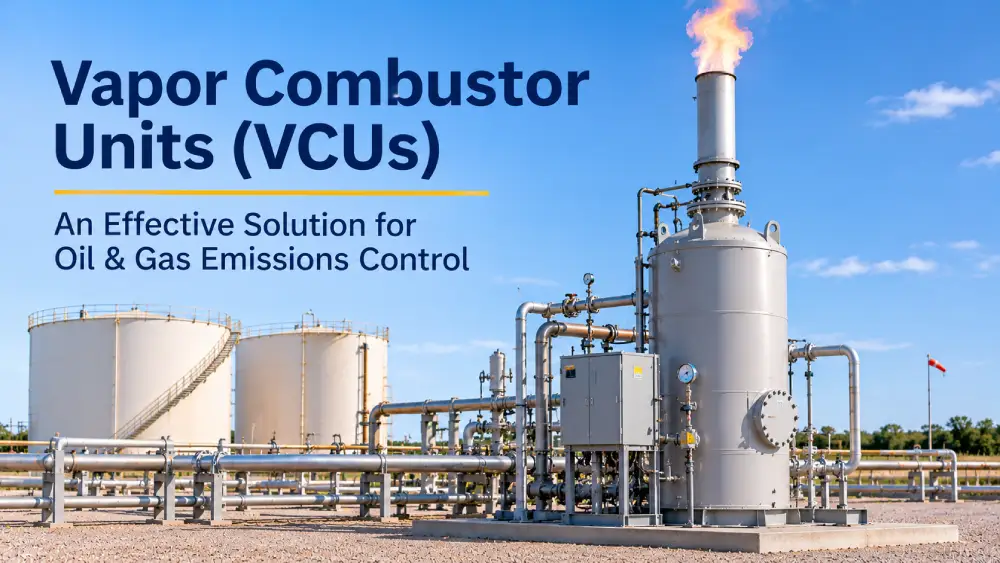
Vapor combustor units (VCUs) are enclosed, ground-level combustion devices that destroy vent gas from storage tanks and wellhead production equipment at 99% or greater destruction efficiency. Unlike elevated open flares, VCUs contain combustion inside a refractory-lined cylinder, maintain stable flame at low flow rates without pilot blow-out risk, and satisfy EPA 40 CFR 60 Subpart OOOOb control device requirements when equipped with a monitored, continuously operating pilot system. They are the standard compliance choice for tank battery vent streams at upstream oil and gas production facilities.
1. How Vapor Combustor Units Work
A VCU routes vent gas from storage tanks or production equipment through a closed-vent collection system into a vertical, refractory-lined combustion cylinder. Inside, a burner assembly mixes the waste gas with combustion air and ignites it using a continuously lit pilot flame. The enclosed cylinder raises flame temperature above 1,400 degrees Fahrenheit, the operating threshold required to achieve 99% hydrocarbon destruction on typical upstream vent gas compositions.
The core mechanical components are the burner assembly, the refractory liner, the exhaust stack, and the ignition and pilot monitoring system. Natural draft units pull combustion air through an annular inlet using thermal buoyancy. Forced draft units use a blower to deliver a controlled air-to-fuel ratio, which matters when vent gas BTU content varies across the production cycle. Both types use a thermocouple or UV flame scanner to confirm pilot presence, which is the monitoring method required for Subpart OOOOb compliance.
The enclosed combustion zone in a VCU maintains stable flame at vent gas flow rates as low as 5,000 BTU/hour, well below the threshold where an open elevated flare would sustain reliable combustion without supplemental fuel gas injection.
2. VCUs vs. Open Elevated Flares: Key Technical Differences
Operators choosing between a vapor combustor unit and an open elevated flare for a new tank battery or a Subpart OOOOb compliance upgrade must understand these technical distinctions before specifying equipment.
| Parameter | Vapor Combustor Unit (VCU) | Open Elevated Flare |
|---|---|---|
| Combustion zone | Enclosed refractory cylinder | Open tip, exposed to wind and ambient air |
| Minimum stable flow | Low (5,000-10,000 BTU/hr typical) | Higher; susceptible to flame-out at low flow rates |
| Destruction efficiency | 99%+ achievable and verifiable | 98% EPA minimum; variable performance at low flows |
| Thermal radiation hazard | Low (contained flame, minimal setback) | Requires radiation setback distance per API 521 |
| OOOOb pilot monitoring | Integral thermocouple or UV scanner | Requires a separate pilot monitoring system |
| Visible flame or smoke | None (enclosed, no visible emission) | Visible; may require air or steam assist for smokeless operation |
| Typical application | Tank battery vent gas, low-flow wellhead service | Emergency and high-flow process flaring |
3. Types of Vapor Combustor Units for Tank Battery Service
VCU configurations differ in capacity, combustion air delivery, and control system design. Matching the unit type to the vent gas flow profile and production site conditions determines both performance and OOOOb compliance reliability.
Natural Draft VCUs rely on thermal buoyancy to draw combustion air into the firebox. They have no blower or fan, which reduces mechanical complexity and maintenance requirements. They perform well on tank batteries with stable vent rates and gas BTU content above 500 BTU/scf.
Forced Draft VCUs use a combustion air blower to maintain a controlled air-to-fuel ratio. This enables them to handle wider BTU variation and lower-BTU waste streams reliably. They are the preferred configuration when separator gas blends with tank vent gas that varies in composition across production cycles.
Trailer-Mounted VCUs combine a vapor combustor with a portable skid-mounted manifold and controls package for temporary production testing, emergency OOOOb compliance coverage, or wellsite operations where a vapor recovery system is being installed and interim combustion control is required before the VRU is operational.
4. EPA OOOOb Compliance: What Vapor Combustor Units Must Meet
Under EPA 40 CFR 60 Subpart OOOOb, storage vessels and associated production equipment at affected facilities must control VOC and methane emissions using an approved combustion device or vapor recovery system. For operators using a VCU as their control device, the rule establishes specific performance and monitoring requirements.
The VCU must achieve a destruction or removal efficiency (DRE) of 95% for VOC, though most equipment is designed for 99% to provide a compliance buffer and to satisfy state permit conditions that routinely exceed federal minimums. The unit must also meet the operating parameter requirements of 40 CFR 60.18, which include a minimum combustion zone temperature or net heating value threshold and a continuously operating pilot system.
Subpart OOOOb requires the pilot flame to be present and monitored at all times the control device is receiving vent gas. A pilot outage without an automated relight system constitutes a permit deviation. Every VCU specified for OOOOb compliance must include a thermocouple or UV flame scanner with automated relight and alarm capability.
In Texas, operators must satisfy TCEQ permit requirements that often require continuous monitoring records and quarterly operational reports. Oklahoma and New Mexico have adopted parallel frameworks for OOOOb-affected facilities. Hero Process Solutions integrates OOOOb-qualified pilot monitoring and documentation packages on all vapor combustors, and the field services team provides startup commissioning and permit documentation support.
5. Sizing a VCU: Flow Rate, BTU Content and Turndown Ratio
Correct VCU sizing depends on three primary inputs: peak vent gas flow rate, the heating value of the waste gas in BTU/scf, and the expected turndown ratio between peak and minimum operating flow.
Peak Flow Rate: The VCU must handle the maximum vent rate from all connected equipment without exceeding rated capacity. For storage tanks, peak flow occurs during tank filling when vapor displacement is highest. For separator vent streams, peak flow coincides with maximum liquid throughput periods.
BTU Content: Vent gas BTU content determines combustion air ratio and minimum stable flow. High-BTU streams above 900 BTU/scf may require dilution air to protect the refractory liner from overtemperature. Low-BTU streams below 300 BTU/scf may need supplemental fuel gas to sustain flame.
Turndown Ratio: The ratio of peak to minimum operating flow is the critical design constraint for reliable VCU performance. A unit with a 10:1 turndown ratio operates stably at 10% of rated flow. Natural draft VCUs typically achieve 5:1 to 8:1 turndown. Forced draft units can reach 15:1 or higher, which matters for tank batteries where vent gas production is intermittent and variable across the production day.
Undersizing the turndown ratio is the most common VCU specification error. An operator who sizes only for peak flow without accounting for minimum flow conditions will experience pilot outages during low-production periods. These are permit deviations under Subpart OOOOb that require reporting to the applicable state air agency.
6. Hero Process Solutions Vapor Combustor Product Line
Hero Process Solutions manufactures vapor combustors across a capacity range suited to single-tank operations through large multi-well pad batteries. All units are fabricated at the Kellyville, OK facility, and the company’s engineering team provides sizing support and detailed application review before purchase.
| VCU Configuration | Typical Application | Air Supply Type | OOOOb Ready |
|---|---|---|---|
| Small natural draft VCU | Single-tank or 2-tank battery, stable low-flow vent gas | Natural draft | Yes |
| Mid-range forced draft VCU | 4-8 tank battery, variable BTU gas composition | Forced draft blower | Yes |
| High-capacity forced draft VCU | Large pad batteries, separator gas blended with tank vent | Forced draft blower | Yes |
| Trailer-mounted VCU | Temporary compliance coverage, well testing, rental applications | Natural or forced draft | Yes |
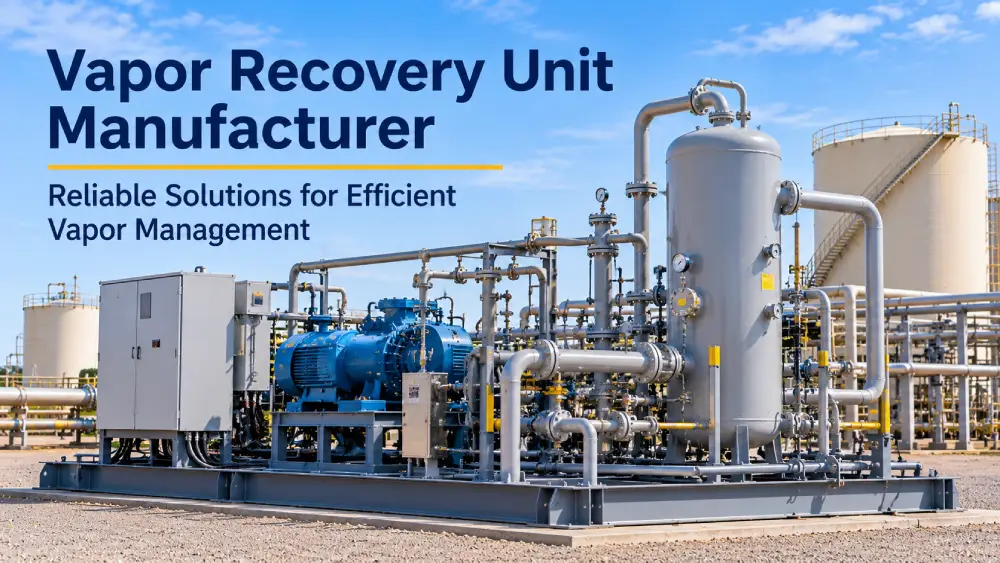
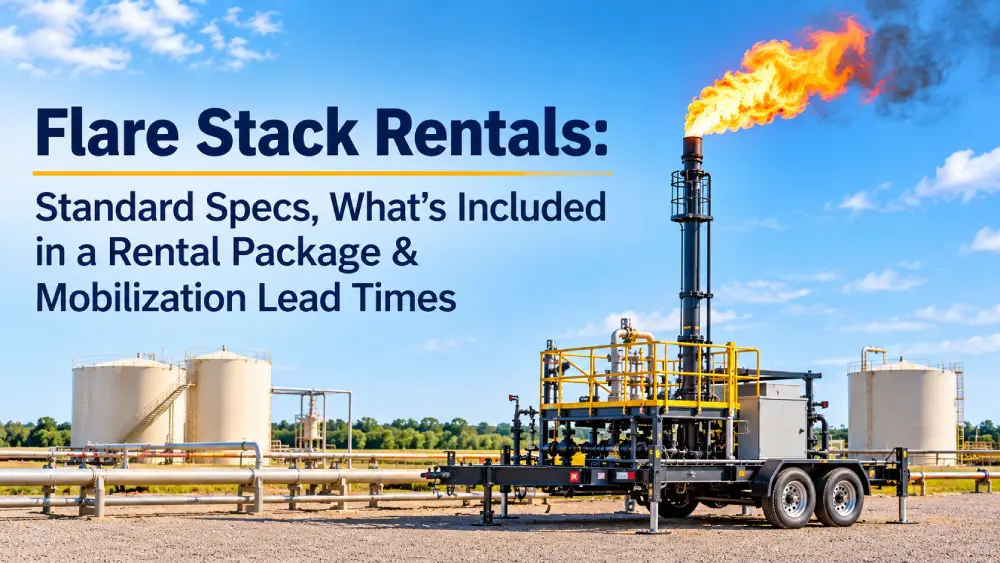
For facilities where vent gas BTU content is too low to sustain stable VCU combustion, low-flow flares provide an alternative control pathway suited to very low volume streams. When vent gas contains condensate with recovery value, BTEX condenser systems recover liquid product while controlling BTEX and VOC emissions, often at a shorter equipment payback period than combustion-only equipment.
7. Regulatory Compliance: State Permits and Federal Requirements for VCUs
Beyond federal Subpart OOOOb requirements, vapor combustor units at affected facilities must meet EPA NSPS recordkeeping and reporting requirements. These include pilot monitoring logs, deviation reports for any operating hours where pilot presence was not confirmed, and semi-annual compliance reports for applicable site categories.
For new construction at oil and gas production sites subject to Subpart OOOOb (construction, reconstruction, or modification after December 6, 2022), compliance obligations apply from the first day of operation. Texas operators must register VCUs with TCEQ under permit-by-rule or standard permit provisions before operation begins. Oklahoma facilities follow ODEQ permitting requirements that parallel the federal Subpart OOOOb framework.
A VCU controlling vent gas from storage vessels at an affected facility also satisfies the control device obligation for associated production equipment that vents into the same closed-vent collection system. Designing the collection piping to consolidate multiple vent streams into a single VCU can reduce total installed equipment count and simplify Subpart OOOOb monitoring obligations.
8. Common Mistakes in VCU Selection and Operation
| Mistake | Why It Hurts Operations or Compliance | Fix |
|---|---|---|
| Sizing for average flow instead of peak displacement flow | VCU overloads during tank filling events, releasing uncontrolled gas | Use peak vapor displacement rate as the design basis, not average daily throughput |
| Selecting natural draft for highly variable BTU gas | Flame instability at low BTU content causes repeated pilot outages | Specify forced draft with air-to-fuel ratio control |
| No automated pilot relight system | Pilot outages become permit deviations without an operator on-site to manually relight | Require integral thermocouple or UV scanner with auto-relight as minimum specification |
| Neglecting turndown requirements | VCU cannot sustain flame at low production rates between tank fills | Specify the full 24-hour flow profile, not just peak capacity |
| Installing without a closed-vent collection system | Open connections allow uncontrolled emissions that defeat OOOOb compliance | Design the collection piping concurrent with the VCU specification |
| Choosing combustion when vapor recovery is economic | VCUs destroy gas that could generate sales revenue or offset facility fuel costs | Evaluate gas recovery payback before defaulting to a combustion control device |
Article Summary
- Vapor combustor units are enclosed, ground-level combustion devices that destroy tank battery and wellhead vent gas at 99% or greater destruction efficiency.
- VCUs differ fundamentally from open elevated flares: they enclose combustion, operate stably at low flow rates, and do not require API 521 radiation setback distances.
- EPA 40 CFR 60 Subpart OOOOb requires VCUs used as control devices to achieve 95% VOC DRE (most units target 99%), maintain a continuously monitored pilot, and satisfy 40 CFR 60.18 operating parameter requirements.
- Correct VCU sizing requires peak flow rate, vent gas BTU content, and turndown ratio. Neglecting the turndown requirement is the most common specification error.
- Natural draft VCUs are effective for stable, higher-BTU vent streams. Forced draft units handle variable BTU gas and achieve higher turndown ratios for intermittent tank battery applications.
- Hero Process Solutions manufactures vapor combustors from Kellyville, OK across the full capacity range, with OOOOb-compliant pilot monitoring integrated from the factory.
- When vent gas has condensate or sales gas recovery value, a VRU or BTEX condenser system should be evaluated before specifying a VCU, since combustion destroys the economic value of the stream.
- VCUs at OOOOb-affected facilities require state registration or construction permits before operation and ongoing monitoring recordkeeping and deviation reporting.
- Consolidating vent streams from multiple tanks and separators into a single closed-vent collection system serving one VCU reduces equipment count and simplifies Subpart OOOOb monitoring obligations.
Frequently Asked Questions
What is a vapor combustor unit used for?
A vapor combustor unit destroys vent gas from storage tanks, production separators, and other low-flow wellhead equipment at oil and gas facilities. The VCU burns waste gas inside an enclosed refractory cylinder at temperatures sufficient to achieve 99% or better hydrocarbon destruction efficiency. Under EPA 40 CFR 60 Subpart OOOOb, VCUs are a standard control device for tank battery vent streams at affected upstream production facilities.
How does a VCU differ from an open flare?
A VCU encloses combustion inside a refractory-lined cylinder, shielding the flame from wind and enabling stable operation at low vent gas flow rates where an elevated flare would extinguish. Open elevated flares burn gas at the tip of a vertical pipe exposed to ambient conditions and are engineered for high-volume emergency and process flows. VCUs are optimized for continuous low-flow service at tank batteries; open flares are the correct device for large-volume emergency relief and process flaring applications.
What are the OOOOb requirements for a vapor combustor unit?
Under EPA 40 CFR 60 Subpart OOOOb, a VCU used as a control device at an affected storage vessel must achieve 95% VOC destruction or removal efficiency, maintain a continuously operating and monitored pilot flame, and meet the combustion operating parameter requirements in 40 CFR 60.18. Operators must keep records confirming pilot presence during all operating hours and report any monitoring deviations within the applicable compliance period.
How do I size a vapor combustor unit?
Size the VCU for peak vent gas flow rate, not average throughput. For storage tanks, peak flow occurs during filling when vapor displacement is highest. Determine the BTU content of the vent gas to confirm whether natural draft is adequate or forced draft is required. Then define the turndown ratio needed to cover minimum expected flow during low-production periods. A forced draft unit with a 15:1 turndown handles tank batteries where vent rates are intermittent and variable across the production day.
Does installing a vapor combustor unit require a permit?
In most states, yes. A VCU installed as an OOOOb control device must be registered with the applicable state air quality agency before operation begins. Texas operators register under TCEQ permit-by-rule or standard permit provisions. Oklahoma facilities follow ODEQ requirements that parallel the federal framework. The specific permitting pathway depends on the facility’s total annual emissions and whether it is subject to major or minor source thresholds under the state program.
When should I choose a vapor recovery unit over a vapor combustor unit?
Choose a vapor recovery unit when the vent gas has commercial recovery value: sufficient BTU content, a viable sales or fuel gas outlet, and a volume that generates a reasonable payback on the VRU equipment cost. VCUs destroy gas that could otherwise generate revenue or offset facility fuel costs. When recovery is not economical due to low flow rates, remote location, or no available gas outlet, a VCU is the correct compliance device for the site.