OIL & GAS EQUIPMENT | Updated November 2026 | 7 min read
WHAT YOU’LL LEARN IN THIS GUIDE
- When renting a flare makes more financial sense than purchasing one outright
- Which rental flare configurations are available for upstream, midstream, and emergency applications
- How EPA 40 CFR 60 Subpart OOOOb compliance requirements apply to temporary rental flare operations
- What is included in a full-service Hero Process Solutions rental package
- How to calculate total rental cost versus capital acquisition cost
- Common specification mistakes that lead to undersized or non-compliant rental flares
- How flare type selection — low flow, air-assist, portable — affects rental cost and lead time
A rental flare is the fastest path to compliant combustion when a production schedule, emergency relief event, or temporary workover cannot wait for a capital equipment procurement cycle. For upstream operators in the Permian Basin and midstream processors running seasonal or turnaround operations, combustion equipment rental eliminates the upfront capital cost while delivering the same EPA-compliant performance as owned equipment. The challenge is matching the right rental configuration to actual gas volumes, composition, and site conditions — a step most operators underestimate until a flare runs smoky or trips offline.
Hero Process Solutions, founded in 2011 and headquartered in Kellyville, OK with operations in Midland, TX, manufactures and rents combustion equipment across the full range of oil and gas applications. Their industrial flare systems product line spans portable trailer-mounted units for temporary well site operations through high-capacity air-assist flares for facility turnarounds, with rental inventory available on short lead times for projects that cannot wait on fabrication schedules.
DIRECT ANSWER: Rental Flare
A rental flare is a combustion unit leased for a fixed term — typically 30 to 90 days or longer — to handle waste gas during well completions, plant turnarounds, pipeline tie-ins, or emergency relief scenarios. Under EPA 40 CFR 60 Subpart OOOOb, rental flares must achieve the same minimum 98% VOC destruction efficiency as permanently installed units; compliance obligations are not waived for temporary operations. Hero Process Solutions provides rental flares from portable low-flow units rated for less than 2 MMscfd through trailer-mounted air-assist systems capable of handling high-BTU gas streams with smokeless combustion.
1. How a Rental Flare Program Works in Oil & Gas Operations
A rental flare program begins with a sizing conversation, not a sales call. Before any unit leaves the yard, the combustion vendor needs three numbers: maximum instantaneous flow rate (MMscfd or MMBtu/hr), gas heating value (BTU/scf), and the composition — specifically hydrogen sulfide content and liquid carryover potential. Operators who skip this step and rent by trailer size alone frequently discover their unit is undersized at peak flow or oversized for normal operating conditions, which degrades combustion efficiency and raises per-day cost.
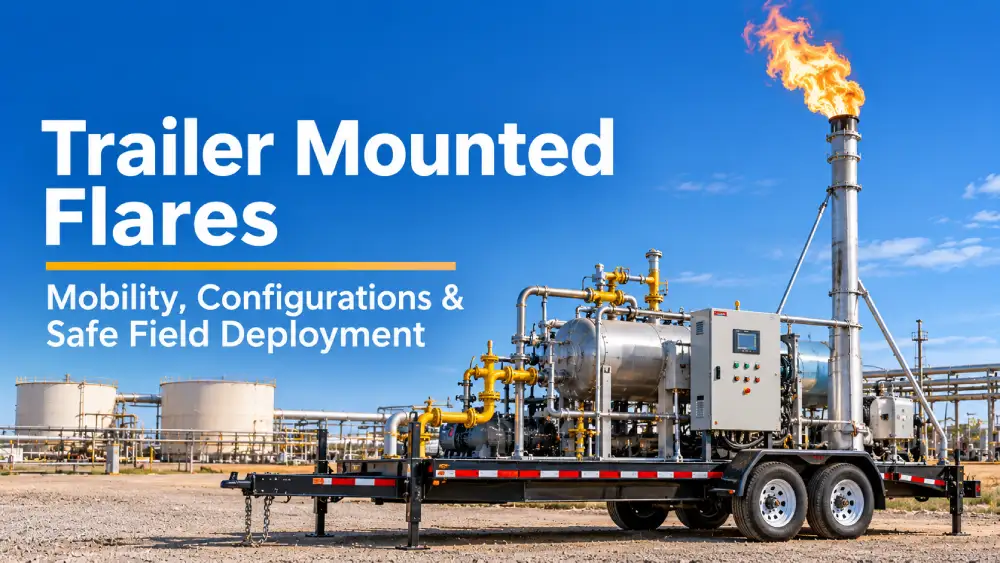
Once sizing is confirmed, a full-service rental program typically covers delivery, installation, commissioning, and removal. Hero Process Solutions’ portable flares are skid-mounted or trailer-mounted for rapid deployment to remote well sites, with integrated pilot ignition, knockout drum, and pressure relief piping designed to meet NFPA 58 and API Standard 537 requirements out of the box. This matters for operators who lack in-house combustion engineering support and need a compliant system without custom engineering on a tight schedule.
KEY INSIGHT
The EPA Natural Gas STAR program tracks methane emission reduction across the oil and gas supply chain. Rental flares used for well completions and workovers count toward an operator’s voluntary methane reduction targets only when combustion efficiency is documented — which requires a compliant pilot design and ignition system, not just a burning tip.
2. Rental Flare vs. Owned Flare: Key Decision Factors
The rent-versus-buy decision hinges on three variables: operational duration, utilization frequency, and capital allocation priorities. For a 60-day well completion program or a single annual plant turnaround, rental unit economics are typically favorable once maintenance, storage, and mobilization costs for owned equipment are factored in. For operators running continuous flaring at a gathering facility with predictable gas volumes, capital acquisition generally delivers better economics over a 10-year horizon.
| Scenario | Recommended Approach | Reason |
|---|---|---|
| Well completion, 30–90 days | Rental flare | No capital outlay; mobilization in days |
| Plant turnaround, 2–6 weeks | Rental flare | Avoids long-term asset for infrequent use |
| Emergency gas relief, indefinite | Rental flare (immediate) then purchase | Rental bridges to permanent equipment |
| Continuous production facility | Owned flare | Lower 10-year total cost of ownership |
| Pilot program, new asset type | Rental flare | Evaluate performance before committing capital |
Hero Process Solutions field services and commissioning support is available for both rental and owned equipment, which matters when an operator’s maintenance crew has no prior experience with the specific flare configuration being deployed.
3. Available Rental Flare Configurations
Not all rental flares handle the same gas streams. Configuration selection starts with BTU content and liquid carryover risk:
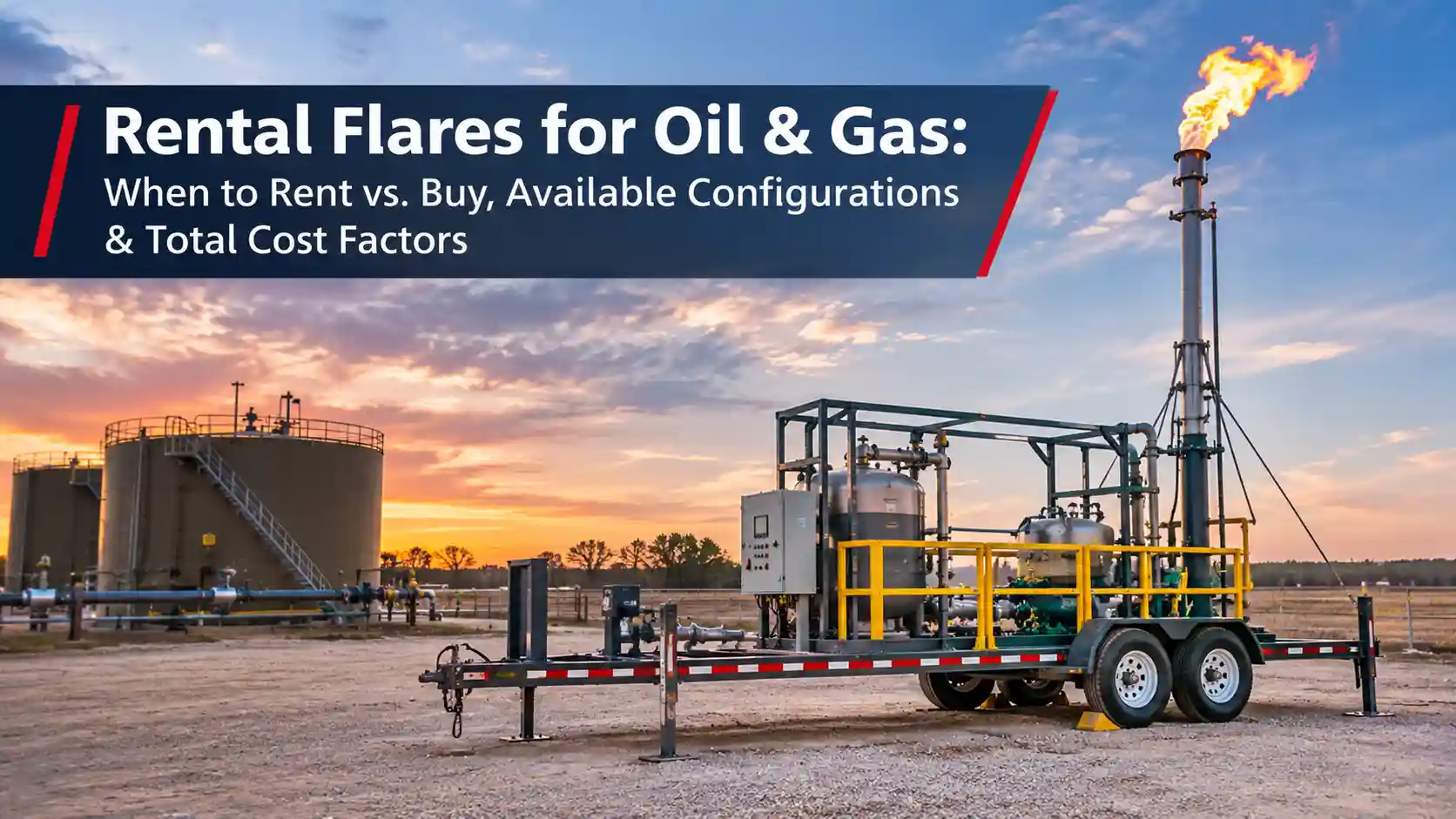
- Portable Low-Flow Flares: Designed for gas streams below 2 MMscfd from individual well sites, tank batteries, and produced water operations. These units are trailer-mounted, single-pilot, and sized for the lean gas compositions common in Permian Basin midstream operations. Hero Process Solutions’ low flow flares are available in rental configurations with integrated knockout drums and pilot gas supply.
- Air-Assist Rental Flares: Required for high-BTU gas streams where smokeless combustion is a permit condition. The air-assist mechanism entrains ambient air into the combustion zone, extending the smokeless capacity range without requiring steam supply. Suitable for gas plants, compressor stations, and high-liquid-content production streams.
- Vapor Combustion Units (VCU): Enclosed combustors for low-pressure, low-flow applications where open-flame flaring is not permitted or where local air quality regulations impose visible emission limits. VCUs achieve 99.5% or greater thermal destruction efficiency at flow rates from 50 to 500 MSCFD.
- Emergency Utility Flares: High-flow capacity units for plant-wide emergency relief. These rental flares are sized for maximum credible relief scenarios and must meet OSHA PSM requirements under 29 CFR 1910.119 for covered facilities.
4. What’s Included in a Hero Process Solutions Rental Package
A turnkey rental package from Hero Process Solutions covers the flare unit, knockout drum or liquid knockout system, pilot assembly with UV flame detection, ignition system, delivery to site, installation support, and removal at term end. Optional add-ons include on-site commissioning, operator training, and periodic inspection under a preventive maintenance schedule.
What is not included unless specifically contracted: pipeline tie-in work, local permit applications, and regulatory reporting under 40 CFR 98 (Mandatory Greenhouse Gas Reporting). Operators are responsible for emission inventory reporting on rental flare operations the same as on owned equipment — combustion efficiency documentation is the operator’s obligation, not the rental vendor’s.
5. EPA 40 CFR 60 Subpart OOOOb Compliance for Rental Flare Operations
Under 40 CFR 60 Subpart OOOOb, the EPA methane and VOC rules covering oil and natural gas operations, rental flares used at affected facilities must achieve 98% VOC combustion efficiency. The rule does not exempt temporary or rental equipment from efficiency standards, flare design requirements, or monitoring obligations.
Key compliance requirements that apply to rental flare operations:
- Minimum net heating value at the flare tip: 270 BTU/scf for unassisted flares
- Visible emissions limit: no more than 5 minutes in any 2-hour observation period
- Pilot flame monitoring: continuous flame detection required; unlit pilots must trigger automatic shutdown or alarm
- Flow monitoring: for flares subject to quarterly reporting, continuous or periodic flow measurement is required
- Recordkeeping: operators must document flare operating hours, gas flow rates, and combustion efficiency calculations for each reporting period
Hero Process Solutions’ EPA 40 CFR 60 Subpart OOOOb compliance resources include application-specific guidance for matching rental equipment to regulatory requirements. Operators running workovers or completions at affected facilities should confirm whether their rental unit’s design documentation meets 40 CFR 60.5413b pilot design specifications before mobilization.
CRITICAL RULE
Renting a flare does not transfer OOOOb compliance obligations to the rental vendor. The well or facility operator remains the responsible party for emission monitoring, recordkeeping, and regulatory reporting under 40 CFR 60 Subpart OOOOb regardless of equipment ownership status. Confirm your rental unit’s design documentation includes pilot specifications that meet 40 CFR 60.5413b before the first gas introduction.
6. Total Cost Factors for Renting a Flare System
The base day rate for a rental flare covers the unit itself. Total project cost includes mobilization (delivery and rigging), commissioning labor if on-site support is included, consumables (pilot gas, igniter cartridges), demobilization, and any maintenance calls during the rental term. For well completions running 45 to 60 days, all-in costs are typically 30 to 50 percent of what a comparable purchased unit would cost new, before accounting for owned-unit storage and maintenance between uses.
Operators who run multiple completions per year on a planned schedule may find that a rental agreement with a fixed annual rate and priority availability is more cost-effective than per-event rentals at spot rates, particularly when regional rental inventory is tight during active drilling seasons in the Permian Basin or DJ Basin.
7. Common Mistakes in Rental Flare Selection
| Mistake | Why It Hurts Operations / Compliance | Fix |
|---|---|---|
| Sizing by trailer size instead of flow rate | Unit runs smoky at peak flow; visible emission violation | Calculate max instantaneous flow rate before spec’ing unit |
| Ignoring H2S content in gas composition | SO2 emissions may require air permit; risk of exceeding emission limits | Provide full gas chromatograph to vendor before mobilization |
| No liquid knockout drum on liquid-rich streams | Liquid carryover to tip causes flameout and uncontrolled emissions | Require knockout drum in rental package spec |
| Renting a unit without UV flame detection | Unlit pilot cannot be detected; unburned gas venting to atmosphere violates OOOOb | Confirm pilot monitoring type before delivery |
| Assuming rental means no compliance obligation | OOOOb applies to operators, not equipment owners; non-reporting creates enforcement exposure | Establish monitoring and recordkeeping plan before first gas introduction |
Internal Linking Plan
| # | Anchor Text | Target URL | Placement Section |
|---|---|---|---|
| 1 | combustion equipment rental | https://heroprocesssolutions.com/rentals/ | Opening paragraph |
| 2 | industrial flare systems | https://heroprocesssolutions.com/flares/ | Second paragraph |
| 3 | portable flares | https://heroprocesssolutions.com/portable-flares/ | Section 1 |
| 4 | field services and commissioning | https://heroprocesssolutions.com/field-services/ | Section 2 |
| 5 | low flow flares | https://heroprocesssolutions.com/low-flow-flares/ | Section 3 |
| 6 | EPA 40 CFR 60 Subpart OOOOb compliance | https://heroprocesssolutions.com/oooob-c/ | Section 5 |
| 7 | markets and industries served | https://heroprocesssolutions.com/markets/ | FAQ section |
External Linking Plan
| # | Anchor Text | Target URL | Placement Section |
|---|---|---|---|
| 1 | EPA Natural Gas STAR program | https://www.epa.gov/natural-gas-star-program | Key Insight box, Section 1 |
| 2 | 40 CFR 60 Subpart OOOOb | https://www.ecfr.gov/current/title-40/chapter-I/subchapter-C/part-60/subpart-OOOOb | Section 5 |
| 3 | API Standard 537 | https://api.org/standards | Section 1 |
Article Summary
- A rental flare delivers compliant combustion on short lead times for well completions, plant turnarounds, and emergency relief without upfront capital acquisition costs
- EPA 40 CFR 60 Subpart OOOOb applies to rental flare operations the same as owned equipment — compliance is the operator’s obligation regardless of equipment ownership
- Rental unit sizing starts with maximum instantaneous flow rate and gas BTU content, not trailer size or physical footprint
- Hero Process Solutions rents portable low-flow flares, air-assist flares, vapor combustion units, and emergency utility flares with integrated knockout and pilot systems
- A full turnkey rental includes delivery, installation support, and removal; monitoring, permitting, and emission reporting remain the operator’s responsibility
- The rent-versus-buy decision favors rental for durations under 90 days or for infrequent applications like annual turnarounds
- Liquid-rich gas streams require a knockout drum in the rental package specification; omitting it risks flameout and uncontrolled emission events
- UV flame detection and continuous pilot monitoring are OOOOb compliance requirements that apply to rental flares at affected facilities
- Visible emission limits — 5 minutes per 2-hour observation period — apply to temporary and rental flares operating at OOOOb-affected sources
Frequently Asked Questions
How much does it cost to rent a flare?
Rental flare pricing depends on unit capacity, term length, and what is included in the package. Small portable low-flow units for well site completions typically run in the range of $3,000 to $8,000 per month for base unit rental; air-assist systems for higher-flow applications run significantly more. Full turnkey packages including delivery, commissioning, and removal will add to that base rate. Contact Hero Process Solutions directly for a site-specific rental quote — combustion equipment pricing is application-dependent and cannot be meaningfully quoted without flow rate and gas composition data.
Can I rent a flare for a well completion in the Permian Basin?
Yes. Hero Process Solutions operates out of Midland, TX with rental flare inventory for Permian Basin well completion and workover applications. Lead times for trailer-mounted portable flares are typically shorter than for custom-fabricated units. Rental units are sized and configured to EPA OOOOb standards for Permian Basin gas compositions, which often include significant liquid hydrocarbon content that requires knockout separation before the flare tip.
Do rental flares have to comply with EPA OOOOb?
Yes. EPA 40 CFR 60 Subpart OOOOb does not distinguish between owned and rented combustion equipment. The well or facility operator is the regulated entity, and all applicable standards — combustion efficiency, pilot monitoring, visible emissions, and recordkeeping — apply regardless of whether the flare is owned or rented. The operator must confirm that any rental unit they deploy meets the design specifications in 40 CFR 60.5413b before introducing gas.
What is the difference between a rental flare and a vapor combustor unit?
An open-tip rental flare combusts gas in an elevated, exposed flame at atmospheric pressure. A vapor combustion unit (VCU) is an enclosed combustor that destroys low-pressure, low-flow gas streams at higher destruction efficiencies — typically 99.5% or greater — without a visible flame. VCUs are preferred where local air quality rules restrict visible emissions or where low-flow tank battery gas does not have enough energy to sustain a stable open flare flame. Both can be rented; application and gas volume determine which is appropriate.
What industries does Hero Process Solutions serve with rental flares?
Hero Process Solutions serves upstream oil and gas production, midstream gas processing and gathering, refining, petrochemical operations, and pipeline facilities with rental combustion equipment. For a full breakdown of markets and industries served, including sector-specific equipment configurations, see the HPS markets page.