
OIL & GAS EQUIPMENT | Updated October 2026 | 8 min read
WHAT YOU’LL LEARN IN THIS GUIDE
- How vapor combustor units destroy hydrocarbon vapor and why that matters for tank battery compliance
- The core technical differences between enclosed combustors and open elevated flares
- How to size a VCU correctly for your waste gas flow rate and Btu content
- What EPA 40 CFR 60 Subpart OOOOb requires from enclosed combustion devices
- Which state-level rules apply in Texas and Oklahoma beyond the federal standard
- Common VCU specification errors that cause permit failures and operational shutdowns
- Hero Process Solutions VCU configurations for upstream and midstream applications
Vapor combustor units are enclosed, ground-level combustion devices that destroy hydrocarbon vapor from tank batteries, produced water vessels, and other low-pressure storage equipment. Under EPA 40 CFR 60 Subpart OOOOb, production sites with affected storage vessels must achieve 95% overall hydrocarbon reduction or route emissions to a control device that achieves 98% combustion efficiency. Hero Process Solutions’ vapor combustors are built to meet that 98% destruction efficiency threshold, and selecting the right unit requires matching device capacity to your site’s actual waste gas composition and flow.
Hero Process Solutions, founded in 2011 and headquartered in Kellyville, Oklahoma, with operations in Midland, Texas, manufactures both open flare systems and enclosed combustors for the upstream oil and gas sector. The decision between these two equipment categories is not always obvious. Waste gas volume, composition, regulatory classification of the control device, and site visibility constraints all feed into the selection. This guide covers the technical and regulatory criteria that distinguish vapor combustor units from open flares.
DIRECT ANSWER: Vapor Combustor Units
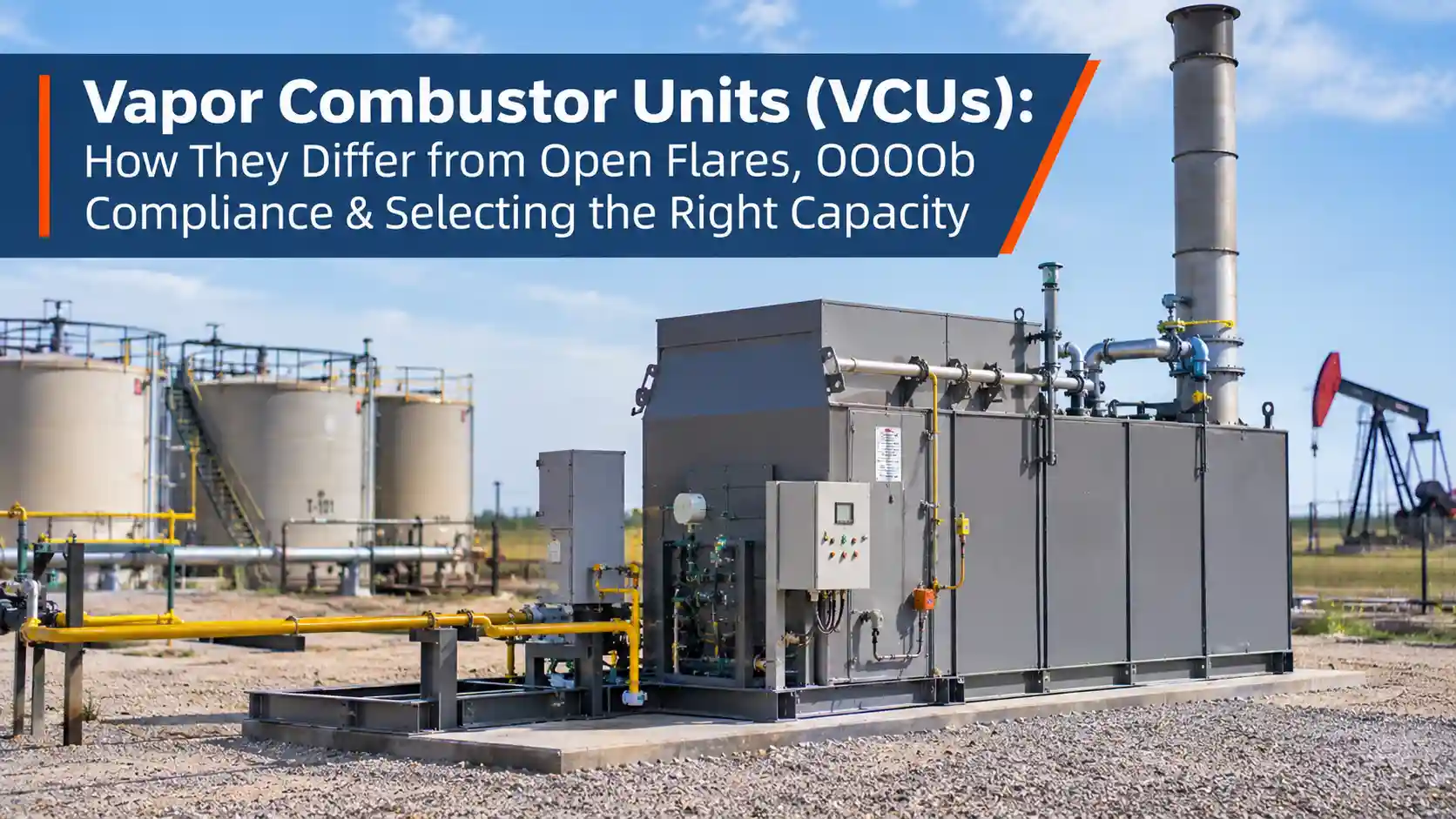
Vapor combustor units are enclosed combustion devices that destroy hydrocarbon vapor at temperatures typically between 1,400°F and 1,600°F, achieving 98% or greater destruction efficiency as required by EPA 40 CFR 60 Subpart OOOOb. Unlike open elevated flares, vapor combustor units are ground-mounted, enclose the flame completely, and are classified as enclosed combustion devices under the OOOOb rule, which affects how combustion efficiency must be demonstrated and monitored. Proper sizing requires knowing the site’s maximum vapor generation rate in standard cubic feet per hour (SCFH) and the Btu content of the waste gas.
1. What Is a Vapor Combustor Unit and How Does It Work?
A vapor combustor unit is a firebox-style combustion device designed to accept low-pressure vapor streams from atmospheric storage tanks, separators, and other upstream process vessels. The vapor enters a refractory-lined combustion chamber where a continuous pilot flame ignites the gas. Combustion occurs inside an enclosed firebox rather than at an open tip, so the flame is not visible from the surrounding area. This matters for sites near populated areas or with visual pollution concerns.
The combustion chamber holds the burning gas long enough to achieve the required destruction efficiency. Residence time at elevated temperature is the key design variable. Most VCUs targeting EPA compliance maintain a minimum temperature of 1,400°F with a residence time of 0.5 to 1.0 second in the combustion zone. Inlet vapor composition drives the combustion temperature: lean streams with low Btu content may require supplemental fuel gas to maintain the setpoint.
KEY INSIGHT
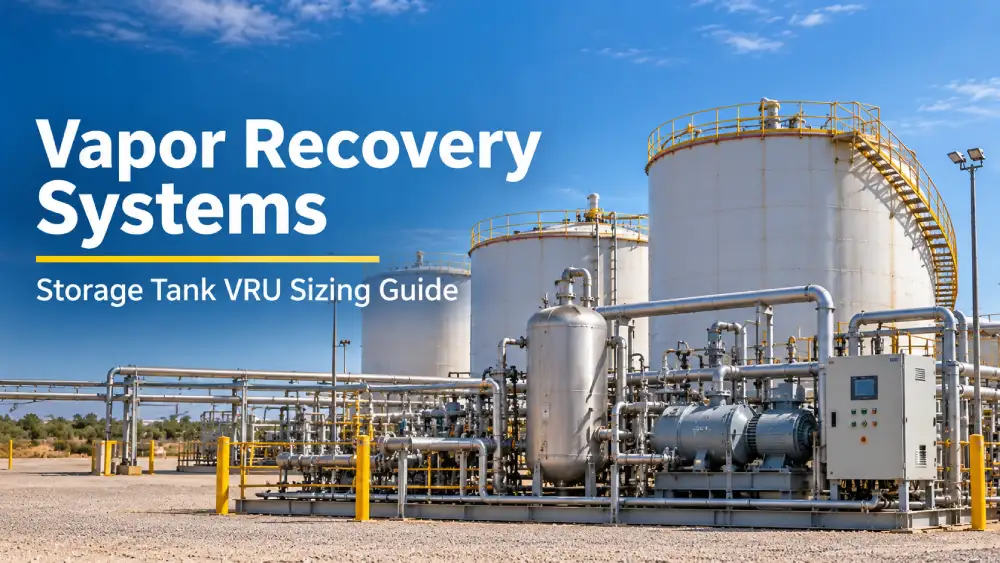
Vapor recovery systems and vapor combustor units serve related but different purposes. A VRU captures vapors for reuse or sale; a VCU destroys them. Sites with high-value gas streams often evaluate VRUs first. If the vapor quality is too poor for recovery, or the economics do not work, a VCU is the next-best compliance option for tanks regulated under Subpart OOOOb.
2. Vapor Combustor Units vs. Open Flares: Key Technical Differences
The core difference between vapor combustor units and open flares is the combustion environment. An open flare burns waste gas at the tip of an elevated stack, exposed to atmospheric air and wind. A VCU burns it inside an insulated firebox with a controlled air-to-fuel ratio. This affects combustion efficiency, visible emissions, monitoring requirements, and the regulatory classification of the device under 40 CFR 60.
| Feature | Vapor Combustor Unit | Open Elevated Flare |
|---|---|---|
| Combustion enclosure | Fully enclosed firebox | Open tip, exposed flame |
| Destruction efficiency | 98%+ with proper sizing | 98%+ with assist (steam/air/gas) |
| Visible flame | No (internal flame) | Yes |
| Regulatory class (OOOOb) | Enclosed combustion device | Flare (subject to API 537) |
| Pilot monitoring | Thermocouple in firebox | Tip thermocouple or camera |
| Typical application | Storage tanks, low-pressure vapor | Relief, high-volume, emergency |
Open flares, including emergency utility flares, handle high-volume relief and emergency depressuring. They are not practical for continuous low-rate tank vapor control because maintaining combustion efficiency at very low flow rates is difficult with an open tip design. VCUs, by contrast, are built specifically for the low-flow, continuous-operation use case that defines upstream storage tank vapor control.
3. VCU Capacity Selection: Matching Unit Size to Your Waste Gas Stream
Sizing a vapor combustor unit starts with the maximum design flow rate for the site. This is not the average rate. It is the peak vapor generation that occurs during the hottest part of the day in summer, when tanks are filling fastest. Undersizing a VCU causes backpressure on the vapor collection system, which can open pressure-vacuum valves and release uncaptured emissions.
The key inputs for VCU sizing are: maximum vapor generation rate in SCFH, the lower heating value (LHV) of the waste gas in BTU/SCF, the required combustion temperature setpoint, and any turndown requirements for the site’s low-flow periods. For sites with highly variable production rates, a VCU with a modulating burner or staged combustion capacity handles the range without wasting fuel gas on a unit running at a fraction of its rated capacity.
Hero Process Solutions’ field services team conducts site surveys to gather the vapor composition and flow data needed for proper unit selection. Do not rely on generic rule-of-thumb sizing. Tank vapor composition varies widely between formations and even between wells in the same field. A unit sized for one crude composition may underperform significantly on a different stream.
4. EPA 40 CFR 60 Subpart OOOOb Compliance Requirements for VCUs
EPA 40 CFR 60 Subpart OOOOb establishes New Source Performance Standards for methane and VOC emissions from the oil and natural gas sector, including storage vessels at production sites. An affected storage vessel requires either vapor recovery to 95% overall reduction or routing to a control device achieving 98% combustion efficiency. Vapor combustor units fall under the enclosed combustion device category, which carries specific performance demonstration and monitoring requirements distinct from those for open flares.
For enclosed combustion devices under OOOOb, the owner or operator must maintain the device operating temperature at or above the level established in a performance test demonstrating 98% efficiency. Continuous temperature monitoring is required using a thermocouple in the combustion zone. The pilot flame must be continuously operating, and a pilot flame monitoring device must generate an alarm if the pilot goes out during an operating period.
Hero Process Solutions’ OOOOb compliance resource page covers the full monitoring and recordkeeping requirements. Key records the operator must maintain include: continuous temperature logs, pilot status records, startup and shutdown logs, and documentation of any deviation events and corrective actions taken. These records form the foundation of an inspection response and any state-level permit compliance demonstration.
CRITICAL RULE
A VCU used as a control device under Subpart OOOOb must have its operating temperature setpoint established through an EPA-accepted performance test. Operating below that temperature setpoint, even briefly, constitutes a deviation under the standard and must be reported. Do not assume that a unit designed for 1,400°F is automatically compliant; the temperature must be demonstrated in the as-installed configuration with your actual waste gas.
5. Hero Process Solutions VCU Configurations and Applications
Hero Process Solutions manufactures vapor combustor units in multiple configurations to match the range of upstream and midstream waste gas streams. Standard units cover vapor generation rates from small single-tank applications to multi-tank battery installations. All units include a continuous pilot flame system, thermocouple-based temperature monitoring compatible with OOOOb recordkeeping requirements, and refractory lining rated for sustained operation at combustion temperatures. Aftermarket support includes replacement refractory, thermocouple assemblies, and pilot tip components.
For sites regulated under EPA’s oil and natural gas air pollution control program, Hero Process Solutions can provide performance test support, operating temperature recommendations, and documentation packages supporting state permit applications. Units are available for permanent installation and for rental applications where a short-term control solution is needed during facility construction or equipment changeover.
6. State Regulations and Industry Standards for VCU Operation
Texas and Oklahoma, where most Hero Process Solutions VCUs are deployed, both impose state-level vapor control requirements for storage tanks that may be more stringent than, or structured differently from, the federal OOOOb standard. Texas Commission on Environmental Quality rules under 30 TAC Chapter 115 address VOC emissions from storage vessels at crude oil and condensate facilities. Oklahoma Department of Environmental Quality rules mirror federal OOOOb language but include state permit conditions that must be tracked separately from federal recordkeeping. Operators with tanks in both states face two parallel compliance programs.
Industry standards also apply to VCU design and operation. API standards for combustion equipment provide design guidance that regulators reference during permit reviews. NFPA 85 covers combustion system safety requirements relevant to enclosed combustors. Following these standards during VCU procurement is a sound basis for defending design choices during state agency reviews.
7. Common VCU Specification and Operational Mistakes
| Mistake | Why It Hurts Operations/Compliance | Fix |
|---|---|---|
| Sizing to average flow, not peak | Backpressure opens PV valves; uncaptured emissions create OOOOb deviations | Use maximum summer-day vapor generation rate as design flow |
| Not accounting for Btu content variation | Low-Btu streams fail to sustain 1,400°F setpoint without supplemental fuel | Test vapor composition; specify supplemental gas burner for lean streams |
| Operating without continuous pilot monitoring | Pilot outage creates uncontrolled period; OOOOb requires alarm on pilot loss | Install thermocouple on pilot; wire alarm to SCADA or control panel |
| Skipping performance test after installation | No documented operating temperature setpoint; compliance cannot be demonstrated | Conduct stack test on installed unit; establish compliant operating temperature setpoint |
| No turndown capacity for low-flow periods | Oversupplied combustion air at low flow quenches flame; efficiency drops below 98% | Specify modulating air or staged combustion for wide flow ranges |
8. Article Summary
- Vapor combustor units destroy hydrocarbon vapor from storage tanks inside an enclosed firebox, achieving 98%+ combustion efficiency at temperatures of 1,400°F to 1,600°F.
- Under EPA 40 CFR 60 Subpart OOOOb, enclosed combustion devices must demonstrate and continuously monitor the operating temperature established in a performance test.
- VCUs differ from open flares in that the flame is enclosed, the device is ground-mounted, and it is classified differently under OOOOb for monitoring and permit purposes.
- VCU capacity must be sized to peak vapor generation rate, not average flow. Undersizing causes backpressure and uncontrolled emissions; oversizing wastes fuel and may cause flame instability.
- Pilot flame monitoring is a federal requirement under OOOOb. An alarm must activate if the pilot flame goes out during an operating period.
- Texas and Oklahoma each have state vapor control rules that run parallel to OOOOb and must be tracked separately in site compliance programs.
- Hero Process Solutions designs VCUs with refractory combustion chambers, continuous temperature monitoring, and aftermarket support for long-term compliance operations.
- API standards and NFPA 85 provide additional design guidance that regulators reference during permit reviews for enclosed combustion devices.
Frequently Asked Questions
What combustion efficiency do vapor combustor units achieve under OOOOb?
EPA 40 CFR 60 Subpart OOOOb requires a control device used for storage vessel vapor control to achieve 98% combustion efficiency. A properly sized and operated vapor combustor unit meets this threshold. The efficiency must be demonstrated through a performance test on the installed unit operating at the site’s actual waste gas composition and flow rate. Operating temperature must then be maintained at or above the level documented in that test.
How do I determine the right VCU size for my tank battery?
Size the unit to your maximum design vapor generation rate, which is the peak rate expected on the hottest day of the year when tanks are filling fastest. Obtain a vapor composition sample to determine the Btu content. Low-Btu gas (below 300 BTU/SCF) typically requires supplemental fuel gas to maintain the required combustion temperature. If your site’s flow rate varies widely between low and peak production, specify a unit with modulating combustion air or staged firing capacity to handle the full operating range.
Can a vapor combustor unit replace a flare on a storage tank?
Yes, for storage tank vapor control applications, a VCU is a direct regulatory substitute for an open flare under Subpart OOOOb, provided the VCU meets the 98% combustion efficiency requirement. The monitoring requirements differ between enclosed combustion devices and flares under the rule, so the operating plan and permit must reflect the VCU’s classification. VCUs are generally preferred over open flares for continuous low-flow tank vapor applications because they are easier to maintain at high efficiency across a wide flow range.
What is the difference between a vapor combustor and a vapor combustor unit?
The terms are used interchangeably in the oil and gas industry. A vapor combustor refers to the enclosed combustion device itself. Vapor combustor unit (VCU) is the more precise term used in regulatory documents and equipment specifications, emphasizing that the device is a packaged unit with burner, firebox, controls, and pilot system. Some operators use enclosed combustor or enclosed combustion device, which are the regulatory terms used in 40 CFR 60 Subpart OOOOb.
Does a VCU require a stack test every year?
The OOOOb standard requires an initial performance test to establish the operating temperature setpoint for 98% combustion efficiency. Retesting is required if the unit is modified in a way that could change performance, or if the operating conditions change materially from those documented in the original test. Ongoing compliance is demonstrated through continuous temperature monitoring rather than annual retesting. Your state air permit may impose additional testing requirements beyond the federal baseline; review both your OOOOb applicability determination and your state operating permit before establishing a testing schedule.