
OIL & GAS EQUIPMENT | Updated May 2026 | 8 min read
What You’ll Learn in This Guide
- The mechanical and performance difference between enclosed and open flares
- When enclosed flares (vapor combustors, enclosed ground flares) win on selection
- When open flares (air-assist, sonic, gas-assist, utility) remain the right choice
- How visible flame, noise, and site location affect the selection decision
- How OOOOb DRE requirements interact with the enclosed vs open choice
- CAPEX and OPEX comparison between the two configurations
- Common selection mistakes when choosing between enclosed and open flares
“Enclosed flare” and “open flare” describe two fundamentally different approaches to combusting waste gas. Both deliver hydrocarbon destruction, but they differ on how they accomplish it, what they look like, what they sound like, and where they fit in a site layout. For operators choosing between them at upstream tank batteries, midstream processing facilities, refineries, and petrochemical plants the right answer depends on inlet stream characteristics, site location, neighbor proximity, regulatory rule set, and OPEX tolerance. This guide walks through the selection framework with specific examples of when each configuration wins.
Hero Process Solutions, founded in 2011 and headquartered in Kellyville, Oklahoma with operations in Midland, Texas, manufactures both industrial flare systems (open flares: air-assist, sonic, gas-assist, utility, portable, low flow) and vapor combustors (enclosed flares / enclosed ground flares) for the full range of oil and gas, refining, and petrochemical applications. This guide draws on the selection patterns we see most often.
DIRECT ANSWER: Choose an enclosed flare (vapor combustor, enclosed ground flare) when the site is near neighbors, requires hidden flame for permitting or community reasons, has continuous low-pressure vent gas service, or needs OOOOb 98% DRE compliance on storage tank vent and flash gas. Choose an open flare (air-assist, sonic, gas-assist, utility) for emergency relief service, high-pressure or high-volume relief, remote sites without neighbor visibility concerns, and applications where lower CAPEX is the priority. Many facilities use both: enclosed combustor for routine vent gas control, open flare for emergency relief and excursions.
1. Mechanical and Performance Difference
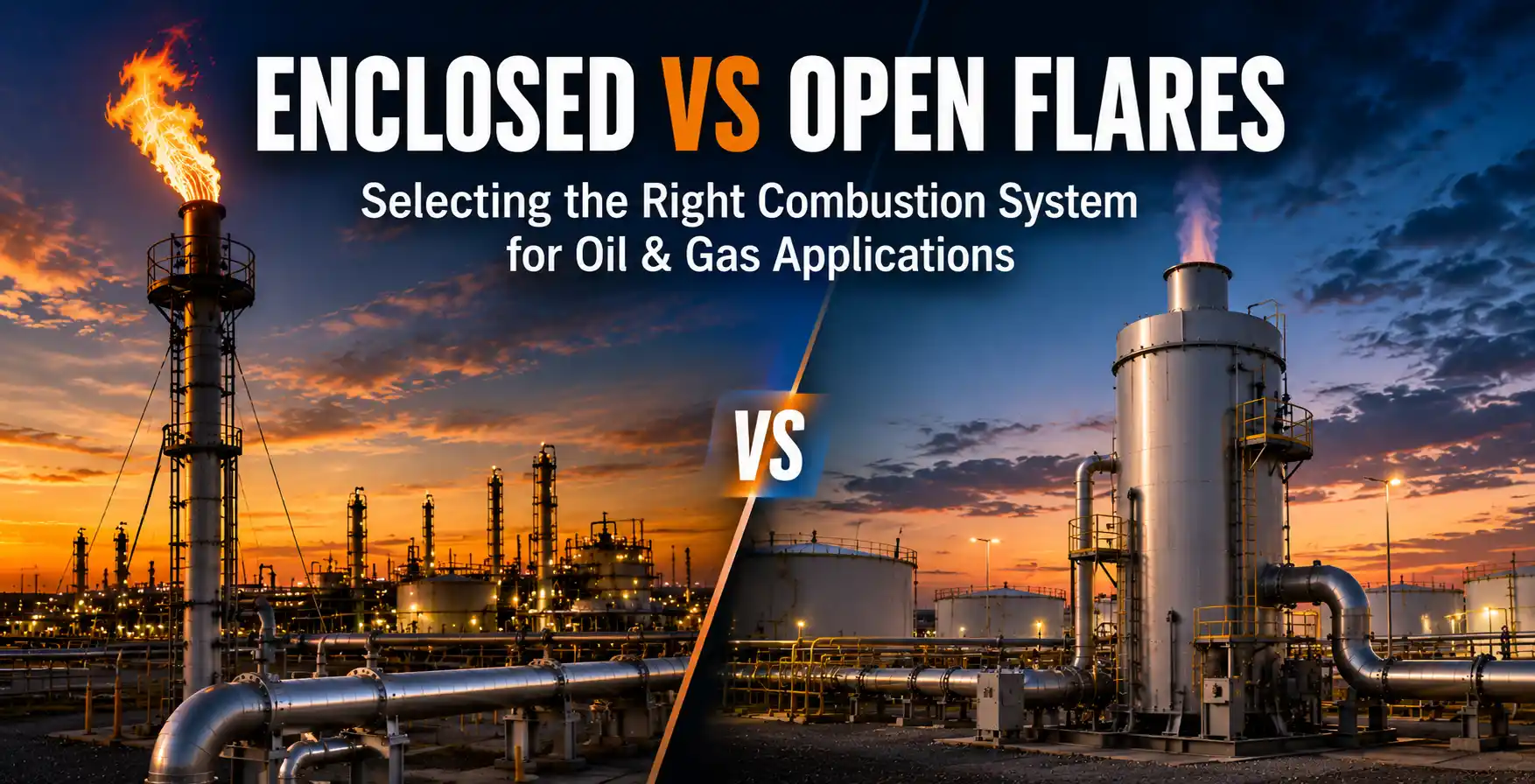
An open flare burns waste gas at an exposed flame on top of a stack. Combustion happens in the atmosphere around the flare tip, with combustion air drawn in from the surrounding atmosphere. Tip design (sonic, air-assist, gas-assist, steam-assist, or open-pipe) controls mixing and combustion completion. Stack height is set by API Standard 521 thermal radiation criteria and dispersion modeling.
An enclosed flare burns waste gas inside a refractory-lined combustion chamber. The chamber holds combustion temperature at 1,800 to 2,000°F by insulation, controls residence time by chamber volume, and supplies combustion air via natural draft or forced-draft blower. The chamber typically vents to atmosphere through a stack at the top, but the flame itself is contained inside the refractory.
Both configurations can reach 98% Destruction and Removal Efficiency on hydrocarbon vent gas under OOOOb. The mechanical difference is where combustion happens (atmosphere vs chamber) and how mixing is controlled (tip geometry vs burner-chamber combination).
2. When Enclosed Flares Win
Enclosed flares (vapor combustors, enclosed ground flares) win on five specific application categories.
Neighbor proximity. Sites near residential or commercial property within visual range of the stack benefit from the hidden flame of an enclosed combustor. Open flames create permit objections and community pushback that compound across the operating life of the facility.
Continuous storage tank vent and flash gas service. The combination of low-pressure, low-Btu inlet streams and 24/7 operation is exactly where Quad O Certified Enclosed Combustor designs are tested and certified. The certified envelope simplifies OOOOb compliance documentation.
Noise-sensitive sites. Air-assisted flares with high-horsepower blowers and high-velocity tip exits are loud. Enclosed combustors with refractory-dampened combustion are noticeably quieter. For sites near offices, residential areas, or wildlife refuges, the noise difference is operationally significant.
Low-pressure, low-Btu streams. Streams with insufficient heating value (below 100 Btu/scf) for self-sustained combustion on an open flare often run cleanly through an enclosed combustor with supplemental fuel gas at the burner. The enclosed chamber holds combustion temperature regardless of inlet variability.
Permit-driven specification. Some state air permits or municipal ordinances specifically prohibit open flames or specify enclosed combustion for storage tank vent gas service. Enclosed combustors are the only compliant choice in those jurisdictions.
KEY INSIGHT: The enclosed flare’s hidden flame is often the deciding factor regardless of cost economics. A 10% CAPEX premium on an enclosed combustor is easier to defend than a 10-year permit fight with neighbors over visible flame. Site location and neighbor visibility should be the first selection question, not the last.
3. When Open Flares Win
Open flares win on five different application categories.
Emergency relief service. Worst-case API 521 contingency relief loads (fire case, power loss, blocked outlet) are often in the millions of pounds per hour range. Open utility flares are the standard answer for emergency-only service because they can be sized for very high peak flow without the chamber-volume scaling issues that limit enclosed combustor capacity.
High-pressure relief streams. Sonic flares using Coanda-effect tips and high inlet pressure (15+ psig sustained) deliver smokeless combustion without auxiliary air, steam, or blower OPEX. Enclosed combustors do not have a comparable high-pressure capture mechanism.
Remote upstream sites without neighbor visibility concerns. At isolated upstream well sites without nearby property, open flames are unobjectionable. Lower-CAPEX open flares (low flow flares with battery/solar spark ignition) fit these sites well.
High-volume continuous service. Air-assisted and sonic flares scale to hundreds of thousands of pounds per hour smokeless flow. Enclosed combustors at equivalent capacity have very large chamber volumes that make the footprint impractical.
Lower CAPEX. For equivalent capacity, open flares typically have lower CAPEX than enclosed combustors due to simpler structure (stack and tip vs refractory chamber, burner, blower, and controls). Where neighbor visibility is not a concern, the CAPEX difference flows directly to project economics.
4. Selection Decision Matrix
| Application | Best Choice | Why |
|---|---|---|
| Upstream tank battery vent gas (rural site) | Low flow open flare or enclosed combustor | Both work; low flow flare wins on CAPEX if no neighbor concerns |
| Upstream tank battery vent gas (near neighbors) | Enclosed combustor | Hidden flame eliminates permit and community concerns |
| Midstream gas processing routine vent | Air-assist or sonic flare for high pressure / volume; enclosed combustor for lower pressure | Match flare type to inlet pressure profile |
| Refinery emergency relief | Utility flare | Worst-case API 521 contingency drives sizing; enclosed combustor capacity impractical |
| Petrochemical continuous service near neighbors | Enclosed combustor or thermal oxidizer | Hidden flame plus high DRE required for RACT/MACT compliance |
| Permian sour gas continuous | Air-assist flare with appropriate metallurgy | H₂S service drives metallurgy; open flame standard for remote upstream |
| Storage tank vent + emergency relief combined | Both: enclosed combustor + backup open flare | Enclosed handles routine; open flare handles excursions |
The selection is application-specific. Most facilities of meaningful size use both configurations enclosed combustor for continuous routine control, open flare for emergency relief and excursions. This combined architecture satisfies routine OOOOb compliance while preserving emergency relief capacity.
5. OOOOb DRE Requirements and Selection
EPA 40 CFR 60 Subpart OOOOb requires 98% Destruction and Removal Efficiency on flares used as control devices at affected facilities. Both enclosed combustors and open flares can satisfy 98% DRE when properly designed and operated. Visit our EPA OOOOb compliance resource for the complete requirements.
The OOOOb path is generally cleaner with Quad O Certified Enclosed Combustor designs because the certification documents the destruction efficiency at the certified operating envelope. The operator’s compliance documentation references the certification rather than conducting site-specific destruction testing. For open flares, the operator typically conducts initial performance test using EPA Methods 18, 25A, or 25B and demonstrates 98% DRE on the site-specific installation.
Both paths are valid. Enclosed combustors offer the documentation efficiency of certified designs; open flares offer broader configuration flexibility for high-pressure, high-volume, or emergency relief applications.
6. CAPEX and OPEX Comparison
| Cost Component | Enclosed Combustor | Open Flare |
|---|---|---|
| CAPEX (typical equipment) | Higher (refractory chamber, burner, controls) | Lower (stack, tip, pilot) |
| Site preparation | Moderate (chamber foundation, blower skid) | Tall stack foundation + radiation zone |
| Supplemental fuel gas OPEX | Often required for dilute streams | Required for assisted flares (gas-assist) or pilot only |
| Electric OPEX | Blower (small) | Air-assist blower (significant) or zero (sonic, utility) |
| Maintenance OPEX | Refractory replacement (5-10 year cycle), instrumentation | Tip replacement, pilot, instrumentation |
| Annual OOOOb compliance OPEX | Annual performance test, instrumentation calibration | Annual performance test, instrumentation calibration |
CAPEX comparison favors open flares for equivalent capacity on most projects. OPEX comparison depends on inlet stream characteristics and on assisted vs non-assisted flare configuration. Run lifecycle cost analysis on the specific stream rather than relying on rule-of-thumb CAPEX comparison.
7. Footprint and Site Layout Considerations
Open flares have small horizontal footprint but tall vertical profile. Stack height is driven by API 521 thermal radiation criteria at occupied areas, the limit is 1,500 Btu/hr/ft². At property boundaries, dispersion modeling may set a higher height. Typical open flare stack heights range from 30 feet (low flow rural) to over 200 feet (refinery utility).
Enclosed combustors have larger horizontal footprint (chamber, burner enclosure, blower skid) but shorter vertical profile. Typical enclosed combustor heights are 20 to 40 feet, with the combustion chamber as the dominant structural element. The footprint suits sites with available ground area but limited overhead clearance.
For tight-footprint sites with overhead clearance, open flares often fit better. For sites with available ground space but limited overhead clearance (e.g., near power lines), enclosed combustors fit better.
8. Common Enclosed vs Open Flare Selection Mistakes
| Mistake | Why It Hurts | Fix |
|---|---|---|
| Specifying open flare near neighbors without permit check | Permit objections delay project; community pushback persists across operating life | Run permit and community check before specifying technology |
| Choosing enclosed combustor for emergency relief duty | Capacity scaling impractical; enclosed combustors not sized for worst-case API 521 contingency | Specify open utility flare for emergency relief |
| Comparing CAPEX without including supplemental fuel gas OPEX | Underestimates enclosed combustor cost on dilute streams | Run complete lifecycle cost analysis |
| Skipping radiation calculation on open flare near property line | Stack height inadequate, radiation limit exceeded | Run API 521 radiation calc against property boundary |
| Treating “enclosed combustor” and “thermal oxidizer” as identical | They overlap but differ on temperature, residence time, and certification path | See our companion article on flare vs thermal oxidizer for VOC destruction |
| Not specifying backup flare on continuous enclosed combustor service | Combustor downtime leaves storage tank uncontrolled | Pair enclosed combustor with backup low flow flare for downtime coverage |
Frequently Asked Questions
What is the difference between an enclosed flare and an open flare?
An open flare burns waste gas at an exposed flame on top of a stack with combustion happening in the atmosphere around the flare tip. An enclosed flare (vapor combustor or enclosed ground flare) burns waste gas inside a refractory-lined chamber that contains the flame and controls combustion conditions tightly. Both can reach 98% Destruction and Removal Efficiency under OOOOb when properly designed.
When should I choose an enclosed flare over an open flare?
Choose an enclosed flare when the site is near neighbors with visible flame concerns, when continuous low-pressure tank vent gas needs OOOOb 98% DRE compliance, when noise sensitivity is high, when the inlet stream is dilute (below 100 Btu/scf), or when state air permits specifically require enclosed combustion. For remote sites with high-pressure or high-volume streams, open flares typically win.
Can I use an enclosed flare for emergency relief duty?
Generally no for large-scale emergency relief. Enclosed combustors do not scale well to worst-case API 521 contingency relief loads (fire case, power loss) that can reach millions of pounds per hour. Open utility flares remain the standard answer for emergency relief duty. For routine vent gas plus emergency relief, the common architecture is enclosed combustor for routine flow plus backup open flare for emergency events.
Does OOOOb favor enclosed combustors over open flares?
No, OOOOb does not specify either configuration. Both enclosed combustors and open flares can satisfy 98% DRE under OOOOb. Quad O Certified Enclosed Combustor designs offer documentation efficiency because the certification documents destruction efficiency at the certified envelope. Open flares typically require site-specific initial performance testing. Both compliance paths are valid; the choice depends on application characteristics rather than the rule itself.
What CAPEX difference should I expect between enclosed and open flares?
For equivalent capacity, enclosed combustor CAPEX is typically higher than open flare CAPEX due to the refractory chamber, controlled-air burner, and instrumentation. The CAPEX premium depends on capacity and configuration. Run lifecycle cost analysis on the specific application including supplemental fuel gas OPEX, blower electric OPEX, and maintenance cycles to compare total cost rather than just CAPEX.
Can Hero Process Solutions supply both enclosed and open flare technologies?
Yes. Hero manufactures the full range of open flare types (air-assist, sonic, gas-assist, utility, portable, low flow) and Quad O Certified Enclosed Combustor designs (acquired from the Tri-Point assets in 2020) as integrated turnkey packages from Kellyville, Oklahoma. The combined enclosed combustor plus backup flare configuration is supplied as a single coordinated package with OOOOb-compliant monitoring and field commissioning support.


