
- How trailer mounted flares are designed and what separates them from permanent flare stacks
- Standard capacity configurations for wellsite, well-testing, and emergency service
- How to determine the right system size for your gas flow and operating pressure
- When renting a trailer mounted flare beats a capital purchase decision
- EPA 40 CFR 60 Subpart OOOOb compliance requirements for trailer-mounted combustion devices
- Pre-deployment inspection steps and site safety requirements before first ignition
- Common field deployment mistakes and how to avoid compliance and safety gaps
Trailer mounted flares give oil and gas operators a deployable combustion solution that arrives ready for service, without the extended lead times, sitework, or capital exposure of a permanent flare stack installation. As EPA 40 CFR 60 Subpart OOOOb tightens venting limits for new and modified upstream and midstream equipment, the ability to put compliant portable flares on location within days has become an operational requirement for many producers facing permit deadlines. This guide covers how trailer mounted flare units are built, which configurations suit which applications, and what must be verified before the first ignition.
Hero Process Solutions, founded in 2011 and headquartered in Kellyville, Oklahoma with field operations in Midland, Texas, designs and manufactures trailer mounted flares for a range of oil and gas applications, from single-well wellsite service to large-diameter emergency utility duty. The company’s rental flares fleet gives operators the option to mobilize a combustion system without purchase commitment, which is particularly useful for well-testing campaigns, tie-in support, and facilities undergoing compliance retrofits under tight regulatory timelines.
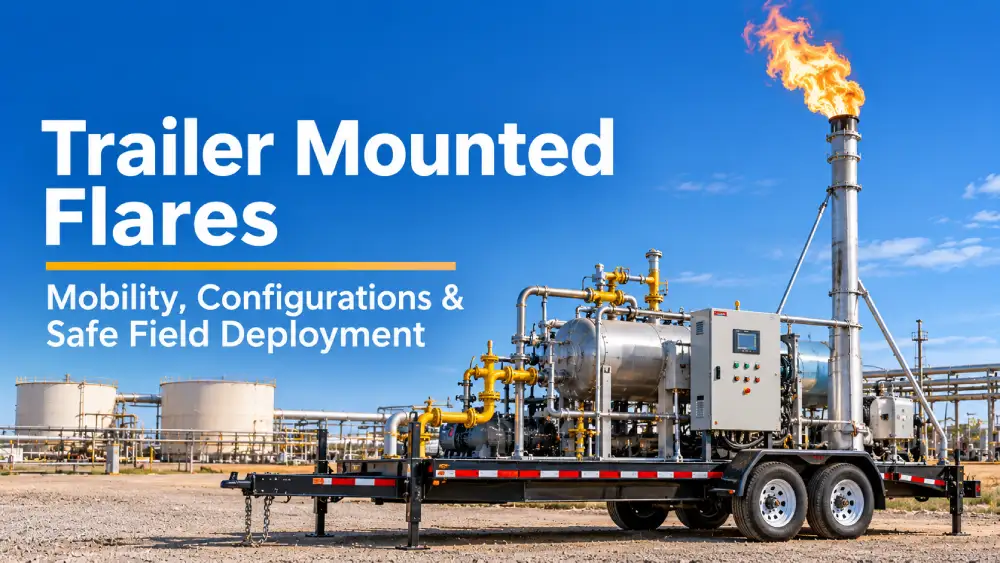
A trailer mounted flare is a combustion system fabricated on a road-legal trailer frame, designed to safely destroy waste gas streams at temporary or remote oil and gas locations. Standard units range from compact 1 MMBtu/hr wellsite systems to high-capacity units exceeding 50 MMBtu/hr for midstream and emergency service. Under EPA 40 CFR 60 Subpart OOOOb, trailer-mounted combustion devices used at covered facilities must achieve a minimum 95% combustion efficiency and maintain a continuously lit pilot with automatic relight capability. The trailer mounting format enables single-day deployment at a new site and relocation without permanent foundation or disassembly.
1. How a Trailer Mounted Flare Is Built
The major components of a trailer mounted flare are identical to those of any permanent combustion unit: a flare tip, a riser pipe assembly, a pilot burner and ignition system, and a liquid knockout drum or seal pot to prevent liquid carryover into the combustion zone. What distinguishes trailer-mounted designs is the integration of these components onto a certified road trailer with DOT-compliant lighting, tie-down provisions, and either a folding or telescoping riser that meets over-road height restrictions during transport.
Riser sections on a typical trailer mounted flare telescope or fold for transport and are field-erected using swivel joints or bolted flanges. Setup time for a properly designed system ranges from 15 minutes for compact wellsite units to two to four hours for high-capacity, multi-stage configurations. The gas inlet connects through a single flanged or threaded tie-in point at the base of the knockout drum, reducing installation complexity on site.
For industrial flare systems in trailer form, ignition typically uses a flame-front generator or electronic spark igniter with a continuous pilot proved through a thermocouple or UV flame scanner. For applications at OOOOb-covered facilities, documented pilot reliability is a regulatory requirement. The ignition system must demonstrate the ability to relight the pilot automatically after an unintended extinguishment, and that capability must be verifiable to an inspector on demand.
API Standard 537 specifies minimum combustion efficiency thresholds, tip exit velocity limits, gas-assist ratios, and smokeless operation performance criteria for flare system design. Any trailer mounted flare specified for smokeless combustion service should include engineering documentation demonstrating that the tip design meets API 537 performance thresholds across the full rated gas flow range, not just at a single design point.
2. Standard Trailer Mounted Flare Configurations in Oil and Gas
Different upstream and midstream applications require different capacity, pressure rating, and mobility characteristics. The table below outlines the most common configurations in oil and gas production and testing service. For wellsite and low-volume applications, low-flow flares in trailer-mounted form offer the most economical path to OOOOb-compliant combustion at single-well or test-separator locations.
| Configuration | Typical Application | Capacity Range | Inlet Pressure | Key Design Feature |
|---|---|---|---|---|
| Compact Wellsite Unit | Single-well production, tank battery | 0.5 to 5 MMBtu/hr | 2 to 15 psig | 1-person setup, low-flow flare tip |
| Mid-Capacity Portable Flare | Well testing, pipeline commissioning | 5 to 30 MMBtu/hr | 15 to 150 psig | Telescoping riser, integral knockout drum |
| High-Capacity Emergency Unit | Facility upsets, compressor station blowdown | 30 to 100+ MMBtu/hr | Up to 300 psig | Gas-assist tip, remote ignition panel |
| Gas-Assist Smokeless Unit | Smoke-restricted zones, flare curtailment areas | 5 to 50 MMBtu/hr | Variable | Fuel gas assist ring, reduced visible emissions |
3. When to Rent vs. Buy a Trailer Mounted Flare
The rent-vs.-buy decision for a trailer mounted flare depends on deployment duration, the number of active sites requiring coverage, and whether the application is recurring or one-time. Hero Process Solutions’ field services team supports both rental fleet mobilization and owned-unit commissioning, so operators can run a cost comparison against their actual deployment schedule before committing.
Renting a trailer mounted flare makes sense when:
- The deployment lasts less than 90 days (well test, tie-in support, turnaround coverage)
- Capital authorization for purchase has not been obtained and a compliance deadline is approaching
- The gas volume is uncertain and over-specification risk is high at the planning stage
- Multiple sites require simultaneous combustion coverage and owned units are already deployed elsewhere
Purchasing a trailer mounted flare makes sense when:
- The same unit will be deployed to recurring locations for more than three to four months per year
- The operator has in-house field capability and prefers to maintain the asset directly
- A specific trailer mounted flare configuration matches a consistent, recurring production profile across multiple pads
4. Sizing a Trailer Mounted Flare: Flow Capacity and Pressure
Undersizing for peak gas flow is the most common cause of field performance failures with trailer mounted flare deployments. The combustion capacity selected must account for maximum foreseeable instantaneous flow, not average production rates, because a flare that cannot handle worst-case upset volumes creates both safety and compliance exposures simultaneously.
Key sizing inputs for a trailer mounted flare include:
- Maximum instantaneous gas flow rate in MMscfd or MMBtu/hr, including well test surge volumes
- Gas composition and lower heating value, particularly for lean or sour streams with significant H2S or CO2 content
- Inlet operating pressure range and expected pressure variability across the production profile
- Minimum smokeless duty requirement (required by permit or optional for smoke management)
- Distance from occupied areas, which drives setback distance and radiation exposure limits under API 521
- OOOOb applicability determination for the site, which affects required monitoring, pilot design, and documentation
For natural gas compositions typical of Permian Basin or Anadarko Basin upstream production, a mid-capacity trailer mounted flare rated at 10 to 20 MMBtu/hr will cover most single-well and small multi-well pad scenarios. Sites with high gas-to-oil ratio or rich casinghead gas streams with heavy component content should request engineering review of the tip sizing across the full expected composition range before mobilization.
5. EPA OOOOb Compliance for Trailer Mounted Combustion Equipment
Under EPA 40 CFR 60 Subpart OOOOb, any combustion device used to comply with the standard at a covered facility must meet specific performance and monitoring requirements regardless of whether it is trailer-mounted or permanently installed. The rule applies to new, modified, and reconstructed equipment at oil and natural gas production, processing, transmission, and storage facilities constructed or modified after the applicability date.
Key OOOOb requirements for operators deploying trailer mounted flare equipment at covered facilities:
- Open flares must meet combustion zone gas heat content criteria per 40 CFR 60.18; enclosed combustors must achieve 95% or greater combustion efficiency
- A continuously lit pilot is required; automatic pilot relight must be documented for unattended locations operating outside normal staffed hours
- Visible emissions from open flares must be minimized; gas-assist or steam-assist may be required at locations subject to visible emissions restrictions
- Operating parameter monitoring records must be retained for a minimum of five years and produced on request during an inspection
The trailer-mounted format does not exempt a combustion device from OOOOb applicability. Any trailer mounted flare operating at an OOOOb-affected facility must have equipment certifications documenting pilot system design, combustion efficiency test basis, and monitoring system configuration. Hero Process Solutions’ OOOOb compliance page outlines which equipment types trigger the standard and the documentation package provided with each compliant combustion unit.
6. Pre-Deployment Inspection and Site Safety Requirements
Safe deployment of a trailer mounted flare begins with a pre-mobilization inspection of the unit and a site walkdown before ignition. Skipping or abbreviating these steps is the primary contributor to field incidents and unplanned compliance violations during trailer flare deployments.
Pre-deployment inspection checklist for a trailer mounted flare:
- Verify knockout drum drain is functional and liquid inventory is at zero before making the gas connection
- Check all flanges, unions, and compression fittings for mechanical integrity after road transport vibration
- Confirm pilot gas supply is available at required pressure, typically 15 to 25 psig natural gas at the pilot regulator inlet
- Test ignition system function with pilot gas only before introducing process gas
- Verify that the automatic relight controller, thermocouple, or UV scanner is operational and responding to simulated flame-out
- Confirm DOT lighting and tie-down provisions are intact if the unit will be repositioned across the site during the deployment
OSHA 29 CFR 1910.119 (Process Safety Management) applies to flare systems at covered facilities where flammable gas inventories exceed threshold quantities. Even at smaller well sites below PSM thresholds, proper bonding, grounding, and minimum setback distances from occupied structures and open ignition sources are required under general industry safety standards. After commissioning, Hero Process Solutions’ aftermarket support program provides inspection intervals, tip replacement schedules, and pilot system service kits to maintain reliable trailer mounted flare performance between deployments.
7. Common Mistakes in Trailer Mounted Flare Deployment
| Mistake | Why It Hurts Operations or Compliance | Correct Practice |
|---|---|---|
| Undersizing for peak gas flow | Flare cannot handle well test surge, creates unburned vapor release and potential OOOOb violation | Size for maximum foreseeable instantaneous flow, not average production rate |
| Skipping knockout drum inspection | Liquid carryover quenches the pilot flame and damages the flare tip, forcing an unplanned shutdown | Drain and inspect the knockout drum before every new site connection |
| Incorrect pilot gas pressure | Exceeds pilot supply design range, causing ignition failure or pilot blowout in crosswind conditions | Confirm pilot inlet pressure against unit spec sheet before connecting supply |
| Neglecting automatic relight verification | Pilot extinction at night or in high wind creates unlit cold venting and an OOOOb monitoring violation | Verify thermocouple or UV scanner response and auto-relight function before unattended operation |
| Deploying non-compliant pilot design at covered facility | Fails OOOOb continuous pilot requirement, triggering potential enforcement action | Confirm that equipment certifications document pilot design compliance before accepting unit on site |
| Incorrect radiation setback placement | Personnel exposure exceeds API 521 limits during high-flow combustion events on site | Calculate setback distance for maximum rated flow before placing unit relative to occupied areas |
Key Takeaways
- A trailer mounted flare is a combustion system built on a road-legal trailer frame, deployable at remote or temporary oil and gas locations within hours of arrival on site.
- Standard configurations range from 0.5 MMBtu/hr compact wellsite units to 100+ MMBtu/hr high-capacity systems for emergency and midstream blowdown service.
- The trailer format allows operators to meet EPA OOOOb compliance deadlines without permanent infrastructure investment or extended equipment fabrication lead times.
- Under 40 CFR 60 Subpart OOOOb, trailer-mounted combustion devices at covered facilities must achieve the required combustion efficiency and maintain a continuous pilot with documented auto-relight capability, regardless of the unit’s trailer-mounted status.
- Undersizing for peak flow is the leading cause of field performance failures; design capacity must account for worst-case upset volumes, not average production.
- The rent-vs.-buy decision turns on deployment frequency: operations deploying a unit three or more months per year typically justify purchase economics over short-term rental rates.
- Pre-deployment inspection of the knockout drum, flanged connections, pilot supply, and ignition system is mandatory before every new site gas connection.
- API Standard 537 provides the engineering performance baseline for tip design, gas-assist ratios, and smokeless operation thresholds relevant to trailer mounted flare specifications.
- Hero Process Solutions manufactures trailer mounted flares from its Kellyville, Oklahoma facility and maintains a rental fleet supporting rapid mobilization across Permian Basin and Midcontinent operations.
Frequently Asked Questions
What is a trailer mounted flare used for in oil and gas?
A trailer mounted flare is used to safely combust waste gas streams at temporary or remote locations in oil and gas production, well testing, pipeline commissioning, and emergency utility service. Because the combustion system is integrated on a road-legal trailer, it can be transported to any site with standard road access and commissioned within hours. Common applications include single-well production during the period before a permanent combustion device is installed, gas collection bypass during facility maintenance, and well-testing projects requiring temporary high-capacity gas disposal.
How long does it take to deploy a trailer mounted flare?
Deployment time depends on unit size and site conditions. Compact wellsite units can be connected and lit in under two hours by a two-person crew. Mid-capacity units with telescoping risers typically require two to four hours for full setup. High-capacity systems for compressor station or facility service may require a half-day for rigging, mechanical connection, and pre-ignition testing. Hero Process Solutions provides on-site commissioning support for new trailer flare deployments through its field services team.
Does a trailer mounted flare meet EPA OOOOb requirements?
A trailer mounted flare can meet EPA 40 CFR 60 Subpart OOOOb requirements if it is designed to the applicable performance standards: combustion efficiency at or above the rule threshold, a continuously lit pilot with documented auto-relight capability, and appropriate monitoring. The trailer-mounted format does not exempt a combustion device from OOOOb applicability at a covered facility. Operators should verify that any unit they rent or purchase includes equipment certifications confirming the pilot and combustion system design meets 40 CFR 60 Subpart OOOOb criteria before deploying it at an affected facility.
What is the typical capacity range of a trailer mounted flare?
Trailer mounted flares in oil and gas service range from approximately 0.5 MMBtu/hr for compact, low-flow wellsite duty to 100 MMBtu/hr or greater for high-capacity emergency and midstream service. Mid-capacity units in the 5 to 30 MMBtu/hr range represent the most common rental configuration for well-testing and production facility use. Sizing must account for worst-case peak flow rates rather than average production volumes to avoid compliance and safety failures during well test surges or facility upset events.
How is a trailer mounted flare different from a portable flare stack?
The terms are frequently used interchangeably in the field. A trailer mounted flare specifically describes a combustion system where the flare stack and ancillary components are pre-mounted on a road-legal trailer frame, requiring no field-fabricated substructure or offloading to a prepared pad. A portable flare stack may describe the same type of unit, or in some uses it describes a skid-mounted system that ships on a flatbed trailer but is set down on a prepared pad at the site. The trailer-mounted format offers the fastest mobilization because the unit remains on its own transport chassis throughout its field life.
What gas compositions can a trailer mounted flare handle?
Most trailer mounted flares are designed for natural gas compositions typical of oil and gas production, with heating values in the 900 to 1,100 BTU/scf range. Rich casinghead gas, streams with elevated H2S content (sour gas service), or fuel-gas with significant inert dilution require additional engineering review before deployment to confirm tip sizing and pilot design adequacy. Hero Process Solutions’ combustion engineering team evaluates gas composition data before recommending a trailer mounted flare configuration for applications outside the standard lean gas range.