OIL & GAS EQUIPMENT | Updated November 2026 | 8 min read
- What standard specifications define a rental flare stack for upstream O&G service
- How to match rental flare capacity to your actual waste gas flow rates
- When renting a flare stack makes more economic sense than buying
- What Hero Process Solutions includes in a complete rental package
- Mobilization lead times and what affects deployment speed
- Regulatory compliance requirements for temporary flare installations under EPA OOOOb
- Common specification errors that delay commissioning or trigger compliance issues
Flare stack rentals give upstream and midstream operators a fast, low-capital path to managing waste gas at well sites, pipeline maintenance windows, and temporary production facilities without the commitment of permanent equipment. When a new well comes online ahead of sales gas infrastructure, or a planned pipeline outage requires a controlled burn solution, a rental flare stack bridges the gap from first gas to permanent disposal. Hero Process Solutions maintains a rental fleet out of Kellyville, Oklahoma and Midland, Texas, with trailer-mounted and skid-mounted configurations ready for rapid deployment across the Permian Basin, Anadarko, and Appalachian plays.
Founded in 2011 and headquartered in Kellyville, OK with operations extending to Midland, TX, Hero Process Solutions manufactures and rents combustion equipment across the full upstream and midstream spectrum. The rental fleet includes low-flow portable flares for marginal well applications, air-assist systems for higher-flow well sites, and emergency utility configurations for unplanned outages. Direct ownership of the manufacturing facility means rental units reflect the same engineering standards as permanent installed systems, with full documentation for permitting.
Flare stack rentals in oil and gas service are short-term or project-based combustion equipment agreements that provide a trailer-mounted or skid-mounted flare system for temporary waste gas management. Standard rental packages include the flare stack, pilot ignition system, instrumentation, and either a knockout drum or liquid seal depending on the application. Rental units from Hero Process Solutions deploy under EPA 40 CFR 60 Subpart OOOOb-compliant designs, with mobilization typically possible within 2 to 5 business days for configurations held in inventory. Rental vs. purchase decisions typically hinge on project duration: operations exceeding 18 to 24 months often justify capital ownership.
1. How Flare Stack Rentals Work in Upstream and Midstream Operations
Renting a flare stack replaces the capital purchase cycle with a service agreement that covers the hardware, delivery, and in some cases site commissioning. Operators specify their waste gas volume, composition, and pressure, then select a rental unit configured for that duty. The rental supplier delivers the unit to the well site or facility, connects it to the existing vent or relief header, and the operator handles tie-in with guidance from the supplier’s field technicians. For operators evaluating the full range of industrial flare systems, understanding the rental pathway is an important part of lifecycle cost planning.
The economics of rental flaring center on three variables: duration of the flaring need, complexity of mobilization, and whether the unit will be redeployed to multiple locations. A 60-day well test program is a clear rental candidate. A permanent tank battery with a 20-year production forecast is a capital purchase. Between those extremes, most decisions involve comparing the total cost of rental over the anticipated service period against the capital cost of ownership adjusted for the probability that the application changes.
Rental flare stacks are classified as temporary combustion devices under EPA 40 CFR 60 Subpart OOOOb when used at oil and natural gas facilities. Even temporary units must meet the same destruction efficiency requirements as permanent installations: 95% VOC destruction efficiency minimum, rising to 98% for facilities subject to new source performance standards.
2. Standard Specifications: What to Expect in a Rental Flare Package
A rental flare stack is not a stripped-down version of a permanent system. The core specifications that define a utility-grade rental unit include the following parameters:
Stack Height
Typically 10 ft to 60 ft in trailer-mounted configurations, selected to achieve minimum heat radiation setback from the stack base. For the Permian Basin, 30 ft stacks are the workhorse configuration for well site service.
Flare Tip Design
Most rental units use a standard round pipe tip or a low-flow multipoint tip. Coanda or sonic tips are available in higher-specification rentals for applications requiring smokeless operation under sustained flow rates.
Flow Capacity
Utility rental units range from 0.5 MMscfd to 15 MMscfd in a single-unit configuration. Capacities above 15 MMscfd require either staged rental configurations or a capital purchase analysis.
Pressure Rating
Most rental flares accept gas inlet pressures between 2 psig and 15 psig at the flare header connection. High-pressure well test applications with pressures above 15 psig require either a pressure reduction station upstream or a high-pressure rated rental unit.
Pilot Ignition
Standard rental units ship with a continuous pilot system, either electronic spark ignition or a standing pilot maintained by a pilot gas supply. Auto-relight pilots are available for unattended remote site applications. For more on ignition system options, see Hero Process Solutions ignition systems.
| Component | Standard Rental Spec | Premium Rental Spec |
|---|---|---|
| Stack Height | 20-30 ft | 40-60 ft |
| Tip Type | Round pipe or multi-point | Sonic/Coanda, variable exit |
| Capacity | 0.5-5 MMscfd | 5-15 MMscfd |
| Pilot System | Continuous pilot, manual relight | Auto-relight, thermocouple monitored |
| Instrumentation | Basic pressure/temperature gauges | SCADA-ready, remote monitoring |
| Liquid Knockout | Integral knockout drum | Oversized KO drum with level control |
3. Rental vs. Purchase: Engineering and Economic Decision Criteria
The decision to rent versus buy a flare stack is fundamentally a capital allocation question shaped by project duration, redeployment potential, and the operator’s cost of capital. For very low volume well site applications, low flow flares available in both rental and purchase configurations offer the most economical path.
When Renting Wins
- Well completions and testing operations under 90 days
- Pipeline maintenance windows or planned facility turnarounds
- Emergency or unplanned outages requiring same-week deployment
- Multi-well programs where the unit moves from location to location
- Operators who lack in-house combustion equipment expertise for commissioning
- Early production facilities pending sales gas tie-in
When Purchasing Wins
- Permanent tank battery or gathering station with long production horizon
- Applications requiring customized tip design for specific gas compositions
- Operations where ongoing rental cost exceeds equipment capital over 2 to 3 years
- Facilities requiring SCADA-integrated combustion control not available in rental specs
A simple break-even analysis: at typical rental rates, most standard flare stack configurations pay off in purchased form over 24 to 36 months of continuous use. Operators running 5 or more years on a stable production facility should request a quote comparison from the Hero Process Solutions sales team.
4. Types of Rental Flare Stacks and When to Specify Each
The Hero Process Solutions rental fleet covers three primary categories:
Trailer-Mounted Portable Flares
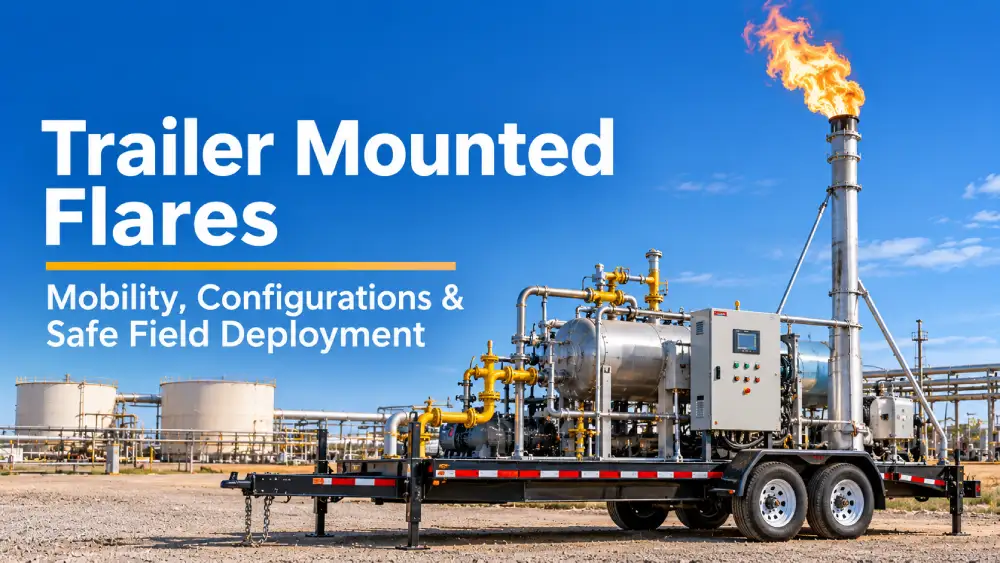
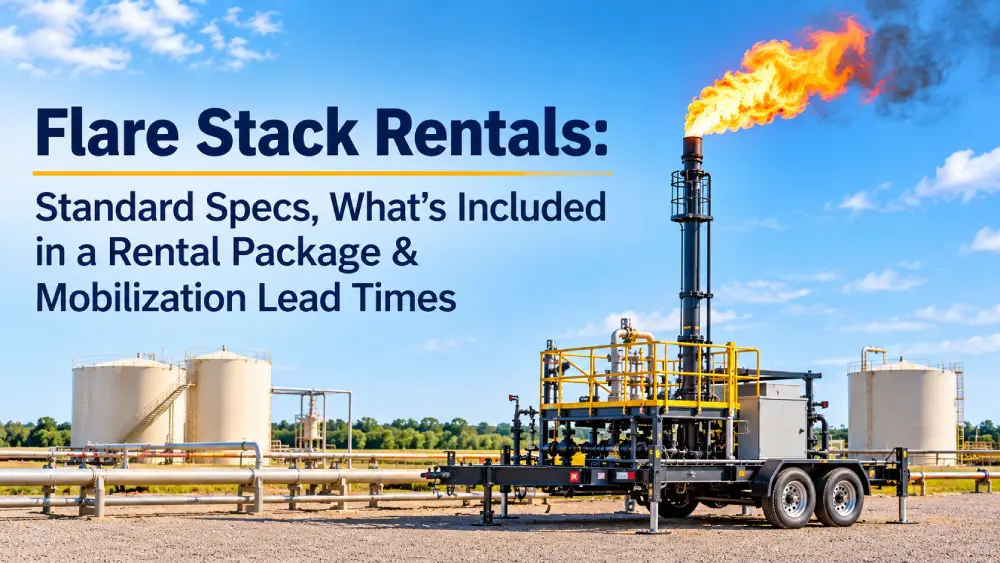
Trailer-mounted portable flares are the most deployed rental configuration for upstream applications. The flare, pilot, knockout drum, and instrumentation ship on a road-legal trailer to the well site. No crane is required for stacks under 40 ft; self-erecting mast systems are standard on the 30 ft and 40 ft configurations. These units work for well tests, temporary production facilities, and emergency backup to permanent flare systems.
Skid-Mounted Low-Flow Flares
Skid-mounted low-flow flares target applications under 500 Mscfd where the waste gas volume does not justify a full-size portable flare. Tank battery venting and marginal well completions are the primary applications. These units are particularly relevant for facilities requiring EPA OOOOb compliance without the cost footprint of an air-assist system. For higher-destruction-efficiency requirements, vapor combustors offer an enclosed alternative to open flaring.
Air-Assist Rental Flares
Air-assist rental flares handle higher-flow applications or gas streams that require smokeless combustion to meet state air permit requirements. These units introduce a controlled air stream at the air-assist flare tip to improve mixing and combustion quality, eliminating luminous burning under steady-state flow. Available in trailer-mounted and skid configurations.
| Flare Type | Best Application | Capacity Range | Key Advantage |
|---|---|---|---|
| Trailer-Mounted Portable | Well tests, temporary production | 1-15 MMscfd | Road-legal, rapid deployment, no crane required |
| Skid Low-Flow | Tank battery venting, marginal wells | 0.1-500 Mscfd | Low capital footprint, OOOOb compliant |
| Air-Assist Rental | High-flow, smokeless requirements | 2-15 MMscfd | Visible emission compliance, state permit ready |
5. Mobilization Lead Times and Site Preparation Requirements
Standard Mobilization Timeline
- Inventory unit confirmation: Day 1
- Rental agreement execution and permitting documentation: Days 1-2
- Transportation and logistics: 1-3 days depending on distance from Kellyville, OK or Midland, TX
- Site arrival and setup: 4-8 hours for a standard trailer-mounted 30 ft unit
For operators in the Permian Basin, Hero Process Solutions can typically achieve 48 to 72 hour well-site delivery for rental units held in Midland inventory. Longer lead times apply for configurations requiring modification or for destinations outside the primary service corridor.
Site Preparation Requirements
The rental operator is responsible for the following before the unit arrives:
- A level, compacted area approximately 20 ft x 50 ft for the trailer (larger for 60 ft stacks)
- Inlet gas piping connection point within 15 ft of the trailer hitch end
- Pilot gas supply or willingness to accept propane-fueled pilot from the rental unit
- Electrical power or battery/solar supply for SCADA-equipped units
- Clear vehicle access path meeting state highway equipment dimensions
Failure to have site preparation complete on delivery day extends mobilization time and can delay commissioning by 24 to 48 hours.
Documentation matters as much as hardware for compliance. Many operators underestimate the time required to assemble permitting records for a temporary installation. Requesting full documentation at rental agreement execution prevents day-of-startup delays caused by incomplete permit files.
6. Regulatory Compliance for Temporary Flare Installations
Temporary flare installations are not exempt from EPA regulations. Under EPA 40 CFR 60 Subpart OOOOb, facilities with oil and natural gas production equipment constructed after December 6, 2022 must meet specific combustion device performance standards.
Combustion Efficiency Requirements
Under OOOOb, the minimum combustion efficiency is 95% VOC destruction for utility flares routed from affected facilities. Enclosed combustion devices operating as control devices under 40 CFR 60.5412(a) must achieve 98% destruction efficiency. Rental units that do not meet these thresholds expose the operator, not the rental supplier, to enforcement action.
Pilot Monitoring
Subpart OOOOb requires continuous pilot monitoring with documentation that the pilot is lit during all periods when waste gas is routed to the flare. Auto-relight pilots with thermocouple monitoring satisfy this requirement for remote sites where manual checks are not operationally feasible.
Visible Emissions
EPA Method 22 visible emissions observations are required during initial startup and periodically thereafter. The standard allows no more than 5 minutes of visible emissions in any 2-consecutive-hour block during steady-state operation.
A temporary flare stack at an OOOOb-affected facility must meet the same performance standards as a permanent installation. “Temporary” refers to the operational duration, not the compliance obligation. Document every flare ignition event, pilot status check, and visible emissions observation from the first day of operation.
State-level requirements in Texas (under TCEQ Regulation 30 TAC) and Oklahoma (DEQ Air Quality) add permit notification requirements for temporary combustion equipment. In Texas, standard portable flares operating under a permit by rule (PBR) must meet specific setback and notification criteria. Hero Process Solutions supplies pre-formatted permitting documentation as part of the rental package.
API Standard 521 provides guidance on relief and depressuring systems including sizing methodology for temporary flare headers applicable to rental configurations. For facilities subject to new source performance standards, see the Hero Process Solutions OOOOb compliance resource page for a detailed breakdown of obligations by equipment category.
OSHA 29 CFR 1910.119 (Process Safety Management) may also apply at facilities where the flare handles flammable vapors above threshold quantities, adding mechanical integrity and management of change requirements to temporary flare installations.
7. What Is Included in a Hero Process Solutions Flare Stack Rental Package
Hardware
- Trailer-mounted or skid-mounted flare stack
- Integral liquid knockout drum (sized for the specified gas flow)
- Pilot ignition system (propane supply or utility gas, specified at order)
- Guy wire anchoring kit for stacks 30 ft and above
- Inlet gas connection manifold (2 inch or 4 inch flanged inlet standard)
Documentation
- Equipment datasheet and pressure rating certificate
- P&ID for the rental unit as configured
- Pilot ignition and startup procedure
- Pre-formatted permit documentation for Texas PBR and Oklahoma portable source notification
- 24/7 emergency contact for field service response
Optional Add-Ons
- Remote pilot monitoring with cellular telemetry
- Oversized knockout drum for high-liquid-loading applications
- Steam tracing for cold-weather operation
- Field commissioning support from a Hero Process Solutions technician
8. Common Mistakes in Rental Flare Stack Selection and Deployment
| Mistake | Impact on Operations or Compliance | Fix |
|---|---|---|
| Undersizing flow capacity based on initial rate only | Flare overload at peak production, visible emissions violations | Size to 125% of peak expected flow, not average rate |
| Ordering without gas composition data | Pilot ignition issues with lean or low-BTU gas streams | Provide complete gas analysis at order: H2S pct, CO2, N2, Btus/scf |
| Assuming rental means no permit required | TCEQ or DEQ enforcement action, potential notice of violation | Confirm permit pathway before unit leaves the rental yard |
| No pilot gas supply plan | Flare down at critical commissioning moment | Pre-order propane bottles or secure utility gas tie-in before delivery |
| Late site preparation | 24 to 48 hour commissioning delay, field crew standby cost | Complete site prep before truck dispatch confirmation |
| Failing to document pilot lighting events | OOOOb monitoring record gap, potential compliance violation | Log every ignition event in writing from Day 1 of operation |
| Wrong pressure rating for well test application | Overpressure at flare inlet, potential gas release event | Confirm inlet pressure range before specifying rental unit configuration |
Article Summary
- Flare stack rentals serve upstream and midstream operators who need temporary combustion capacity without capital equipment investment
- Standard rental packages include the stack, knockout drum, pilot system, and permitting documentation
- Capacity ranges from under 500 Mscfd (skid low-flow) to 15 MMscfd in trailer-mounted configurations
- Hero Process Solutions deploys from Kellyville, OK and Midland, TX with 48 to 72 hour Permian Basin lead times typical
- Rental vs. purchase break-even is typically 24 to 36 months for standard utility configurations
- Temporary flares at OOOOb-affected facilities must meet the same performance standards as permanent units
- Pilot monitoring, visible emissions documentation, and destruction efficiency certification are required from day one
- Proper site preparation is the most controllable variable in achieving on-schedule commissioning
- Gas composition data and accurate peak flow estimates are critical inputs for correct rental unit selection
- State permit pathways in Texas (TCEQ PBR) and Oklahoma (DEQ portable source) are logistics items that must be addressed before delivery
Internal Linking Plan
| # | Anchor Text | Target URL | Placement Section |
|---|---|---|---|
| 1 | Flare stack rentals | https://heroprocesssolutions.com/rentals/ | Opening paragraph |
| 2 | low-flow portable flares | https://heroprocesssolutions.com/portable-flares/ | Second paragraph |
| 3 | industrial flare systems | https://heroprocesssolutions.com/flares/ | Section 1 body |
| 4 | low flow flares | https://heroprocesssolutions.com/low-flow-flares/ | Section 3 intro |
| 5 | vapor combustors | https://heroprocesssolutions.com/combustors/ | Section 4, skid low-flow |
| 6 | air-assist flare tip | https://heroprocesssolutions.com/air-assist-flares/ | Section 4, air-assist |
| 7 | Hero Process Solutions OOOOb compliance resource page | https://heroprocesssolutions.com/oooob-c/ | Section 6 regulatory |
External Linking Plan
| # | Anchor Text | Target URL | Placement Section |
|---|---|---|---|
| 1 | EPA 40 CFR 60 Subpart OOOOb | https://www.ecfr.gov/current/title-40/chapter-I/subchapter-C/part-60/subpart-OOOOb | Section 6, compliance intro |
| 2 | API Standard 521 | https://www.api.org/products-and-services/standards/important-standards/api-521 | Section 6, sizing guidance |
| 3 | OSHA 29 CFR 1910.119 | https://www.osha.gov/laws-regs/regulations/standardnumber/1910/1910.119 | Section 6, PSM reference |
Frequently Asked Questions
How quickly can I get a rental flare stack on site?
Hero Process Solutions typically confirms inventory availability within 24 hours of a rental inquiry. For standard 20 to 30 ft trailer-mounted units held in Midland, TX, Permian Basin operators can expect 48 to 72 hours from signed agreement to site delivery. Destinations outside the primary service corridor in West Texas and Oklahoma add transportation time, typically 1 to 3 additional days depending on routing.
What information do I need to provide to get a rental quote?
To size a rental flare correctly, provide: estimated waste gas flow rate (Mscfd or MMscfd), peak vs. average flow profile, gas composition or Btu/scf estimate, inlet pressure range at the flare connection, H2S concentration if above 50 ppm, site location and access constraints, and anticipated duration of the rental. Providing complete gas composition data at inquiry prevents mis-specification and delivery delays.
Are rental flare stacks compliant with EPA OOOOb?
Yes, Hero Process Solutions rental units are designed to meet the combustion efficiency requirements under EPA 40 CFR 60 Subpart OOOOb. This includes minimum 95% VOC destruction efficiency for utility flares and continuous pilot monitoring capability. Operators are responsible for site-level compliance documentation including ignition logs and visible emissions observations, which the rental documentation package is designed to support.
What is the difference between a rental flare and a portable flare?
The terms are often used interchangeably in field operations. A portable flare is a trailer-mounted or skid-mounted combustion unit designed for relocation between job sites. A rental flare is a portable flare provided under a service agreement rather than purchased outright. The underlying equipment is identical; the distinction is financial and administrative. Rental flares return to the supplier fleet at the end of the agreement; purchased portable flares remain the operator’s property.
Can I rent a flare stack for a one-time well test?
Rental terms are flexible. Hero Process Solutions offers daily, weekly, and monthly rates with minimum rental periods that vary by unit configuration. Well test rentals spanning 15 to 90 days are common. For very short-duration tests under 2 weeks, confirm whether the minimum rental period cost is competitive with the cost of a small portable unit purchase before committing to a rental agreement.
What happens if the flare needs service during the rental period?
Hero Process Solutions provides 24/7 field service contact for all active rental units. Scheduled maintenance during the rental period is handled by the supplier’s field technicians. If a hardware failure occurs, Hero Process Solutions will dispatch a replacement unit or technician based on the nature of the failure and site location. Response time and terms are defined in the rental service agreement.